Your Mission Matters

It is not unusual for businesses and enterprises to have “mission statements” to outline their objectives, goals, philosophy, and proposed impact their products or services are intended to have.

When you think about it, the “statement” is a great way to bring focus to an image about an outcome, or the goal of an organization. It is also a way for there to be creative control over how we would like people to envision us, our message, and our ethics and values as we seek our mission. In short, our mission statement holds us accountable for what we seek to accomplish and it includes the culture we seek to generate in the process of reaching this mission.

What’s Your Mission?

Do you have a mission statement? Are you involved in something where you have “bought-in” to its image, message, and mentality? If you are employed then to a degree you share something of the company’s “mission” whether it be in baby care, athletic activewear, intellectual property law, or even that entrepreneurial zest.

Being on Mission at Work

When I worked at NikeTown, San Francisco in the Union Square of San Francisco, CA, as a sales floor associate, I was all in. Everything was Nike. Socks, shoes, T-shirts, jackets, watches, even my gifts were Nike. I was all in on the apparel, the knowledge of our products, and its work culture. What was my mission? To find out what our customer’s athletic needs were and match them with the proper activewear so they can achieve their goals. So when I had track and field athletes, we went over to running wear, and when I worked with the head coach of a major league soccer club we went over soccer wear. I was all in on our mission and committed to it. I loved my time there.

Then there were those jobs I had no investment in its mission. It was just a job, just a paycheck, and I did as little as possible. I came in late. I

It is not even about personal aspirations.

So the question posed here again is: Do you have a “mission statement”? Yes, this is a spiritual double entendre – I have another meaning in mind.

A Line of Thought on the Mission

First, let us begin with a few ideas. Everything around us that we see on Earth and in the universe is the result of a Creator. It is unfortunate that some do not acknowledge this truth but suppress it (Rom 1:18).

To this point, the apostle Paul writes:

For what can be known about God is plain to them, because God has shown it to them. For his invisible attributes, namely, his eternal power and divine nature, have been clearly perceived, ever since the creation of the world, in the things that have been made. So they are without excuse. (Romans 1:19–20 ESV)

The world is evidence within itself that there is a creator of limitless power and intelligence, and he is to be acknowledged by us – the product of his creation (Psa 8:3–8) – in the way we live.

The quote ends with the strong indictment that if we do not acknowledge His existence we are “without excuse” (Rom 1:20). The word has a litigious background, and essentially means that in the cosmic courtroom such are “without defense” (Gk. anapologetos).

No words, no smooth arguments, no loopholes, nothing will be grounds for a mistrial; there is simply no excusable rationale for rejecting the existence of a Creator as revealed in nature which bears the marks of intelligent design and infinite power.

Moreover, such a Creator by virtue of His very nature has the right to demand faithful service from His creative progeny – humanity (Gen 1:26–30, Rom 1:18, 21–23; 9:19–21). If we mortal parents may expect by virtue of our position to hold authority over our children, how can we expect the Father of all to hold any less authority?

Second, every expectation to obey God’s will (= Law/commandment) is a reflection of His holiness and the expectation that humanity will take upon themselves the freedom to make a choice to obey or to disobey.

This freedom of choice is reflected very clearly in the historical narrative of Adam and Eve as they are given everything in the Garden of Eden save the right to eat from the tree of the knowledge of good and evil. The stated consequence should such an infraction occur, the Lord said, is “death.”

It is not told to us how long or short the first family lived in compliance with this expectation of behavior in the garden; however, it is revealed to us that unfortunately Eve gave in to temptation as did Adam. As the initial consequence, the first couple was expelled from the Garden and lost access to the Tree of Life (Gen. 3).

Sin it is said by John, the apostle, is the rejection of God’s law (1 John 3:4). In fact, it is an expression of a lack of love and a lack of fidelity to God (1 John 5:2). Hence, what we have been given in this freedom of choice is an ability to decide our relationship with God – will we show love and fidelity, or will we show a lack thereof?

Freedom of choice is a powerful instrument of human behavior. With it, we fall from grace and the stature of one made in the image of God (Rom 3:9–18, 23), and by it we return to God and submit our powers of decision into the hands of a forgiving and holy God (Rom 2:4; 3:26).

At every instance, then, we have a choice. Will we make those choices that inherently become less as we expend more earthly time on His service or our own selfish ambitions? Surely, our plans can only be enhanced by submitting to the Mind of God (Prov 16:25; Isa 55:8–9).

Third, while we may enjoy the blessing of freedom of choice it is a privilege that swings two ways. Much like the tongue, by our choices, we may praise God or reject him (Jas 3:45). As a consequence of our decisions, sin is a common problem to all accountable individuals (Ezek 18:20). And yet, in Jesus we are given the saving message of rebirth (John 3:4), of salvation (1 Thess 1:10), and a new creation (2 Cor 5:17).

If in our sinful choices, we have lost our identity as the image of God, then surely our choices which reflect our recreation in Christ amount to a new plan of action in our lives. Paul, the apostle, writes that when we are saved we are remade to walk in certain works He has assigned us to accomplish (Eph 2:10).

Back to Our Question

What’s your mission statement? While we have freedom of choice, when a person chooses to become a Christian that person has committed to live as God directs, as Christ reflects, so that our living connects His mission with our mission in this world.

The Lord’s mission was to reconcile the world back to Himself:

[I]n Christ God was reconciling the world to himself, not counting their trespasses against them, and entrusting to us the message of reconciliation. Therefore, we are ambassadors for Christ, God making his appeal through us. We implore you on behalf of Christ, be reconciled to God. (2 Corinthians 8:19–20 ESV)

Notice how Paul acknowledges that his mission is the same as God’s mission: to appeal to others through the message of the Gospel to announce how God is reconciling the world to himself.

Christians are those recreated in Christ, and our “mission” is to help other people see God’s abundant love found in the Gospel. Our mission matters because our mission is supposed to be His mission. So how does your “mission” add up?

Book Review: Scripture and the Authority of God

N. T. Wright, Scripture and the Authority of God: How to Read the Bible Today (New York: HarperCollins, 2005), pb, 210 pages.

In his volume, Scripture and the Authority of God: How to Read the Bible Today, the former Bishop of Durham (2003–2010) and Anglican scholar, Nicholas Thomas Wright (1948–), argues in close quarters (200 pages) that the “authority of God” is mediated in the scriptures and this authority is properly accessed today when the church takes the biblical narrative seriously—Jesus redeems, renews, and completes the human story—as the rubric by which it engages today’s meaningful questions in face of God’s victory revealed in the gospel.

Book Summary

Wright argues that God is the only authority that can be spoken of concretely and that the authority of God manifested in the world is a necessary reality in way of sin’s corruption of creation in the fall. This assertion of divine authority is realized by the concept of rulership and kingdom. The written word, properly understood as the scriptures (i.e., the Bible), is not authoritative in a moralistic sense as being a scrapbook of good ideas, but instead communicates God’s authority in a narratival sense. For Wright, the flow of this story is played out in five acts (creation, the fall, Israel, Jesus, and the church) revealing the way in which God plans to heal and renew his image-bearers and the creation itself through the work and person of Jesus Christ. The scriptures, therefore, mediate God’s authority in the same way as revealed in the work of prophets as they spoke and proclaimed his word. Today, that same authoritative word is mediated properly to the church—the Bible reading community—when this overall message is narratively understood, contextually appreciated, and Christologically applied.

The overall purpose of the book is to provide a remedy to the “bible wars” in which the question and place of the scripture’s authority have lost their fixed placement in the “culture wars.” The church has always been a “Bible reading” entity and its history reflects this point; however, the church interacts with culture as well as the Bible and must constantly apply afresh its narrative to the church’s ever-changing setting and questions. The areas of contemporary tensions (culture, politics, philosophy, theology, and ethics) the church faces “interlock” with how the Bible-reading church applies the scriptures.[1] The most important resource which sets the scriptures apart as a unique source of Christian guidance is that the Bible is “the authority of God.” This is, as Wright describes a “shorthand” to help densely pack into a phrase that the narrative of the scriptures has an effect upon its readers because it carries a transcendent narrative that reveals the only true authority—God—as one who has created, and is now confronting the fall of his creation by the manifestation of his kingdom through Jesus Christ. 

In this significant sense, the Bible reveals that in the kingdom (the kingship), in Jesus, God is confronting a fallen world in order to redeem, renew, and complete it in him. To do so God not only enlists his image-bearers (humans), but must also in the process redeem, renew, and complete them to be those who embrace the kingship of God. Authority, according to Wright, is not static nor flat but must be understood within the conflict of the biblical narrative. The authority of God includes the scriptures, but the scriptures do not exhaust God’s authority. In other words, “the authority of God” resides in the scriptures because it is the form God has chosen to mediate his kingship authority to his bible reading image-bearers, who will be redeemed, renewed, and completed in Jesus Christ. The narrative of scripture as alluded to above, unfolds in five stages, beginning with the good creation, the fall of humanity, the call of Israel, the incarnation of Jesus Christ, and the full consumption of God’s plan in the church. God’s authority in scripture only makes sense within that narrative. 

Wright conceives of a theological foundation for his approach to the authority of scripture. This approach brings his main purposes and overarching points into focus. Much of what Wright sees in the broader church culture are significant influences and forces on the academic study of scripture that undermine its authority and accessibility to the church—the intended Bible reading community—and therefore his proposal. Wright spends a major part of his proposal engaging and providing clarifications based on his extensive body of research (which he self-references) to highlight the lingering benefits and problems from the Enlightenment (i.e., Age of Reason), and the influence of the Reformation. Negatively, the development of scientific tools of historical research birthed a movement of pure rationalism, and with it an accompanying skepticism of the divine (or tendency toward deism). This has created a polarization within the theological academy which is still felt to this day represented in his catalog of various “misreadings.”[2] Wright argues that good historical criticism and the Bible can co-exist without the loss of the scripture’s supernatural authority. It is not only possible but necessary for the church to contextually understand the Bible’s story.

Meanwhile, the celebrated Reformation period has likewise contributed to contemporary problems in Bible reading. In particular, Wright culls out the mantra of the Reformation—sola scriptura—and contextualizes it. The slogan was not intended to eviscerate any appreciation for the history of how the historic church had responded to the authority of the scriptures. Wright affirms the Reformer’s “insistence that scripture contains all things necessary to salvation… was part of their protest against the Roman insistence on belief in dogmas like transubstantiation as necessary articles of faith.”[3] The slogan was to affirm a limit, namely, that “nothing beyond scripture” could be taught as an article of salvation.[4] The need to stress this speaks to the “muddled” understanding of the “protest” theology behind the slogan. Furthermore, Wright goes on to underscore a common misunderstanding of another term reaffirmed in the Reformation period, being on insisting on the “literal” sense of scripture. This phrase does not pursue “the sense of the letter” but instead it means “the sense that the first writers intended.”[5] For Wright, this is crucial because it underscores the importance of historical criticism in understanding the text, and it discards a misunderstanding of a hermeneutical principle.

A Brief Evaluation

Wright argues that the question regarding the “authority of scripture” is not a flat discussion, and must take into account more than a book citation by observing how a text of scripture fits within his five-act biblical narrative, and how the trajectory of the “new creation” frames an important narratival hermeneutical context to understand the relevance and application of these texts.

Simply because there may be a “proof text” of an idea found in the Bible does not provide sufficient warrant that the notion is provided positive authority for the practicing Christian today. More is required. This is certainly an important point which Wright demonstrates in the two case studies that Sunday is not the new Sabbath and that the Sabbath ultimately speaks to the coming divine-human co-habitation,[6] and on how to establish the proper basis for male-female monogamy in the face of considerable evidence that the Old Testament tolerated polygamy.[7] What is extremely helpful in Wright’s model is how it grounds the textual and the application of the text in the renewing story of the gospel, and in this way provides God’s authority mediated through these scriptures.

If there is any drawback to Wright’s argument it may be found in his writing style. Granted, it is refreshingly straightforward, but the inclusion of caveats and parenthetical notations can detract from the argumentation. It is not so much of a drawback in Wright’s argument, but the writing style of a very aware scholar seeking to maintain in every statement an accurate reflection of the substance of his thesis. More significantly, Wright does not spend any time working through 2 Timothy 3:16-17, being by his own admission, “the famous passage about scripture.”[8] His only observation is that the passage is not about the nature of scripture but an encouragement to study the scriptures. Certainly, Paul’s focus the usefulness of “all scripture” to make its students “proficient, equipped for every good work” (3:17 NRSV).[9] Nevertheless, “all scripture” is both “useful” (ōphélimos) and “inspired by God” (theópneustos) which are both adjectival statements in the same clause about scripture in general, and are affirmations of their origin (theópneustos) and purpose in particular (ōphélimos). The explanation for this lack of attention is probably because the work presupposes the Bible as God’s mediated authority on the one hand, and that Wright is focused on how to appropriate this authority.

Finding Application

The thesis of Wright’s work has proven to find an immediate application in my life. First, the emphasis on the renewing work in Christ as the “end game” of the theological trajectory has an immediate and personal application in how I process scripture. Second, recognizing that scripture still mediates God’s authority has invigorated my confidence in the theological process.

First, Wright’s work has significantly challenged how I apply the same principle behind the transformative “renewing” of my mind principle of Romans 12:2 to the trajectory of the gospel narrative. As Paul says, “So if anyone is in Christ, there is a new creation: everything old has passed away; see, everything has become new!” (2 Cor 5:17). It has certainly made me more aware of the need to ground my conclusions to what Christ is renewing in the world. The narrative framework looks at the promises of God as “speech acts” wherein he heals not only me, but the world around me.

Second, even in the wake of its historical, occasional, culturally bound essence which requires reason and the Spirit to evaluate my experience(s) and church traditions, God’s authority is still mediated in the scriptures. This has re-invigorated my confidence in the theological process. Wright’s survey of biblical interpretation and authority was extremely helpful in providing better clarity of how authority and scripture have been connected over the centuries.[10] Wright also called attention to the importance of private and communal study, not just in the academic context but also in the congregational setting. Since our insights are limited, it is worthwhile to gain insight from what others see in their in-depth study of God’s word.

Conclusion

What Wright accomplishes in Scripture and the Authority of God is to chart an important course that affirms that “the authority of God” is mediated in the scriptures, and this authority is properly accessed and applied when the redeeming, renewing, and completing work of Jesus Christ is applied to understanding the narrative of scripture as the church answers its call today.

Endnotes

  1. Wright, Scripture and the Authority of God, 4–18.
  2. 107–14.
  3. 72.
  4. 72.
  5. 73–74.
  6. 143–73.
  7. 176–95.
  8. 97.
  9. New Revised Standard Version of the Holy Bible.
  10. Wright, Scripture and the Authority of God, 61–81.

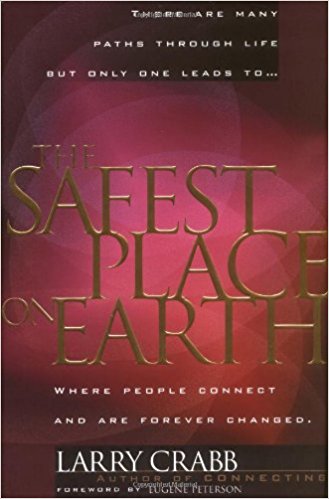
Book Review: The Safest Place on Earth

Safest Place on Earth - Crabb.jpg

Larry Crabb, The Safest Place on Earth: Where People Connect and Are Forever Changed (Nashville, TN: W Publishing, 1999), Hardback, 240 pages.

Dr. Larry Crabb is an established licensed psychologist, a well-known Christian author on marriage and biblical counseling topics, and current Distinguished Scholar in Residence at the Colorado Christian University (Morrison, CO).[1] 

Dr. Crabb earned his Ph.D in Clinical Psychology from the University of Illinois, and has been a professor of psychology since 1970. Dr. Crabb also provides workshops and weekend seminars across the United States as part of his non-profit New Way Ministries and its web presence which features interviews, video lectures, and other multimedia outlets to share resources from his School of Spiritual Direction.

Dr. Crabb has been involved in counseling and marriage, in self-help ministry, and in developing a context of “spiritual community” for over 40 years, and so has earned a place among the various “Christian voices” seeking to make the church a better place.

In 1999, Dr. Crabb released a significant but brief volume on the church as a safe spiritual community. The volume is entitled, The Safest Place on Earth: Where People Connect and Are Forever Changed (238 pages).[2] Dr. Crabb has registered his own frustration with two elements which bear upon the community of the church and its spiritual health, which he further addresses in Real Church: Does it Exist? Can I Find It? (Nashville, TN: Nelson, 2009).

In The Safest Place on Earth, however, Dr. Crabb establishes a vision for the church as a group of believers on a journey towards God, and it is within the journey that spiritual community must begin and end for spiritual healing and direction. Despite Dr. Crabb’s own training in psychology, he believes when it comes to the soul care that ought to go on within the church, such assistance must yield “to special revelation and biblically dependent thinking.”[3] Dr. Crabb is adamant,

We don’t need more churches, as we usually define the word. We need more spiritual communities where good friends and wise people turn their chairs toward each other and talk well.[4]

Structurally, The Safest Place on Earth is organized in seventeen chapters, divided into three parts, and finishes with a section of questions for each chapter. The layout follows a very clear program of development, and the content is written in a popular style. Dr. Crabb is able to articulate and shape a conceptual paradigm of what is a spiritual community and what is not a spiritual community without complex vocabulary. His illustrations, personal anecdotes, and insights from personal interactions are delivered to support his vision for a spiritual community is very clear and helpful ways.

Dr. Crabb also interacts with and depends upon the works of Dutch Catholic priest Henri Nouwen[5] (1932-1996), who focused on spiritual solitude, spiritual community, and spiritual compassion, along with Swiss Catholic philosopher Jean Vanier (b. 1928) and his work connected to L’Arche communities which have overlapping concerns.[6]

A Book Summary

In part one, Dr. Crabb develops and sharpens the idea of spiritual community and how the church needs to develop sensitivity to being the spiritual community it was intended to be. Spiritual community is, according to Crabb, at the core of what the church is.

It is people facing each other in intimate, honest, and safe ways as they journey together on their way to God. Spiritual community, however, will not occur if there is no opportunity for vulnerability and a full sense of validation from these that witness the vulnerable parts of who we are.

One of the difficulties in church community life is to wrestle with the crux,

if they knew who I really was, the church would probably not like me.

To be a spiritual community, then, we must be able to love free from ego and embrace those so broken by those things which burden our souls and even cripple us.

The health metric of a spiritual community is its ability to love the unlovable, the broken, those that can only let you love them in their brokenness.

In part two, Dr. Crabb reframes the New Testament discussion of flesh and spirit elements of our soul in terms of the analogies of the Lower Room (carnal/wretchedness) and the Upper Room (spiritual/greatness).

It is in this phase of the book that Dr. Crabb focuses on the part of the church community that needs to be addressed first — our internal struggles to be spiritual. Enter Dr. Crabb’s “two rooms” analogy which he builds from the words of Jesus:

If anyone loves me, he will keep my word, and my Father will love him, and we will come to him and make our home with him. (John 14:23)

And he amplifies these words with Paul’s regarding “Christ in you” (Colossians 1:27).[7]

In essence, the two rooms represent fully furnished environments that exist within us.

Now there are two rooms inside us, the one we built where our natural self thrives, and the one the Spirit built where our natural self suffocates and our new self flourishes.[8] 

Dr. Crabb does not explicitly use all the terms, but these “rooms” parallel the Freudian id, ego, and superego dynamics, the difference being they are spiritualized.[9] The lower room is self-furnished by our wretchedness and “dark forces” with its corruption and stench (id). The upper room is furnished by the Spirit of God only enjoyed once we open the doors of the lower room, acknowledge its stench, and celebrate the confidence to be a new us (an obedient us) empowered by God’s grace and teaching (superego?).

Finally, we consciously (ego?) take these “two rooms” within us and the internal struggles that go with them —because we prefer to be in the lower room— to receive outside help from “another room” which is the spiritual community, the church. This room is furnished by the Spirit with safety, vision, wisdom, and power.

In part three, Dr. Crabb continues his visioning for spiritual community with another analogy of “turning our chairs toward each other” but now by “turning our souls toward each other.”

In this process, the members of the church community must practice three needed things. First, spiritual community can only be done by the Holy Spirit. Second, personal holiness grounded in the Spirit influences the pursuit of personal holiness of others. Third, there must then be a safe place to “own and trace our desires to their source.”[10] 

Spiritual community, however, will only occur when spiritual passions are “supernaturally” aroused when we are together in spiritual community experiencing acceptance, mutual faith in God’s presence in our lives, affirm the “upper room” elements in our lives, and allow God to change us without applying human pressures of forced change.

It is certainly a place of risk, but risk will always be a factor when embracing the need for vulnerability. Therefore, the real question is: will we, the church, be the safe place for those being vulnerable?

Response and Review

I chose this book principally because of the title. In fact, I had seen this title on the cover of the September/October 2001 New Wineskin magazine as part of the issue theme of “Authentic Christian Community.”[11] The concept peaked my interest because I do feel the church has not been the safest place on Earth in managing people’s sin. One example will suffice. I once heard a preacher react to the exposed sins of others with the derogatory question, “where are the normal people?” That’s not a safe place for healing. Nor is the following response to a fellow congregant’s addiction any safer, “there’s a word they need to learn – repent.”

Rebuking sin is the easy work of preaching, but creating a compassionate environment to help brothers and sisters work through repentance is the harder – and in my judgment – more fruitful work of ministry.

Crabb’s book further calls the church to be the community through which Christians experience spiritual healing for spiritual problems often mistreated —according to Dr. Crabb—as psychological disorders or problems. The gospel and the New Testament teaching that the church is the dwelling place of God, and Christians are the temple of the Holy Spirit, seem to support the overall agenda that the culture of the local congregation should be more attuned to openly working through sin, temptations, and openly celebrating grace, and spiritual empowerment by God. Even Paul declares that the church is being recreated (2 Corinthians 5:17) and repurposed for ministry (Ephesians 2:10).

Dr. Crabb’s book both intrigued me and made me uncomfortable in that he elevates the spiritual components of the church where the Holy Spirit dwells. Again, it is not that I’m troubled by the Holy Spirit, it is that in many pockets of the Churches of Christ the Holy Spirit and the use of “community” have been so tinged with so-called “liberal agendas” in the latter, and doctrinal controversial hotbeds regarding the former. His emphasis that the church is specifically designed to be a spiritual community and therefore it must be that spiritual community on a journey to God is what stands out the most to me. If we are not a spiritual community, then there will not be the Spirit.

I do not agree with all of his points on the “wretchedness” of man, but Dr. Crabb has challenged me to speak more about the Spirit and the church as the community in which God does His best work to heal us from the effects of sin.

Concluding Thoughts

What I liked overall about the book is the Dr. Crabb’s challenging call to the church to be a safe place for the sort of healing love that needs to exists between God’s people, so that the Spirit of God may work through the church to heal its members as they bear each other’s burdens with the gifts of the Spirit (Galatians 5:22-26). The church must be so, because, as Dr. Crabb reminds us, we are traveling together on a journey to God.

I recommend the challenge of this book to every Christian and church leader. The reminder that Scripture centers the body of Christ as the place where the Spirit dwells, and therefore must be the safe place where the members of the body can serve each other empowered by the same Spirit. To overcome sin, the church must be, and in some cases become, the place where no one struggles with sin void of love, compassion, support, and patience as we journey to God breaking free from the bondage of sin.

Endnotes

  1. “About Larry Crabb,” http://www.newwayministries.org/larrycrabb.php.
  2. Full details: Larry Crabb, The Safest Place on Earth: Where People Connect and Are Forever Changed (Nashville, TN: W Publishing, 1999).
  3. Crabb, The Safest Place on Earth, 7.
  4. Crabb, The Safest Place on Earth, 10.
  5. “Henri Nouwen Society,” http://henrinouwen.org.
  6. “History of L’Arche,” https://www.larcheusa.org/who-we-are/history.
  7. Unless otherwise stated all Scripture quotations are taken from the English Standard Version of The Holy Bible (Wheaton, IL: Crossway, 2001).
  8. Crabb, The Safest Place on Earth, 62–63.
  9. Crabb, The Safest Place on Earth, 78–79.
  10. Crabb, The Safest Place on Earth, 121–30.
  11. Larry Crabb, “Is the Church the Safest Place on Earth?,” New Wineskins 5.4 (Sept/Oct 2001): 12–15.

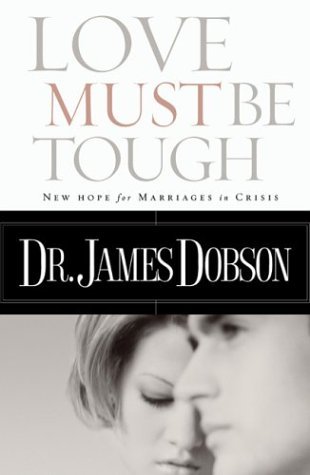
Book Review: Love Must Be Tough

Love must be tough

James C. Dobson, Love Must Be Tough: New Hope for Families in Crisis (1983; repr., Tyndale Momentum, 2007), hardback, 238 pages.

Dr. James Dobson (1936-) is a well known and established licensed psychologist (Ph.D., University of Southern California), who has addressed social and family issues from an evangelical perspective for about 40 years. He held a teaching post at USC’s School of Medicine as Associate Clinical Professor of Pediatrics and was on staff at the Children’s Hospital in Los Angeles for many years. And he served on a number government advisory panels and testified at several government hearings.[1]

Dr. Dobson is perhaps known more for the ministry network Focus on the Family he founded in 1977 through which he has provided a steady evangelical voice with regards to social issues on radio, television, print, and online. Since 2010, however, Dr. Dobson formally transitioned away from Focus on the Family and established another multi-media ministry venture, Dr. James Dobson’s Family Talk.

Love Must Be Tough to Save Families

The book under review, Love Must be Tough, is not a new contribution. Dr. Dobson wrote it in 1983 and because of its popularity, it is often reprinted. I read this book as part of a family ministry class. I found it to be an insightful and highly useful volume designed to provide a strategic proposal to help restore marriages struggling under the burden and crisis of marital infidelity. Dr. Dobson argues that his strategy strikes at the heart of the recovery from marital infidelity better than those provided by the then-current advice by counselors and literature.

What appears to be at the heart of the problem lies at a spouse’s passivity and allowance for the other spouse to have all the control in the relationship. This imbalance is subversive to the marriage. Dr. Nancy M. Rockstroh, M.D., who often recommends Love Must be Tough agrees:

when the balance of power switches so that one person has undue control, the potential for abuse of that power becomes imminent. Once individuals have the opportunity to do anything with the tacit acceptance of their partner, they have carte blanche to engage in destructive patterns of behavior without fear of losing the benefits of the relationship.[2]

Nancy Moultrie Rockstroh, “Love Must Be Tough: Proven Hope for Families in Crisis,” Primary Care Companion to the Journal of Clinical Psychiatry (2000)

It is not just theories or bad counseling which Dobson believes to be destructive and subversive to marital restoration. Marriage culture also is to blame, in particular, those which are so co-dependent that there is a loss of self-respect and the mutual respect which should exist within a marriage. Or, as Dobson argues, what marriages in crisis really need is the application of a simple principle: love must be tough.

Book Overview

Dr. Dobson develops his thesis by first showcasing the destructive nature of common approaches advised for reclaiming an unfaithful spouse. But, perhaps most instructive is the fact that he shares real experiences of infidelity and how the wounded spouse attempts to restore the marriage. According to Dobson, counselors tend to advise self-loathing, fault assuming, affair indulgent, and spiritually careless strategies. But even still further, wounded spouses often attempt to regain their unfaithful spouse through strategies (planned or not) that can be summed in the phrase: a complete lack of self-respect and identity (Panic, appeasement, etc).

This behavior must be stopped. Dobson argues strongly that this lack of self-respect and identity is a leading contributor for both the circumstances for a spouse to become unfaithful and for the pushing away of a cheating spouse. Dobson explains this character “defect” can be permissive as it “allows” flirtation with a potential lover, or it passively “allows” the spouse to continue dangerous relationships with a would-be lover. And once suspicion (or infidelity) occurs, the concerned spouse begins to tighten their grasp upon their beloved in order to keep them, but this often times pushes them farther away. The distrusted spouse feels caged and develops a need to escape. The spouse needs freedom. To further aggravate the situation, the worried partner who cannot feel complete without their spouse loses their individual identity and panics only to try to appease their unfaithful spouse. This behavior feels more like constrictions around the unfaithful spouse’s neck, and continue to fuel the desire for freedom (extramarital freedom).

Case upon actual case is rehearsed as testimonial evidence to support Dobson’s thesis that love must be tough. Consequently, if Dobson is right that popular counseling has it wrong in its strategic opinions, and that a consistent lack of self-respect and identity provide the stimulus for infidelity, then a new approach must be considered. Dobson argues therefore that the marriage relationship must include a number of applied principles. Despite the concept of “union” in marriage, each partner must exist with their sense of individuality intact, and each partner must be able to respect themselves. This sets forth the building blocks for a healthy sense of mutual accountability needed in a marriage that will allow it to thrive.

Thus, should signs of a potential extramarital affair begin to loom in the distance, a perceptive spouse can be grounded in their self-respect and identity, provide strong warnings set forth in love, self-respect, freedom, and independence (example: “I love you, but if you continue this course, then I will leave”). Spouses must be able to hold their ground, despite loving their spouse and not wishing them to depart. This “willingness to end a relationship,” says Dr. Rockstroh, “is the very essence of freedom and independence.”[3] Yet, this principle must be, according to Dobson, practiced with caution (see below).

Chapter 12 provides a timeline of eleven benchmarks showing how good marriages end in abandonment, adultery, divorce, and guilt. Side-by-side, the storyline of a husband and wife is unfolded. It shows how emotional starvation experienced by a loving spouse can lead to frustration and depression, only to work the heart into fertile soil for an extramarital affair. Preoccupations, such as work, only blind them of their beloved’s pain and that they too have contributed to this isolation. Eventually, an affair does ensue and is discovered. At this point, Dobson argues, the marriage can still be saved if both partners want to use “tough love” to regain themselves and restore their marriage. In this scenario that Dobson narrates, the cheating spouse leaves and a divorce is finalized. As in many cases which Dobson is aware of, at the end, the love affair turns mundane, the enabling but wounded spouse lives in ignorance of their contribution and the guilt for the children’s situation overshadows their heart.

Here Dobson makes one more appeal to confront misunderstandings that affect marital happiness. He appeals to the fact that culture essentially lies to our young ladies and young men in the aspect of who provides the happiness in the home. For the women, the lie is simple but devastating: “that marriage is a lifelong romantic experience.”[4] Moreover, the husband is entirely responsible for making this a reality; hence, women enter marriage with unrealistic expectations. And when these expectations are not met, it is her husband’s fault. For the men, the lie is relatively clear: “his only responsibility is to provide materially for his family.”[5] The love must be tough principle affirms individual responsibility for one’s happiness, and each spouse must play a role in creating marital happiness.

Of many of the valuable aspects of the book, is Dobson’s honesty that as much as the love must be tough principle is valuable and helpful, it can also be dangerously misapplied. The development of self-respect, individual identity, of creating a culture of freedom, of forgiveness, and many other traits can be so developed to the point where the wounded spouse uses them to destroy the marriage. For example, a person may become so independent that they want nothing to do with their spouse. Another spouse might defend their self-respect to the point where they become so outspoken that there is no mutual accountability. Dobson, therefore, warns against running wild with this strategy.

A Critique on Dobson’s Divorce and Remarriage View

There is no debate that Dr. Dobson’s book is valuable; however, his discussion on divorce and remarriage is perhaps the most egregious section in an otherwise well-developed book.[6] To Dobson’s credit, he inserts a disclaimer that he knows some Bible students will disagree with him. I register here as one who finds Dobson’s discussion of what constitutes a scriptural divorce and remarriage completely lacking biblical support.

Dobson affirms three matters to keep in mind in the discussion of divorce and remarriage. We agree with his discussion on what constitutes adultery in Matthew 19:9 so we will focus on the second passage discussed.

First, Dobson alleges that 2 Corinthians 5:17 sanctions the notion that it “includes divorce prior to salvation,” leading him to conclude:

when the marriage and divorce occurred prior to salvation, I believe God grants His “new creation” the freedom to remarry.[7]

James Dobson, Love Must Be Tough: New Hope for Families in Crisis (1983)

Dobson’s view hinges upon a phrase in this passage, namely “old things.” “Old things” as part of the “new creature” is typological imagery that supports the real emphasis of the verse, namely, that of a new creation. The personnot his/her marital situation– is made “new.” Paul had said previously to the Corinthian church that some of them had been adulterers (1 Cor 6:9-10) but not anymore because of their conversion (1 Cor 6:11). They changed their behavior. Conversion requires a change in behavior (Acts 2:38), it is not a simply a status change.

The third discussion Dobson enters is based upon a misrepresentation of 1 Corinthian 7:25-40. Dobson alleges that if a Christian is abandoned the believer has a right to remarry. Maybe there are other circumstances involved in the abandonment (i.e., adultery), but that is not discussed in this passage. Paul, however, argues that the abandoned spouse is not under an obligation -enslaved- to follow the departing spouse. The emphasis here is about fidelity to God’s sexual and marital laws (cf. 7:1ff). In fact, earlier in the passage Paul addresses “the married” and the potential of a legal separation,[8] to which he clearly gives two options: remain separated or be reconciled (1 Cor 7:10-11).

These are significant drawbacks from an otherwise really helpful book. I further understand that many would disagree with my critique of Dobson’s view. Still, neither conversion nor mere abandonment is biblical grounds for divorce and a subsequent remarriage.

Concluding Thoughts

In the final analysis, the book is generally sound and very helpful. But, because of the material on divorce and remarriage, I would recommend an alternative to sharing its articulation Dobson’s love must be tough strategy. Perhaps create a series of handouts (with due credit) with the strategies listed and illustrated. Or, recommendations to people well versed in the scriptural teachings on marriage, divorce, and remarriage. The material on self-worth and boundaries is the relevant and helpful element of Dobson’s work.

Dobson tackles a hard issue but the counsel he offers is advantageous. It is dated somewhat. For that reason, I would use Love Must Be Tough as a supplemental work to the more current volume by Henry Cloud and John Townsend, Boundaries in Marriage.[9] “Boundaries,” as Cloud and Townsend articulate, help to develop the issues Dobson is concerned with: a healthy sense of identity, personal responsibility, and mutual accountability. So, in the end, I offer a limited recommendation of Dobson’s book for the counselor and minister.

Endnotes

  1. James Dobson,” Wikipedia.org.
  2. Nancy Moultrie Rockstroh, “Love Must Be Tough: Proven Hope for Families in Crisis,” Primary Care Companion to the Journal of Clinical Psychiatry 2.6 (Dec. 2000): 229.
  3. Rockstroh, “Love Must Be Tough.”
  4. James Dobson, Love Must Be Tough: New Hope for Families in Crisis (1983; repr., Waco, TX: Word, 1996), 176.
  5. Dobson, Love Must Be Tough, 176.
  6. Dobson, Love Must Be Tough, 129-33.
  7. Dobson, Love Must Be Tough, 130.
  8. It is documented by R. L. Roberts, Jr., very clearly that the passive phrase “to be separated” (Grk. choristhenai) in these verses is a “technical expression for divorce” as it exists in ancient legal documents before and during the apostolic era (“The Meaning of Chorizo and Douloo in 1 Corinthians 7:10-17,″ Restoration Quarterly 8.3 [1965]: 179-80). Consequently, those that only see a “separation” as we commonly conceive of it as temporary “space” between spouses are unreasonably limiting the meaning of this word here.
  9. Henry Cloud and John Townsend, Boundaries in Marriage (Grand Rapids, MI: Zondervan, 1999).