Lectures: Ephesians 4:1–3 and Christian Unity

These lectures form a series on the basis of Christian unity based on Ephesians 4:1–3 delivered at the annual Faithbuilders of the Northwest conference held in Tacoma, Washington, at the Lakeview church of Christ as a collective work of many congregations of the Pacific Northwest. The theme of the conference: “That They May All Be One” (John 17:21).

I believe that Paul’s instruction beginning in Ephesians 4 lays the responsibility of maintaining the unity Jesus died for, the Holy Spirit secures, and the Father purposed on the redeemed, on us Christians. It takes people redeemed and led by the Spirit of God in order to accomplish a unity that cannot be achieved in no other way. I pray these talks will provide you with the same hope they have given me when I was preparing them.

I therefore, a prisoner for the Lord, urge you to walk in a manner worthy of the calling to which you have been called, with all humility and gentleness, with patience, bearing with one another in love, eager to maintain the unity of the Spirit in the bond of peace. 
Ephesians 4:1–3 (English Standard Version)

1 – Unity Requires a Worthy Lifestyle (Ephesians 4:1)

Watch the lecture on YouTube.com

Description: Paul places a high priority on a Christian’s lifestyle and how it must be anchored to what God is doing in Christ as a community. Christians are not to think in terms of individuality, but about what God is doing by uniting the body of Christ. We must live worthy of this work in Christ.

2 – Unity Requires Three Attitudes (Ephesians 4:2)

Watch the lecture on YouTube.com

Description: We must develop the attitudes of humility, gentleness, and patience if we are going to contribute to the greater fullness of the unity found in Christ. We must (1) realize that in Christ, our egos have gone to die, (2) learn to embrace our shared need for acceptance, and (3) learn to take the long view of God’s grace applied to all members of the body of Christ.

3 – Unity Requires Two Behaviors (Ephesians 4:3)

Watch the lecture on YouTube.com

Description: Actions manifest our attitudes. We speak with actions. Unity is spoken clearly felt and communicated when Christians learn to endure the challenges of life in the body. We are all prickly in our own way, we must demonstrate love for each other with our endurance. This feeds into another behavior which is to trust God’s Spirit to bind us rather than our perfection. God’s organic work of unity is our goal to bring all nations together into the family of God.

Are Miracles Possible?

The question of whether miracles are impossible strikes at the heart of the Christian faith. Its viability hangs on one significant miracle: the resurrection of Jesus. Paul argued,

 if Christ has not been raised, then our preaching is in vain and your faith is in vain. (1 Cor 15:14 ESV)

If the bodily resurrection never happened, because it is impossible, then the traditional Christian faith is catastrophically and irreparably compromised. In response, I will first argue there is evidence for a creator-God necessary for miracles to occur, then demonstrate that anomalies (like miracles) require intelligent causation. Finally, I will look at the resurrection as a case study.

The Creator-God

The evidence for the existence of God is cumulative in nature. This means there is a body of positive evidence combined to support the case that the universe is created by a personal Creator-God. Furthermore, God as creator is separate, or outside, of this creation. This Creator-creation relationship would allow, then, for the possibility of miracles:

if God exists then miracles are possible.[1]

Norman L. Geisler and Ronald M. Brooks
When Skeptics Ask, rev. ed. (Baker, 2013)

Natural theology affirms that the created world is host to evidence positively supporting God’s existence and justifying belief in him. There are four broad categories of arguments from natural theology:[2]

  • Cosmological (argument from causality, from effect to cause),
  • Teleological (argument from fine-tuned and intelligence-laden design),
  • Moral (argument from the objective value of morality and ethics), and
  • Ontological arguments (argument of a necessary uncaused Being).

These arguments represent a preponderance of the evidence that justifies belief in a personal ethical Creator-God.

A strong case can be made for the existence of God with the Kalam cosmological argument.[3] The first premise may be stated as “the universe had a beginning.” The evidence from the second law of thermodynamics affirms that the universe is experiencing entropy, a running out of useable energy. This points to the finite nature of the cosmos and points to a beginning when the universe was “fully charged.” The second premise affirms, “the universe was caused to exist.” What caused it to exist? Or had it come into being out of nothing? The evidence from nature (natural theology) points to a powerful (creation), ethical (morality), and intelligent designer (DNA) which brought these phenomena into existence. The reasonable conclusion is that a supernatural being created the universe into existence, this is God.

Not all Causes are Naturally Recurring

In response to the above supernatural claim, proponents of a naturalistic worldview argue that the existence of miracles would render the scientific method impossible to practice. This is only an assumption because there are different kinds of scientific ways of understanding causation, for not all causes are natural. A difference must be made between “operational science” which studies “regular patterns in the present from which predictions can be made,” and “forensic science” which studies “past singularities.”[4] The study of photosynthesis which takes into account how sunlight, carbon dioxide, and water, are converted into food by plants (operational science) would be conducted differently than a study of a singularity like the creation of the Mt. Rushmore monument (forensic science).

Miracles would no more disrupt operational science than would the reshaping of a naturally formed mountainside into a monument bust relief at Mt. Rushmore, or the carved-out ruins of Petra Pella. The use of intelligence and power offers a different source for causation than the naturally regular patterns in the world. The question remains how to decipher in what way miracles interact with the regular patterns of nature (disrupt, break, suspend). This difficulty of understanding anomalies like miracles or “the Big Bang” is not proof that such anomalies are incompatible with known scientific theory. It suggests we still have much to learn.

The Resurrection

A religion that is consistent with the picture of God derived from natural theology should have evidence of supernatural activity (historical reliability, fulfilled prophecy, etc.).[5] As noted already, the central figure of the New Testament, Jesus Christ, is presented in the historical setting of first-century Palestine, in which his teaching ministry is substantially interwoven with supernatural activity (healings, exorcisms, telepathic and empathic actions). The most significant miracle is his post-mortem bodily resurrection from the dead following his execution by means of crucifixion. Is this just legendary material that has been added, or are these ancient documents reliable eyewitness testimony to the most important miraculous event of human history?

The study of the historical reliability of the New Testament demonstrates that it has the strongest transmission history of any work from antiquity. It has preserved the eyewitness testimony of its authors who acknowledge the supernatural resurrection of Jesus Christ. For example, Paul’s words in 1 Corinthians:

Now I would remind you, brothers, of the gospel I preached to you, which you received, in which you stand, and by which you are being saved, if you hold fast to the word I preached to you—unless you believed in vain. For I delivered to you as of first importance what I also received: that Christ died for our sins in accordance with the Scriptures, that he was buried, that he was raised on the third day in accordance with the Scriptures, and that he appeared to Cephas, then to the twelve. Then he appeared to more than five hundred brothers at one time, most of whom are still alive, though some have fallen asleep. Then he appeared to James, then to all the apostles. Last of all, as to one untimely born, he appeared also to me. For I am the least of the apostles, unworthy to be called an apostle, because I persecuted the church of God. 10 But by the grace of God I am what I am, and his grace toward me was not in vain. On the contrary, I worked harder than any of them, though it was not I, but the grace of God that is with me. 11 Whether then it was I or they, so we preach and so you believed. (1 Cor 15:1–11 ESV)

Their ancient words have been preserved in over 5,000 Greek manuscripts.[6] These documents contain doctrinal traditions which include the Divine Lordship of Jesus, his bodily resurrection, and his miracles, so early (within less than a decade of the actual events) that there is no room for legends to displace Christianity’s core historical truths.[7]

The question “did Jesus rise from the dead?” must then be taken seriously. The death of Jesus is one of the surest known historical facts of Christianity.[8] Despite many attempts to theorize that he successfully survived the crucifixion, the medical evaluation[9] of the historical descriptions of his wounds points out that he was a “dead man” before the spear was thrust through his side (John 19:34). The belief that Jesus appeared bodily to his disciples after his execution is another known fact of Christianity, which transformed his disciples and converted unbelievers (e.g., James). The early disciples shared their witness that Jesus was raised from the dead by the power of God, many of them dying for their claim that they saw Jesus bodily raised.

Conclusion

The short version of this brief essay’s argument is, “if God exists, then the supernatural anomaly of the miraculous bodily resurrection of Jesus, as historically reported in the New Testament, is possible.” The possibility of the miraculous is, therefore, quite reasonable.

Endnotes

  1. Norman L. Geisler and Ronald M. Brooks, When Skeptics Ask: A Handbook on Christian Evidences, rev. ed. (Grand Rapids, MI: Baker, 2013), 71.
  2. Geisler and Brooks, When Skeptics Ask, 9–19.
  3. James P. Moreland, “Transcript: Arguments for the Existence of God” (Class lecture, Defending the Faith course of Talbot School of Theology, La Mirada, CA, n.d.); Geisler and Brooks, When Skeptics Ask, 10.
  4. Geisler and Brooks, When Skeptics Ask, 74–77.
  5. James P. Moreland, “Transcript.”
  6. Geisler and Brooks, 101–05; Joe Hellerman, “Handout: Defending the Gospel Accounts of Jesus” (Class lecture, Defending the Faith course of Talbot School of Theology, La Mirada, CA, n.d).
  7. Lee Strobel, “Handout: The Case for Faith” (Class lecture, Defending the Faith course of Talbot School of Theology, La Mirada, CA, n.d.).
  8. Known historical facts of Christianity are taken from Craig Hazen, “Handout: Evidence for the Resurrection” (Class lecture, Defending the Faith course of Talbot School of Theology, La Mirada, CA, n.d.).
  9. William D. Edwards, Wesley J. Gabel, and Floyd E. Hosmer, “On the Physical Death of Jesus Christ,” Journal of the American Medical Association 255.11 (March 1986): 1462.

Lecture: Conversion of a Gang Member

1

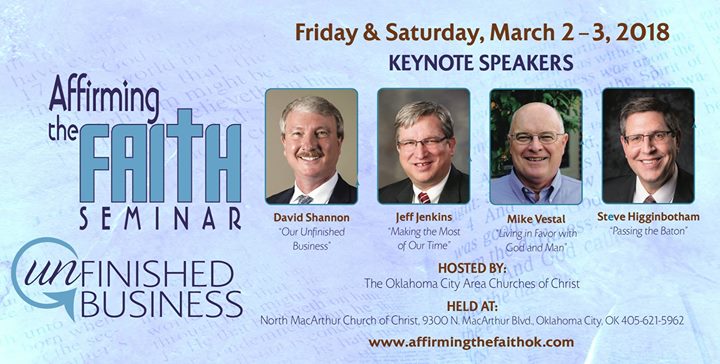
“Conversion of a Gang Member” was a part of the Conversion Series for the 11th annual Affirming the Faith Seminar held at the North MacArthur church of Christ (Oklahoma City, OK). The 2018 theme was Unfinished Business.

ATF 2018.jpg

Lecture Audio

Lesson Summary

The conversion to Christ by a gang member comes with its own challenges culturally, spiritually, socially, and developmentally. The stark contrast between the evils and perils of the world from the lives of long-time church-goers is often hard to quantify and hard to appreciate. We need a cooperative learning model that gives the church insight to enter and help their communities and provides a “training in righteousness” mentorship for the new covert.

The Lecture Presentation Slides

Notes

  • Related reading: Jovan Payes, “Leaving a Street Gang for Christ,” Gospel Advocate (April 2015).
  • “Lessons and Suggestions…”
    • I was able, for the most part, to blend and weave “lessons and suggestions” throughout the lecture.
    • Let me add a few Lessons
      • Even when we do not understand “where” our new converts are coming from socially and culturally, we can love them and plug them into the culture of the church. What we do not understand about them should not hinder us from incorporating them.
      • Shaming converts because they are urban, ethnic, or from a broken home will never do. The world no longer has the old “normal” standards or expectations. We need to be flexible with our expectations of what people know, how they think and relate, and where their pains exist – for not all scars are skin deep, some go to the soul. We do not need to add to their trauma. There are no “normal” people, there are only people.
      • In our excitement to celebrate people’s conversions to Christ, we need to be careful not to tell their story without permission. Some people are not ready emotionally to talk about where they come from, or what they’ve done in their life. Learn to embrace their new life in Christ, without forcing them to dig out their skeletons and trauma. They will do that when it is right for them to glorify God in Jesus.
    • Let me add a few Suggestions
      • We -the church- need to stop taking ourselves so seriously. We are all in need of grace and forgiveness… that includes our elderly members as well. So, we need to take Paul’s words to heart: “welcome one another as Christ has welcomed you, for the glory of God” (Romans 15:7 ESV).
      • Develop a “adopt a new Convert” program, or adopt a new convert on your own. Sometimes we wait for churches to create programs that need to happen now. Don’t wait for approval to serve… just serve. If you need permission… I permit you to serve. :) : “For whoever does the will of God, he is my brother and sister and mother” (Mark 3:35).
      • Remember the goal is to make disciples, but everyone starts at a different start line. Jesus’ words are clear, we are to not leave them to figure things out, but to develop them – give them moral and spiritual goals: “Go therefore and make disciples of all nations, baptizing them in the name of the Father and of the Son and of the Holy Spirit, teaching them to observe all that I have commanded you…” (Matthew 28:19-20).

The Word of God among the Denominations

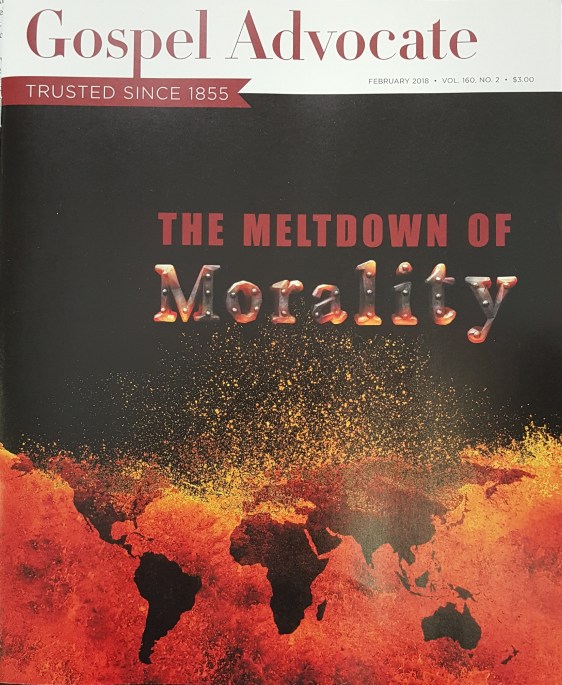
Reprinted with permission from the February 2018 issue of Gospel Advocate Magazine.

20180124_150851.jpg

Hebrews affirms, “For the word of God is living and active, sharper than any two-edged sword, piercing to the division of soul and of spirit, of joints and of marrow, and discerning the thoughts and intentions of the heart” (4:12 ESV). This is part of a warning in Hebrews, which affirms that Christians who defect from God will fail to meet their rest as their Israelite counterparts did (vv. 1-11). God holds his people —and His creation— accountable by His presence (“sight”) in the word of God (Hebrews 4:13). This is a raw incontrovertible truth.

This passage makes no caveats; it makes no attempt to remedy a distinction between God’s word and God’s presence. They are both manifested at the same time. God is involved with real life (time and space) with Israel and with Christians. God makes promises and keeps his word regarding their “rest,” and God holds His people and creation accountable to His word. God is Lord of heaven and earth and everything in between, and He holds it together by the power residing in Jesus (Hebrews 1:3; Colossians 1:17). The word of God is connected not only to the authority of God but also to His nature and how He reveals Himself to the world.

Let me say the above in a differently. Our God, who is beyond time and space (God’s transcendence), enters our earthly “realm” bound by time and space (God’s immanence) with His divinity and authority (sovereignty) intact; furthermore, God enters into relationship with His creation (Abraham, Israel, Christians) by revealing Himself in creation and in His word. God is active both in creation and in His word. Creation reveals God’s existence and hints at elements of His attributes (natural theology), but it is His word that reveals God and His “will” so that humanity can enter into covenant with God. The word of God was both proclaimed orally through particular spokesmen (patriarchs, prophets, kings, apostles), but the prophetic word was not only through oracles but also in written communiqués embedded with the same divine authority (2 Peter 1:16–21). These writings reveal the mind of God (1 Corinthians 2:11–16), His purposes and mystery (Ephesians 3:1–6), His involvement in human events (Acts 17:26–27), and the righteousness by which He will bring justice to the world (Acts 17:30–31).

To say it bluntly, the Bible is the word of God set in a permanent written form. Paul declared, “all scripture is breathed out by God” (2 Timothy 3:16). The Scripture bears the character of God and is no “dead” codebook, for it transforms every “man of God” into a competent, equipped servant (2 Timothy 3:17). The profitability of all Scripture is due to its quality as “God’s breath.” There is no pecking order between the spoken or written word of God. The inspired written word is as inerrant as God’s character. There is no source outside of the Holy Spirit-given Scripture that speaks God’s transforming work since it is the depository of the gospel’s message. What the word of God promises, God will do; what God proclaims, God’s holds His creation accountable to (1 Thessalonians 2:13).

The above may seem to belabor the point, but as anticipated by the title of this piece, we will sketch how the word of God is handled among Liberal (Modern) and Neoorthodox influences. It is essential for the church to reflect on these twentieth-century influences because dialogue is healthy, truth has nothing from which to hide, and any redefinition of biblical Christianity must be given due consideration (Galatians 1:6-7).

The following historical sketches will probably not satisfy everyone, but they will be enough to see their direction and how they redefine significant elements of historic Christian beliefs and their tendency to subvert scriptural authority.

Liberalism/Modernism

The word “liberal” is a very loaded word. It is often used with contempt to show disapproval of someone else thought to be progressive (instrumental music, expanded role of women, etc.). But this is not the historic sense of the word. Liberalism emerged in the late nineteenth century through the interplay of many players, thinkers, and philosophical trends. The influence of Liberalism, or Modernism, is seen in three levels: (1) revelation is not the final answer to reality, (2) naturalism is the key to reality and religion, and (3) since the Christian documents are built on ancient myths and superstitions, the historic supernatural claims of Christianity is immaterial. To be a “Christian” is a matter of experience and the “essence” of its teaching.

Liberalism, as an intellectual revolution, is a child of the Age of Reason (the Enlightenment). The “Age” saw the elevation of human reason over the institutional “church,” which wielded divine revelation. It was “the church” that dictated to the people what to believe about reality. Divine revelation was the final answer to determining truth and what really happened in the past. This was displaced with rationalism, scientific history (criticism), and naturalism as final answers to genuine and authentic history and truth. In essence, as Stanley Grenz and Roger Olsen point out, the maxim “I believe in order that I may understand” was turned to “I believe what I can understand.”[1] Faith was overturned by a reason informed by modern findings — thus, this point of view is called “Modernism.”

Everything that was received as genuine knowledge, now, was shaped by the natural world. This was further supported by what is called “the principle of analogy,” popularized by the liberal theologian Ernst Troelsch (1865–1923), which argued that the present is the best way to understand the past. The consequence was detrimental in the extreme on the trustworthiness of Scripture. The supernatural elements interwoven in Scripture are, by definition, myths and superstitions. This meant that there are no miracles, no supernatural interventions by God, and no resurrection of Jesus Christ. Thus, many new schools of “criticism” emerged to study Scripture with mixed results.

This naturally led to an embrace of “the essence of Christianity” so long as reason and experience allowed. “Liberals” are open to the modern findings from the natural world, open to a religious humanism and science —in particularly embracing Darwinian evolution as the process by which God created. If God exists, He could only be revealed through religious “experience.” It was also immaterial if the events of Scripture happened or not because religion is a condition of the heart. Yet, the apostle Paul makes it abundantly clear that if the resurrection event has not occurred, both our preaching and faith are in vain and we are still in our sins (1 Corinthians 15:14, 17).

Another arm of Liberalism is the demythologizing of the New Testament pioneered by the “Form Critic” Rudolf Bultmann (1884–1976). Bultmann argued that historic person of Jesus is built on untrustworthy sources. The New Testament is Christian propaganda shrouded in the imagery of the Greek myths and Roman legends. As such, they are not relevant for faith nor spiritual truth claims. It is the symbolism that matters. Today, one only need to watch the latest “history” programming to find modern theological liberals interviewed. Theological liberalism has significant questions that need to be answered, but it brings Christianity to a logical dead end.

Neoorthodoxy

The Swiss theologian Karl Barth (1886–1968) ignited a movement when he published his commentary on Romans in 1919. It charted a new theological direction away from Liberalism/Modernism. Barth (pronounced “bart”) was not fond of the misnomer “neoorthodoxy,” but his strand of thinking regarding the meaning of “revelation” and “the word of God” would rival the prevailing traditional belief held historically by the church. As a consequence, many regard Barth as one of the great theologians and the father of modern theology.

Orthodoxy affirms the teaching of historic Christian truth based on Scripture. This includes, for example, the following concepts: the inerrant inspiration of scripture, the triune Godhead, the deity and virgin birth of Christ, the historic creation and fall of humanity, the bodily resurrection and ascension of Christ, the return and final judgment. Barth argued, on the other hand, that “revealed truth” was not written, but was the outcome of an encounter (an experience) with God. Thus, instead of scripture as being the objective word of God, Barth argued for a subjective experience with God initiated by reading the Bible.

Barth was offering a completely different course of thought altogether. “Revelation” does not appear in the form of propositional truths. Arguing book, chapter, verse, or appeals to the very words of scripture is insufficient to reveal God. Revelation (the word of God), it is argued, is an “event” in which God acts in history (God’s immanence). Barth even argued that revelation is not found in natural theology (Acts 17; Psalm 19; Romans 1) but, instead, in events like the call of Abraham, the exodus, and the resurrection. Millard Erickson is spot on when he classifies Neoorthodoxy as an illumination theory divorced from an objective standard.[2]

Although Neoorthodoxy is not a unified movement, there are three interconnected witnesses (modes/forms) that shape its view on revelation.[3] First, Jesus is the word of God in the truest sense, for He reveals God in the event of His incarnation, life, ministry, death and resurrection. This is true revelation, the very gospel. Second, Scripture points to Jesus but it is a flawed human (read “errant”) attempt to provide a witness to divine revelation. It is instrumentally God’s word but not properly. Third, the proclamation within the faith community —Barth preferred “community” to church— is likewise instrumentally God’s word. The Bible, then, only becomes God’s word when God uses it to reveal Jesus Christ in the encounter, contrary to 2 Timothy 3:16.

In fact, Neo-orthodoxy is quite a popular approach to handling the Word of God, even among churches of Christ. A popular theological branch of this movement is “Canonical Criticism,” popularized by the late American scholar Brevard Childs (1923–2007). It seeks to broadly bypass much of the liberal destructive criticism of the twentieth century by accepting the texts of Scripture as literary units. Nevertheless, this point of view struggles, as did Barth’s, to embrace the Bible as a very human (errant) book while appealing to its authority for theological thought as if they were inerrant. They seek, in the words of one sympathetic Abilene Christian University professor, to “articulate a doctrine of Scripture that recognizes human flaws in it.”[4] Treating the Bible as an inerrant text is simply a form of bibliolatry.

Keeping the Faith

Today, the phrase “Word of God” means different things to different believers, and that includes preachers. Liberalism ultimately rejects a supernatural Christian faith, and is at home with amputating its historic claims of a resurrected ascended Lord Jesus, in exchange for a subjective diluted Christianity. Neoorthodoxy, on the other hand, embraces a supernatural Christian faith, but it rejects the supernatural origin, inerrancy, and authority of the Scriptures which undergird its claims. The Word of God has always been a manifestation of God’s presence in our lives, in His proclamation, and in His Scripture without pecking order. Let us join Paul who declares, “Let God be true though every one were a liar” (Romans 3:4).

Notes

  1. Stanley J. Grenz and Roger E. Olsen, 20th Century Theology (Downers Grove: InterVarsity, 1992), 17.
  2. Millard J. Erickson, Christian Theology, 3rd ed. (Grand Rapids, Baker Academic, 2013), 220–21.
  3. Karl Barth, Evangelical Theology: An Introduction, trans. G. Foley (New York: Holt, 1963), 26–36.
  4. Christopher Hutson, “Scripture as the Human Word of God: Why Faith Contradicts Inerrancy,” Lexington Theological Quarterly 44.1 (2011): 210–21. Hutson serves as a professor of ministry and missions at Abilene Christian University.

To subscribe to Gospel Advocate, click here.


Be the Gift (1 Peter 4:10-11)

It is a staggering thought when you think about it. Christians have gifts to share with their neighbors. Much like the old nativity hymn of the three orient kings, who came from the far east with rich gifts for the newborn king Jesus, Christians have gifts to share with the people they come in contact with every day. In a word, we have a calling. It is greater than Toys for Tots, it is greater than Secret Santa, it is greater than the presents carefully wrapped and laid under the Christmas tree. The gifts Christians have are those which come from God, they are packaged by him and must be shared.

When the apostle Peter wrote to the beleaguered Christians in the northeastern Roman provinces of Asia (1 Peter 1:1), he wrote to encourage them to embrace the slander and the social persecution with the reminder that they walk in the footsteps of Jesus (1 Peter 2:21). For example, should they suffer unjustly —as did Jesus— the suffering will bring about the opportunity to extend grace to the world. Furthermore, the Christian must not focus on the momentary suffering but instead upon God’s validation and vindication. As God vindicated the suffering servant Jesus, so will He vindicate his suffering people (4:1).

As You Have Received God’s Gift

As an extension of this moral encouragement, the apostle goes on to address very practical aspects of Christian living in chapter 4. Here is an excellent moment to pause and reflect upon the truth that doctrinal purity is important, but these Christians are called to practice godliness in the face of persecution. In one of the summarizing passages of this exhortation, Peter writes the following:

As each has received a gift, use it to serve one another, as good stewards of God’s varied grace: whoever speaks, as one who speaks oracles of God; whoever serves, as one who serves by the strength that God supplies—in order that in everything God may be glorified through Jesus Christ. To him belong glory and dominion forever and ever. Amen. (1 Peter 4:10–11 ESV)

A point that is not readily notable from the English version is the connection between gift (charisma) and grace (charitos) in verse 10. They are built on the same word root, which was interconnected at the social level. It portrays God as a benefactor —a gift giver— for his people and asks them (us) to also be gift-givers (benefactors) as well.

This makes the term “good stewards” (oikonomoi) equally enlightening. It is a word that has domestic and political usage, and this usage is seen in the New Testament documents. In the ESV, the word is translated as “manager” of domestic affairs (Luke 12:42, 16:1, 3, 8; Gal 4:2), and once as “treasurer” which would have been a political office in Rome (Rom 16:23). As here in 1 Peter 4:10, “steward” in passages that emphasizes a conservatorship over a given responsibility (1 Cor 4:1-2, Tit 1:7). It was a well known Greco-Roman phenomenon that members of a benefactor’s household were also “brokers” of the gifts of the head of their household. The imagery of Peter’s message is parallel to this type of behavior.

Christians as members of God’s house are blessed by their Father’s gifts so that they may be brokers of God’s grace. We are in a very real way representatives of God’s house and what we offer in a variety of ways is the very gift of God — Jesus Christ and the gospel message. We are to teach it, we are to proclaim it, but most importantly we are to live it. Below, we will consider the points left behind in this section by the Spirit through Peter in verse 11.

Whoever speaks…

One of the overarching themes of the film, Waiting for Superman, a 2010 documentary on the American education system, is that many within the system are waiting for someone to fix it, to do the hard work to shore up its failures. Instead, such systemic problems will only be fixed by teachers and educational leaders working together and initiating helpful and creative programs. There is no one person who can fix the educational system of America, all resources must come together. The same is true with sharing the gift of Jesus and His gospel.

Every Christian (woman and man) must remember that our gift is a gift of words. Not just words, but words of God. For this reason, when a Christian shares the gospel it truly is God’s gift of grace we are sharing. We must not speak our words. We must not speak from our own anger. We must not speak our theories of the word. We must not speak our “pet” religious opinions. We must not speak from any other basis other than from the depository of God’s word — found only in the Scriptures. Our words must be as if it were God talking. God’s word is the only true gift (1 These 2:13).

Whoever serves…

Christian activity is always dramatically presented as services rendered as one who waits on tables, doing as told by their superior (Acts 6:2; John 2:5). Every Christian (woman and man) must remember that our gift is also a gift of action — of service. Christians broker God’s grace with others with the service we render to other people. Edgar Guest was spot on with this passage when he penned the opening lines of his poem, “I’d rather see a sermon than hear one any day; I’d rather one should walk with me than merely tell the way” (“I’d Rather See a Sermon Than Hear One Any Day”). Indeed, there is no greater opportunity in life than to serve as an example of God’s grace to others.

Words can be misunderstood. Actions, however, are less so. But, serving others often comes with a tall price. Service is not convenient emotionally, or physically. It is perhaps for this reason that Peter says that Christians who serve others do so and are empowered by the strength supplied by God. We do not serve others based on our own merits. It is a hard lesson for so many of us, but we need to trust in God for Him to be God when we are serving others. Whether it is food, clothing, or shelter that we offer as expressions of God’s varied graces, we do so, trusting that God will make our service His gift and that alone should empower us to serve.

Concluding Thoughts

Whether it’s the best of times or the worst of times, Christians can make a mark in the world and in the times in which they live. My prayer for all of us is to be the Christians we are called to be. Be the best gift you can be to your family and friends in word and service. Let it be the kind that brings glory to God and not to self. Remember, to say, “it’s not about me… it’s about Him.” “To him belong glory and dominion forever and ever. Amen” (4:11).


The Gospel of Luke

Reprinted with permission from the July 2017 issue of Gospel Advocate Magazine.

20170626_144252.jpgThe Gospel of Luke, like Matthew, Mark, and John, provides a narrative of Jesus that dramatically emphasizes the story and significance of His life and ministry, His rejection and crucifixion, and His resurrection and exaltation. Yet, despite bearing strong similarities with the other inspired accounts, Luke’s approach expands our understanding of Jesus and the working out of God’s plan to bring salvation into the Jewish and Gentile world.

In fact, Luke is the first book of a two-volume set. Luke and Acts are joined at the proverbial hip by their prologues styled in the manner of ancient historical accounts (Luke 1:1-4; Acts 1:1-3). If one is to truly appreciate Luke, one must understand that the ministry of Jesus is but a beginning —a prelude— to the establishment and expansion of the church. Luke is the only Gospel Account that has a sequel (i.e., Acts). Said another way, in relation to Acts, Luke is a prequel. From this broad perspective, then, we can see that Luke purposefully expanded the stories of Jesus’ ministry to include more genuine details, to provide unique emphases, and to show that the ascension was not the end of the redemption story but that it was to be continued by the church.

The Prologue and Purpose

When one pauses to appreciate how each gospel accounts begins, Luke’s prologue to “book one” is set with a series of unique features. In Luke 1:1-4, the inspired text reads in such a way that the reader should see early on that this account is framed along different lines than previous accounts:

Inasmuch as many have undertaken to compile a narrative of the things that have been accomplished among us, just as those who from the beginning were eyewitnesses and ministers of the word have delivered them to us, it seemed good to me also, having followed all things closely for some time past, to write an orderly account for you, most excellent Theophilus, that you may have certainty concerning the things you have been taught. (ESV)

This one sentence in the Greek outlines very clearly the overarching concern of Luke’s gospel account, and it does so in a formal way consistent with ancient Greek historians and medical writers according to Graham N. Stanton in his classic work, The Gospels and Jesus.[1]

Here, Luke acknowledged the presence of other narratives preexisting his own account (Gk. diégesin). Despite their existence, it appeared to be the right time to provide his own inspired account. Luke told us explicitly that his gospel is in keeping with three aspects of early Christian testimony: (1) these preexisting accounts, (2) earliest eyewitness testimony, and (3) those who served to deliver the Word to the world. To be clear, Matthew, Mark, and John demonstrate to have the same concerns, but regarding emphasis, Luke’s account is the clearest. And this feature is most likely due to the sort of audience he seeks to reach that is, people like Theophilus who are interested in the certainty of the events of Jesus’ life and ministry, death and resurrection, and the progress of those who followed Him afterward.

Luke’s Author and Audience

Two more unique feature of Luke is seen in both its author and its recipient, and this speaks to Luke’s heavy emphasis on providing a closely followed and orderly account. Luke, a physician by profession (Col 4:14), is the only known gentile author in Scripture period. That alone is a spectacular fulfillment of the end goal of the gospel to reach the Jews first, and then to the Gentiles (Rom 1:16; Acts 1:8, 13:46-48). Accordingly, Luke became a participant in the work of the Apostle Paul at some point before entering the province of Macedonia (Acts 16:10). Luke includes himself in many of the journeys of Paul, marking them with the terms “we” and “our” or “us” (Acts 16:10-17, 20:5-15, 21:1-18, 27:1-37, 28:1-16).

These “we” sections tell us something very rich about Luke. He is not just an author. Luke was a collaborator and eyewitness of the continuing story of the redemption in the church, who then investigated the origins and narratives regarding Jesus by interacting with eyewitnesses and early teaching of the Word. Luke was a Gentile convert who joined Paul’s missionary fellow workers, and now offered an inspired history of the full gospel story. For this reason, Luke bears many similarities with Matthew and Mark, gospel accounts based upon eyewitness testimony. And, the book of Luke shows that his missionary itinerary screeches to a halt in Jerusalem when Paul is arrested in the Temple and after meeting with James the brother of Jesus (Acts 21:17). It is within reason to point out that Luke had over two years in the Judean region to collect eyewitness accounts while Paul is detained in Caesarea, Philippi, until Paul appealed to Caesar (Acts 21:1-26:32). 

Moreover, unlike Matthew, Mark, and John, Luke names the immediate recipient of his two-volume work, Theophilus (Acts 1:1; Luke 1:1). Many theories and speculations abound regarding the nature of the relationship Theophilus had with Christianity in general and Luke in particular. While his name means “lover of God” or “friend of God,” this was not uncommon in the ancient world, nor in the New Testament (cf. Diotrephes, “nourished by Zeus,” 3 John 9). So, it is not as reasonable as one might think to suggest it is a “code name” for a believer.

What helps our understanding of Theophilus’s connection to Luke is the way he was honored with the term “most excellent” (Gk. kratiste). The word is used four times in the New Testament and all by Luke (Luke 1:3; Acts 23:26, 24:2, 26:25). In Acts, it used when addressing the governors Felix and Festus respectively. In Luke 1:3, there is not enough evidence to suggest such a political status, but it points to, at minimum, the upper-class status of Theophilus and his social circle. This would not be the first time Christianity intersected this social sphere (Romans 16:1-2; Acts 13:1; Philippians 4:22). Thus, Luke’s audience is probably of the intellectual kind, and this fits with his stated purpose and the “better” Greek he used.

It is not surprising then, given Luke’s research and experience, his relationship to Theophilus, and his social circles, that Luke would “write an orderly account for you… that you may have certainty concerning the things you have been taught” (Luke 1:3-4). Luke promises that he is framing his account with an attention to detail —that is, with a strong historical emphasis.

Luke’s Unique Framework

Not a lot of disagreement exists concerning the general outline of Luke. The narrative is relatively straightforward. The following outline of Luke not only provides a survey of the book, but also points out the unique features of this gospel. The Gospel of Luke cannot be understood a part from an emphasis upon the intertwining of history and faith.

Book One: Prologue (1:1-4). As emphasized thus far, Luke begins with a prologue all its own. Like John 20:31, Luke 1:1-4 states the purpose of his Gospel. This is reinforced by Acts 1:1-3, which summarizes that Luke is but the beginning story of “all that Jesus began to do and teach.” There is more to the story of Jesus, and Luke provides a detailed account of it.

Birth Narratives of John and Jesus (1:5-2:52). It is not without significance that Luke provides interwoven birth and youth narratives of John the Baptist and Jesus of Nazareth. Matthew recounts elements of the nativity story during the period of Herod the Great as does Luke. Luke intertwines divine events surrounding John and his family, and Jesus and Mary, anchoring them to real life with the historical lead in “in the days of Herod, king of Judea” (Luke 1:5) and “in those days a decree went out from Caesar Augustus” (2:1). Such passages like Mary’s magnificat (1:46-55) and the two stories of Jesus in the temple (2:22-52) are recorded only here.

Anticipating the Ministry of Jesus (3:1-4:13). Among the “time stamps” Luke employs, 3:1-2 is layered with seven political figures that suggest a window from 27 to 29 for the beginning of the ministries of John the Baptist and the Lord. The intertwining of their stories continue, as John is set up as the voice to anticipate the coming of the “salvation of God” —Jesus (v. 6). Jesus is again anchored to not just history but biblical history and creation itself, as His genealogy begins with his adoptive father’s lineage down to Adam, “the son of God” (3:38), the phrase Jesus would identify with (1:35, 4:3, 9, 41, 20:36, 22:70; Acts 9:20). These are significant unique elements of Luke.

Jesus Ministers in Galilee (4:14-9:50). If one were to read Mark, this section would have many similar events recorded, but Luke expands on them or gives them a fresh twist. One event that is of particular importance for its uniqueness is Jesus reading the Isaiah scroll (Luke 4:17-21; Isaiah 61) in the synagogue, during which He not only declared its fulfillment in Himself, but also revealed what His ministry would look like. It will be a series of reversals (blind see, captives free, etc.). Jesus’ concern for the disenfranchised is witnessed in all the Gospel Accounts, but Luke strongly emphasizes it.

Jesus Travels to Jerusalem (9:51-19:44). This section is often called the “central section” of Luke as it roughly covers ten of its twenty-four chapters. Jesus has “set his face to go to Jerusalem” in anticipation of being “taken up” (9:51). It is unique in that Luke is the only gospel account to record Jesus’ travel route on the eastern side of the Jordan River. It contains some of the most memorable events (rejection in Samaria, the seventy-two sent), parables (Good Samaritan, the Rich Fool, Prodigal Son, Rich Man and Lazarus), encounters (Mary and Martha), and sayings of our Lord (return of the unclean spirit, sign of Jonah). This section is bursting with teaching and events unique among the gospel accounts.

The Passion Week in Jerusalem (19:45-21:38). Here, Luke recounts a series of controversial events leading up to his betrayal and rejection. One immediately sees the unity between the way Matthew, Mark, and Luke chronicle the “passion week.” This includes the challenge of Jesus’ authority, paying taxes to Caesar, the resurrection, the question regarding the lordship of Christ, and the prediction of the destruction of the temple in AD 70. The section concludes with a summary statement.

From Shame to Exaltation (22:1-24:53). One of the unique elements in this section is the portrayal of the institution of the Lord’s Supper and the cup-bread-cup scenario. It is not that Luke makes a mistake here, but that it perhaps reflects the practice of having four cups employed during the Passover. Another unique feature of this section is in the resurrection appearances —in particular, on the road to Emmaus where two disciples find a Jesus “in hiding.” They recount this event along with their sense of a loss of hope until they connect the dots that this was Jesus. These are the details that provide a sense of uniqueness of Luke’s gospel.

Conclusion

Luke, along with Acts, were probably published and sent to Theophilus around AD 70. Acts ends with Paul under house arrest for two years in Rome, awaiting his case to be heard by Caesar (Acts 28:30-31). This is a few years before his death, which is traditionally dated to the time of Nero (AD 54-68; Eusebius, Ecclesiastical History 2.25.5). At the time of publication, we should picture Luke as a veteran evangelist, an experienced missionary who has researched the ancient origins of the faith. He was addressing those engaged by the story of Jesus who wish more details and certainty. His inspired record, then, is offered as a powerful demonstration of the historical basis of the claims of Christianity.

Endnotes

  1. Graham N. Stanton, The Gospel and Jesus, eds. Peter R. Ackroyd and Graham N. Stanton (Oxford: Oxford University Press, 1989), 83.

Jovan Payes preaches for the Highland Church of Christ in Bakersfield, California.

To subscribe to Gospel Advocate, click here.

Regarding the Divide Between the Christ of Faith and the Jesus of History

college papers

There is a long-standing view that an impassible divide exists between the Jesus of history and the Christ of faith. This paper is about crossing this epistemic divide centered on what can be known about Jesus. Many scholars believe this divide cannot be bridged, but this paper argues that it can. This challenge reminds me of two cautionary tales.

Growing up in San Francisco, I was surrounded by bridges. Traveling northbound from the San Francisco peninsula, one crosses the Golden Gate Straight by virtue of the world-famous Golden Gate Bridge. Traveling eastbound, out of “the city,” there is the less famous double-stacked Oakland Bay Bridge, which is the workhorse among the Bay Area bridges. There are two events connected to these bridges that have taught me two relevant lessons.

First, few know that many said the Golden Gate straight could not be bridged. In fact, engineering experts said a bridge would never be built because the straight was too long, the winds were too strong, the waters would be a nightmare for construction, and the fog would further hamper the process. Yet, four years of construction (1933-1937) later, the impossible expanse was built. Sometimes, the naysayers give you the planks upon which to build your bridge.

Second, during the 6.9m 1989 Loma Prieta earthquake, a large section of the top-level (outbound) of the Bay Bridge collapsed. I watched, on a small battery-powered radio/tv, a news report of a vehicle attempting to jump the divide, only to fail tragically. The vehicle had no ability to jump the gap. I learned that day that hope is not enough to cross a wide gap. We must evaluate the evidence to “look before we leap.”

Christianity and the Impassable Divide

These anecdotes inspire me to challenge the so-called “impassable” ditch at hand. It is not a small challenge, for the claim has been made by some of the sharpest minds in “thinking” history. It is, nevertheless, part of the calling of every Christian to be “prepared to make a defense to anyone who asks you for a reason for the hope that is in you” (1 Pet 3:15 ESV).[1] Peter was aware that Christians will be called upon to explain the connection between their behavior and their conviction in Jesus as Lord (1 Pet 4:1-5). Life and faith converge in Jesus. What some would argue is an impassable gulf -reality and value/significance- was the connective tissues of a Christian ethical apologetic. It may be argued, then, that first-century Christians were already crossing the “impassable” bridge between the Jesus of history and the Christ of faith.

Peter anticipated no epistemic difficulty -no crisis- explaining how “Jesus as Lord” connects with significance to the everyday issues of his life and his future. Accordingly, this early text assumes that the full identity of Jesus held an immediate significance to the lives of struggling Christians. It is the result of both his historic existence and his spiritual Lordship viewed as one tightly interwoven reality. This “interwoven reality” is not, however, the view of many within the academic circles of biblical and philosophical criticism.

This issue at hand is multifaceted and complicated, but it is not insurmountable nor impassable. One must evaluate the evidence and acknowledge the complexity of the problem at hand in order to offer a solution. For instance, there is a large time-gap between today and the first-century. This raises a lot of genuine historical questions all by itself concerning sources which provide any measure of access to Jesus. Further, those ancient sources must be evaluated to test their genuineness to weigh their authenticity and accuracy to verify if they are primary or secondary sources, literary or non-literary sources. These and many other questions are used to evaluate ancient sources that allow the historian to reconstruct a probable and revisable picture of the ancient past. If the current matter were simply an issue regarding sources, then there are numerous literary sources from the first-century which point to Jesus, the events and personalities surrounding his ministry, his death, and the belief and practices of early Christians. Many have discussed and debated these sources,[2] but the tension at hand focuses on a level a bit “deeper” than literary sources (though they will be considered).

At its core, the problem at hand is epistemic; that is, it centers on “how” knowledge is obtained, how knowledge connects the self “within” (internal) to the world “without” (external).[3] David Lipe briefly summarizes it as, “the study of the origin, nature, extent and reliability of knowledge.”[4] Vergilius Ferm points out that epistemology seeks to answer the following questions:

What is the source of human knowledge? What are its limitations? How do we come by our knowledge of the external world, of ourselves, of others? How can we trust our ideas as valid?[5]

“Epistemology,” in Twentieth Century Encyclopedia of Religious Knowledge, ed. Lefferts A. Loetscher (Baker Books, 1955)

Schools of thought, such as empiricism and rationalism, and the debates which they create have formed the basis of the dichotomy that pits the “historical Jesus” against the Christ faith-claim. In particular, with rationalism (Decartes, Spinoza, Leibniz), mind (a priori) is regarded as being given authority/primacy over the senses (a posteriori); that is, a priori knowledge is superior to a posteriori knowledge. Conclusions drawn would be deductively reasoned knowledge such as Aristotle’s “laws of thought.” On the other hand, empiricism (Locke, Berkeley, Hume) approaches knowledge from the other direction -the senses/experience; that is, a posteriori knowledge is regarded superior to a priori knowledge. This would be inductively experienced knowledge grounded in life.[6]

Enter Immanuel Kan (1724-1804). In the late eighteenth century, Kant would attempt to split the difference by attempting to synthesize and hold both in tension. That is, we can know “how” we know something, but the knowledge is completely subjective. Knowledge is only a perception, a “representation,” and not actually real to life (the thing in-itself).[7] Kant develops the thought this way:

all our intuition is nothing but the representation of appearance; that the things that we intuit are not in themselves what we intuit them to be, nor are their relations so constituted in themselves as they appear to us; and that if we remove our own subject or even only the subjective constitution of the senses in general, then all constitution, all relations of objects in space and time, indeed space and time themselves would disappear, and as appearances they cannot exist in themselves, but only in us. What may be the case with objects in themselves and abstracted from all this receptivity of our sensibility remains entirely unknown to us.[8]

Michael Rohlf, “Immanuel Kant,” https://plato.stanford.edu/index.html

Yet, as Norman Geisler points out, Kant’s epistemology results into a self-defeating “philosophical agnosticism.”[9] Attempts like these to explain how we obtain knowledge is at the core of the so-called impassable gulf between the Jesus of history and the Christ of faith.

The Contours of the Impassable Divide

This debate fundamentally represents the struggle between connecting the tangible to the intangible, life and significance, the historic and the historical. In addition to a number of certain epistemic concerns, the divide is infused with an anti-supernatural bias which has manifested in at least five forms.[10] They are summarized briefly here, with the danger of oversimplification:

  • Gotthold E. Lessing (1729-1781) argued that there is an “ugly ditch” between historical contingent truths and the eternal necessary truths. His “ugly ditch” language has essentially framed the whole conversation.
  • Immanuel Kant (1724-1804) argued that there is a gulf between facts (contingent truths) and values (experience/reasons) that cannot be bridged but by faith (not knowledge).
  • Martin Kähler (1835-1912) expressed his concern for a reconstructed (historical) Jesus that must be mediated by the trained hands of critical scholarship. Kähler affirmed an impassable divide between the historical (reconstructed) Jesus and the historic (real) Jesus that cannot be cross unless by faith evoked by the historic Jesus. 
  • Søren Kierkegaard (1813-1855) viewed that the “historical” has no connection to the eternal, so real history is immaterial to the “leap of faith” toward the spiritual/eternal.
  • Rudolph Bultmann (1884-1976), argued that Jesus —as built on untrustworthy sources (Christian testimony, myths, and legends)— is not relevant for faith nor spiritual truth claims. It is the symbolism that matters at an existential level, that is, the meaning intended by such “sources.”

These all reflect a gap, a ditch, a divide, for which it is claimed that they cannot be bridged. It will be, then, the approach of this paper to first briefly critique the arguments for this impassable gap. Then, attention will be given to ancient sources, both within the New Testament canon and outside the New Testament canon to demonstrate that history and value claims must be intertwined to make sense of evidence. From this, provisional conclusions will be made that are reasonable and consistent with this evidence.

Critique of the Impassable Gap of the Historical Quest

The problem with the arguments used to articulate the dichotomy of the Jesus of history and the Christ of faith are typically self-defeating and beg the question at the methodological level. The “gap” issue significantly touches on the crux of the quest for historical Jesus. Albert Schweitzer (1875-1965) points to Lessing’s publication of Herman S. Reimarus’ Fragments in which Reimarus separates what the apostles said about Jesus from what Jesus said about himself.[11] Since Schweitzer, the publication of Fragments has been viewed as the early stages of the quest for the historical Jesus.

Gotthold E. Lessing

Reimarus influenced Lessing, and who in turn, affirmed a tension between the relationship of history and revelation. Lessing states this as “the ugly broad ditch”; namely, “accidental truths of history can never become the proof of necessary truths of reason [and revelation].”[12] For Lessing, a Spinozan pantheistic deist, there is no supernaturalism in the world. So, events are fortuitous (accidental) and have no meaning/significance of themselves. Why, because like Spinoza, Lessing argues that since God is immanent and extends throughout creation, he naturally governs the world with its unbreakable natural law. Accordingly, supernatural activity (miracles, providence, etc) is impossible because to do so would violate his own nature as expressed in natural law. Thus, miracles are impossible and God does not reveal himself in history. Thus, Jesus the real-person (a posteriori) is not associated with the faith-truth as the Christ (a priori) by definition. In fact, no religious claim can be absolutely true.

Lessing’s argument, however, presumes that “natural law” is inflexible. A further problem in Lessing’s epistemology is its self-defeating agnosticism that not only arbitrarily forces a divide between history and truth. For, in order to make the observation (a posteriori) that history and value (a priori) are detached from one another, Lessing must make an absolute value statement based on how history and value relate to each other historically. So, Lessing is doing what his thesis says is impossible to do: to intertwine history and evaluative judgments.

Immanuel Kant

This is essentially the same fundamental flaw in Immanuel Kant’s agnosticism (that he knows that one can perceive but not know a thing in itself). Again, Kant says,

We are acquainted with nothing except our way of perceiving them, which is peculiar to us, and which therefore does not necessarily pertain to every being, though to be sure it pertains to every human being.[13]

Quoted in Rohlf, “Immanuel Kant.”

People only know what they think they know, and what they know is not necessarily true “in itself.” This is the tension of his contradictions (“antinomies”) which, therefore, force him to reject a priori (and ontologically) arguments for believing a thing to be true in itself. For example, what is logically necessary, is not actually necessary.[14] Consequently, the Bible is not the result of God adapting to human finiteness (which is logically necessary) but is instead a book of mythology. It is not actually necessary that the Bible be from God, and such a truth claim is only a perception. Instead, what has more logical value and tangible significance to Kant is one’s duty to their neighbor.[15] Thus, the events of Jesus portrayed in the Gospels, then, is a subjective statement of a spiritual truth-claim that Jesus is the Christ of faith.

In order for Kant to make this claim (that we only know perceptions, no what is real in-itself), he is must make an absolute truth (a priori) claim in a world that he has argued can only be perceived in a subjective manner. Kant self-defeats himself by crossing the divine he denies is possible cross. Would not the argument, “I know for certain that it is impossible to know a thing in itself” argue that Kant knows this as a historical truth claim in itself? Kant derails himself.

Søren Kierkegaard

Kierkegaard argued for a dichotomy which “real history” is unimportant to faith, or rather, that it is impossible to move from the historical toward the spiritual. Kierkegaard finds no causation between a historical event and meaning (its value, or truth). In fact, this is his great paradox when it comes to truth claims since human knowledge is unable to have certainty about meaning and significance. Thus, for example, spiritual truth is beyond human rationality. For Kierkegaard seeking how to explain or understand the nature of God, one enters a paradox/contradiction. The act to explain the nature of God, is in effect, to limit a full understanding of God. To be certain about something is to limit what can be known about something.

In this sense faith —in particular, Christian faith— is a different beast altogether, for it carries within it a built-in certainty to its truth claims. In Kierkegaard’s view, it is purely nonsense that by understanding what happens in history (Jesus of history), one can obtain knowledge of the contradiction — the non-historical (Jesus of faith). Therefore, fact and history are not as important to Kierkegaard as the “leap of faith.” The problem is, as Geisler sums up, “while the historical as such does not bring one into contact wth the eternal, neither can the eternal be divorced from real history.”[16] Yet, Kiekergaard’s case proves too much on this point, for “the shift in emphasis from fact to value leads to the denial of fact and its support of faith.” It is not that all of his observations are to be dismissed, but he undermines the role of fact to understand value-claims.

Martin Kähler

Martin Kähler, who builds on Kant, also voiced his concern that the “real Christ” is not the Christ of Faith. This point is easily misunderstood. Kähler rightly argued that historical research should inform faith, so he was loved by liberals but hated by conservatives. Kähler also rejected attempts to separate the Jesus of history from the Christ of faith and was loved by conservatives and hated by liberals. He served, therefore, as a middle ground historical critic, who was “loved” and “hated” by conservative and liberals but for different reasons. Kähler coined the phrases “historical Jesus” (historische) and “historic Jesus” (geschichtliche), yet what he meant by the terms is not how most employ the term today. The “historical Jesus,” according to Kähler is a reconstructed Jesus based on scholarship which may, or may not correspond to the “historic Jesus” — that is, the real-life Jesus. Kähler took issue with equation the two.[17]

It came down to two problems. First, there is limited knowledge, or the lack thereof, to sufficiently “reconstruct” Jesus. Second, believers are at the mercy of the “fluid results” of scholarly reconstructions about Jesus. Jesus was, therefore, mediated by the elite scholars. For this reason, Kähler declares, “the real Christ, that is, the influential Christ, with whom millions in history have had fellowship in a childlike faith… is the preached Christ.”[18] The proclaimed Christ solved this problem. For this reason, Kähler made a distinction between the “historical Jesus” from the “historic Jesus.”

The line he draws on this point, between the two, is too strong and undermines the fact that the New Testament builds its case upon sources which are built on eyewitness accounts (Luke 1:1-4; Acts 1:1-3). Even if one were to argue that there is a minimal amount of authentic evidential sources about Jesus, then to that degree a faithful reconstruction of the historic Jesus can be made and understood. Which in many respects is the case for everything that could be said about Jesus of Nazareth has not been recorded (John 20:30; 21:25).

Rudolf Bultmann

One of the most significant contributors to the dichotomy of the Jesus of history and the Christ of faith is Bultmann. Bultmann’s significance for New Testament criticism and theology are, according to Ricard N. Soulen and R. Kendall Soulen, equaled by few and excelled by none in the areas of form-criticism and the practice of demythologizing the New Testament.[19] Working on his form-critical methodology, Bultmann differentiated between the sayings of Jesus and the deeds of Jesus (e.g. Reimarus), between the pre-scientific worldview of Jesus’ day and today, and the fact that to accept this worldview would be to sacrifice one’s intellect. Thus, he argued for a non-historical symbolism based upon kerygmatic (proclamation) themes.

What matters from the New Testament point of view, he argued, are the transcendent truths of faith (existential meaning). Thus, the resurrection “myth” did not happen, but what matters is the transcendent truth the “resurrection” is suppose to provide.[20] However, form-criticism, when properly applied is about finding genres and even sub-genres of types of literature within a text(s). It is not inherently anti-supernatural as Bultmann wielded it. In one way, it is a tool for genre classification. In another, it provides the framework for what tools an exegete may require for interpretation.[21]

Yet, Bultmann infused his approach with a naturalism which rejects the supernatural by definition. Consequently, at the methodological level, Bultmann begs the question that miracles are not possible and builds an interpretive framework in which miracles do not make sense. However, if one employs a theistic worldview that leaves the possibility open that miracles are possible,[22] then Bultmann’s approach would not have created his mythological approach to understanding Jesus, which his student Ernst Kasemann viewed as docetic.

Ancient Sources on Jesus of Nazareth

Turning now to consider sources within the New Testament canon and those outside the New Testament canon. The New Testament documents clearly emphasize a concern for and establish the historical underpinnings of the gospel message. It is the presentation of Jesus as a historic, and not mythic, figure which leads Edward M. Blaiklock to affirm that “Christianity triumphed over its most serious opponent, the soldiers’ worship of the soldierly Mithras, largely because Christianity could oppose to the legendary Mithras the historical reality of Christ.”[23]

Canonical Christian Sources

Broadly, though, there are three tests of historicity, according to James P. Moreland, that establish that New Testament documents are “as reliable as, superior to, most other ancient documents.”[24] These general tests are: bibliographical tests, internal tests, and external tests.

First, is the bibliographical test, which establishes the number of extant manuscripts and how far removed they are from the originals. In the case of the New Testament documents, the extant Greek manuscript copies exceed 5,000 (not including quotations, ancient translation, lectionaries), in fragmentary or complete form, many of which are from the second-century. In this regard, the New Testament is the most attested document of the ancient world.[25]

Second, the internal tests evaluate any claims of representing eyewitness history. The Gospel accounts and Acts reflect eyewitness testimony (Luke 1:1-4; 3:1-2; ). Luke tells us explicitly that his Gospel is in keeping with three aspects of early Christian testimony: preexisting accounts, earliest eyewitness testimony, and those who served to deliver the Word to the world. Moreover, Luke chronicles his involvement as a collaborator with Paul (Acts 16:10-17, 20:5-15, 21:1-18, 27:1-38, 28:1-10). The letters reflect personal encounters with Jesus (1 John 1:1-4; 2 Pet 1:16-17; 1 Cor 9:1; 15:1-11), or with those close to first-generation disciples of Jesus (Gal 1:18-19; 2:1-14).

Third, the external test verifies if there is material evidence to confirm the reliability of the document. Edwin M. Yamauchi demonstrates that despite a long-standing skepticism against the historicity of New Testament, there are numerous significant and “insignificant” confirmation of the social, political, and geographical background of the New Testament and demonstrates the literary source to be reliable.[26] One instance may illustrate these observations. In Acts 18:12-17,  Paul stands before the tribunal of the governor (proconsul) of Greece (Achaia), one L. Junius Gallio. There is an inscription was found from Delphi with Gallio’s name on it. Most likely it refers to his proconsulship during July 51 to July 52, which means Paul’s year-and-a-half stay began a year or so before this time (ca. 50-51).[27]

Non-Christian Sources

The other side of this issue is ancient testimony outside of the New Testament. Rudolf Bultmann belief that the quest for the historical Jesus lacked non-Christian sources. He ignored Christian sources specifically because they eyewitness documents which he believed inserted legendary and mythological elements, and therefore, cannot be trusted. While the extant sources are not all the kinds which a historian might like (legal documentation, birth records, etc.), what is available serve as independent literary reinforcement of that Jesus of History and Christ of faith are one interwoven as one figure.

E. M. Blaiklock surveys the sort of extant ancient sources available from the first-century. The majority of which are not focused on the region of Judea nor on history. In fact, he writes, “Bookends set a foot apart on this desk where I write would enclose the works from those significant years. Curiously, much of it comes from Spanish emigrants in Rome.”[28] Yet, what is available impressively corroborates with the historical framework of the New Testament and the significance they assert for Jesus of Nazareth.

Non-Christian sources, moreover, may be grouped into six categories of various weight and detail.[29] There are ancient historians (Tacitus, Suetonius, Josephus, Thallus), government official correspondence between (Pliny the Younger, Emperor Trajan, Emperor Hadrian), Jewish sources (Talmudic references to Jesus, Toledoth Jesu document), other Gentile sources which do not speak favorably of Christianity (Lucian, Mara Bar-Serapion), and gnostic sources (Gospel of Truth, Apocryphon of John, Treatise on Resurrection). The latter certainly have their theological slants, but they to point to Jesus as a historical figure.

Of these non-Christian sources, two sources will receive particular attention: first-century references to Jesus in the Roman historian Cornelius Tacitus (ca. AD 56-121) and Jewish historian Flavius Josephus (ca. AD 37-100).

Cornelius Tacitus

Tacitus was a Friend of Pliny and Suetonius. He began writing history in AD 98 with a volume about his father-in-law, Argicola, and another about Germany, Germania. Then early in the second-century, Tacitus published two more volumes, Histories (ca. AD 100-109) and Annals (ca. AD 109-116).[30] The Histories focus on the political troubles of Rome during A.D. 69-96, including the destruction of Jerusalem (Histories 5). The Annals chronicle the reign of Augustus to Nero (AD 14-68). In describing the depravity of the Caesars, Tacitus digresses with a note about the burning of Rome:

Consequently, to get rid of the report, Nero fastened the guilt and inflicted the most exquisite tortures on a class hated for their abominations, called Christians by the populace. Christus, from whom the name had its origin, suffered the extreme penalty during the reign of Tiberius at the hands of one of our procurators, Pontius Pilatus, and a most mischievous superstition, thus checked for the moment, again broke out not only in Judaea, the first source of the evil, but even in Rome, where all things hideous and shameful from every part of the world find their centre and become popular.[31]

(Annals 15.44)

Robert L. Wilken explains the usage of the term “superstition” (Lat. superstitio) in its common and familiar sense, “the term superstition referred to beliefs and practices that were foreign and strange to the Romans… that had penetrated the Roman world from surrounding lands.”[32] This is how Tacitus and other Romans felt about such groups.

More to the point, Tacitus is a Roman historian with no interest in proving Jesus existed; however, he knew the basic facts of his death as he “suffered the extreme penalty” and during the proper time frame and location while Pilate was procurator in Judea (AD 26–36).

Flavius Josephus

Flavius Josephus is a self-described first-century Pharisee and Jewish rebel during the early Jewish rebellion against Rome, who surrendered to Rome.[33] He wrote of the Jewish and Roman dynamics of the Jewish War provides a retelling of Jewish history in Antiquities of the Jews, an autobiography (Vita), and a defense of Judaism (Against Apion). There are three references in his works which are of interest, Antiquities 18:63-64, 18.116-119 and 20.200. The latter two are rather straightforward as they reference John the Baptist and James the brother of Jesus.

The first reference is Antiquities 18.116–117, in which John the Baptist is mentioned:

Now, some of the Jews thought that the destruction of Herod’s army came from God, and that very justly, as a punishment of what he did against John, that was called the Baptist; for Herod slew him, who was a good man, and commanded the Jews to exercise virtue, both as to righteousness towards one another, and piety towards God, and so to come to baptism; for that the washing [with water] would be acceptable to him, if they made use of it, not in order to the putting away [or the remission] of some sins [only], but for the purification of the body; supposing still that the soul was thoroughly purified beforehand by righteousness.

The reference is strikingly similar to the way the Gospel accounts outline the fate of John the Baptist (Mark 6:14-29).

The second reference is Antiquities 20.200, in which the Christian leader, James, is mentioned in passing as a digression to Josephus’s discussion of Ananus’s ambition to exercise his authority. Josephus mentions him as “the brother of Jesus, who was called Christ… James”:

Festus was now dead, and Albinus was put upon the road; so he assembled the Sanhedrin of judges, and brought before them the brother of Jesus, who was called Christ, whose name was James, and some others; and, when he had formed an accusation against them as breakers of the law, he delivered them to be stoned.

Jesus is James’s “famous” brother. The Gospel accounts describe Jesus as having siblings (Matt 13:55; Mark 6:3; John 6:42) and the apostle Paul acknowledged James as “the Lord’s brother” (Gal 1:19). Interestingly, Origen (ca. 184-253) comments on this reference, “though he [Josephus] did not accept Jesus as Christ, he yet gave testimony that the righteousness of James was so great” (Comm in Matt 10.17).[34]

The third reference, known as the Testimonium Flavianum (18:63-64), is complicated by Josephus’ favorable description of Jesus. The passage includes such descriptions of that question whether one should call Jesus “a man,” “he was [the] Christ,” “a doer of wonderful works,” “for he appeared to them [the disciples] alive again the third day,” and “as the divine prophets had foretold.” The textual strength of the passage is strong, but it appears to be out of balance with what is know about Josephus’s belief about Jesus (Origen above).

Origen, who appears knowledgeable of this material in Josephus, curiously does not seize upon the passage as it stands today. Eusebius appears to be the first ancient author to cite the testimonium in its present form (Ecclesiastical History 1.11).[35] James South argues, along with many scholars, that this passages is evidence of a tampering with the passage, the “culprit” most likely being an unknown Christian scribe.[36] The general approach, then, is to redact the passage to eliminate the positive language from the passage.[37] Like the following redaction of William Whiston’s translation:

Now, there was about this time, Jesus a wise man. He drew over to him both many of the Jews, and many of the Gentiles; and when Pilate, at the suggestion of the principal men amongst us, had condemned him to the cross, those that loved him at the first did not forsake him; and the tribe of Christians, so named from him, are not extinct at this day.

Nevertheless, historical scholarship agrees that Josephus said something about Jesus here. What is clear, though, is that Josephus, a premier historian of first-century Judea is fully aware of Jesus, as he is aware of Pilate, Herod, John the Baptist, and James.

Concluding Thoughts

A study like this needs to come to a sense of balance with regards to objectivity. Norman Geisler reminds that “if objective means, ‘a fair but revisable presentation that reasonable men and women should accept,’ then the door is open to the possibility of objectivity.”[38] The goal has been to cross the impassable epistemic gulf believed to exist between the Jesus of history and the Christ of faith. It is believed that the goal has been reached. There are just a few general observations which should be made in conclusion. First, E. P. Sanders makes an important point and warning about sifting through the available sources concerning Jesus:

Ancient history is difficult. It requires above all common sense and a good feel for sources. Our sources contain information about Jesus, but we cannot get at it by dogmatically deciding that some sentences are completely accurate and some are fiction. The truth will usually lie somewhere in between. As I have already said more than once, and may repeat several more times, we have very good knowledge of Jesus at a somewhat general level. With regard to chronology, we know that he was active during some part of the period 26-36 C.E. It is wrongheaded to try to turn the gospels – and, for that matter, Josephus – into modern encyclopaedia [sic] articles, or to suppose that one sentence is dead right, and the others are completely wrong.[39]

Only when we seek to establish by the ancient evidence what can be established historically, then we are in the position to intertwine reliable history (a posteriori) and the significance (a priori) of the life of Jesus of Nazareth. The impossible bridge, then has been made. Second, despite the complexity of historic inquiry, a worldview and framework can be articulated that is objective and not be anti-supernatural.

Third, both Christian and non-Christian sources do provide evidence and information that is objective and informative regarding what was believed to have occurred by eyewitnesses and historians. Finally, at minimum here, it can be affirmed that historical evidence points to Jesus as a “wise man” who “drew over to him both many of the Jews, and many of the Gentiles,” died under the proconsulship of “Pilate” who was influenced by the “principal men” among the Jews to condemned Jesus “to the cross;” nevertheless, Jesus had disciples “that loved him at the first who did not forsake” and they are may thought of as “tribe of Christians… so named from him… [and] … are not extinct at this day.” Bridge toll paid.

Endnotes

  1. Unless otherwise stated all quotations are taken from the English Standard Version of The Holy Bible (Wheaton, IL: Crossway, 2001).
  2. Gary R. Habermas, The Historical Jesus: Ancient Evidence for the Life of Christ (Joplin, MO: College Press, 1996), 187–228; F. F. Bruce, Jesus and Christian Origins Outside the New Testament (Grand Rapids, MI: Eerdmans, 1974); Edward M. Blaiklock, Jesus Christ: Man or Myth? (1974; repr. Nashville, TN: Nelson, 1984),19–31; Craig Blomberg, The Historical Reliability of the Gospels (Downers Grove, IL: InterVarsity, 1987), 190–233; Graham N. Stanton, The Gospels and Jesus (Oxford: Oxford University, 1989), 139–49.
  3. C. Stephen Evans, Pocket Dictionary of Apologetics and Philosophy of Religion (Downers Grove, IL: InterVarsity, 2002), 39–40.
  4. David L. Lipe, Values in Thought and Action (Henderson, TN: Hester Publications, 2001), 7.
  5. Vergilius Ferm, “Epistemology,” in Twentieth Century Encyclopedia of Religious Knowledge, ed. Lefferts A. Loetscher (Grand Rapids, MI: Baker Books, 1955), 1:385.
  6. Ferm, “Epistemology,” 386.
  7. Michael Rohlf, “Immanuel Kant,” https://plato.stanford.edu/entries/kant/#TraIde.
  8. Rohlf, “Immanuel Kant.”
  9. Norman L. Geisler, Baker Encyclopedia of Christian Apologetics (Grand Rapid, MI: Baker Books, 1999), 401–05.
  10. Geisler, Encyclopedia of Christian Apologetics, 141–42.
  11. Geisler, Encyclopedia of Christian Apologetics, 385–86
  12. Ricard N. Soulen and R. Kendall Soulen, Handbook of Biblical Criticism, 3rd ed. (Louisville, KY: Westminster John Knox, 2001), 102.
  13. Rohlf, “Immanuel Kant.”
  14. Geisler, Encyclopedia of Christian Apologetics, 402.
  15. Lipe, Values, 78.
  16. Geisler, Encyclopedia of Christian Apologetics, 409.
  17. Soulen and Soulen, Biblical Criticism, 92.
  18. Martin Kähler, “Martin Kähler on the Historical Jesus,” in The Christian Theology Reader, 2d ed., ed. Alister E. McGrath (Malden, MA: Blackwell Publishing, 2001), 294.
  19. Soulen and Soulen, Biblical Criticism, 28, Evans, Apologetics and Philosophy, 18–19.
  20. Geisler, Encyclopedia of Christian Apologetics, 517–18; Colin Brown, “Quest of Historical Jesus,” DJG 334–35.
  21. Stephen H. Travis, “Form Criticism,” in New Testament Interpretation: Essays on Principles and Methods, ed. I. Howard Marshall (1977; repr., Grand Rapids, MI: Eerdmans, 1979), 153–64.
  22. Geisler, Encyclopedia of Christian Apologetics, 320–30.
  23. Blaiklock, Jesus Christ, 11.
  24. James P. Moreland, Scaling the Secular City: A Defense of Christianity (1987; repr., Grand Rapids, MI: Baker Books, 1988), 133–57.
  25. Moreland, Scaling the Secular City, 135-37; Philip W. Comfort, Encountering the Manuscripts: An Introduction to New Testament Paleography and Textual Criticism (Nashville, TN: Broadman & Holman, 2005), 103–98.
  26. Edwin Yamauchi, “Archaeology and the New Testament,” in The Expositor’s Bible Commentary, ed. Frank E. Gæbelein (Grand Rapids, MI: Zondervan, 1979), 1:647–69.
  27. Everett Ferguson, Backgrounds of Early Christianity, 3rd ed. (Grand Rapids, MI: Eerdmans, 2003), 545-86; Mark Cartwright, “Corinth,” http://www.ancient.eu/corinth/.
  28. Blaiklock, Jesus Christ, 11-12; see, Wayne Jackson, “Jesus Christ: Myth or Genuine History,” https://www.christiancourier.com/articles/1061-jesus-christ-myth-or-genuine-history.
  29. Habermas, The Historical Jesus, 187–228; Geisler, Encyclopedia of Christian Apologetics, 381–85; James T. South, Just Jesus: The Evidence of History, Kindle ed. (Chillicothe, OH: DeWard Publications, 2012), loc. 237–555.
  30. Albert A. Bell, Exploring the New Testament World (Nashville, TN: Nelson, 1998), 289.
  31. Tacitus, Annals 15.44. http://www.perseus.tufts.edu/hopper/text?doc=urn:cts:latinLit:phi1351.phi005.perseus-eng1:15.44.
  32. Robert L. Wilken, The Christians as the Romans Saw Them (New Haven, CT: Yale University Press, 1984), 50.
  33. Bell, New Testament World, 289.
  34. Origen, “Commentary on the Gospel of Matthew Book 10.” http://www.newadvent.org/fathers/101610.htm.
  35. Ken Olsen, “Eusebius Reading of the Testimonium Flavianum,” http://chs.harvard.edu/CHS/article/display/5871.
  36. South writes, “What we have here is likely a legitimate text from Josephus, in which he mentioned Jesus, but which has been re-worked by a Christian editor” (Just Jesus, loc. 318); Charles K. Barrett, New Testament Background: Selected Documents (1956; repr., New York, NY: Harper & Row, 1961), 198.
  37. Olsen, “Eusebius Reading of the Testimonium Flavianum”; Bruce, Jesus and Christian Origins, 39.
  38. Geisler, Encyclopedia of Christian Apologetics, 320–30.
  39. E. P. Sanders, The Historical Figure of Jesus (repr. London: Penguin Books, 1995), 55–56.

Bibliography

Barrett, Charles K. New Testament Background: Selected Documents.1956. Repr., New York, NY: Harper & Row, 1961.

Bell, Albert A. Exploring the New Testament World. Nashville: Nelson, 1998.

Blackburn, Simon. Oxford Dictionary of Philosophy. 2d edition. Oxford: Oxford University, 2005.

Blaiklock, Edward M. Jesus Christ: Man or Myth? 1974. Repr., Nashville, TN: Nelson, 1984.

Blomberg, Craig. The Historical Reliability of the Gospel. Downers Grove, IL: InverVarsity, 1987.

Brown, Colin. “Quest of Historical Jesus.” DJG 326–41.

Bruce, Frederick F. Jesus and Christian Origins Outside the New Testament. London: Hodder and Stoughton, 1974. Grand Rapids, MI: Eerdmans, 1974.

Bultmann, Rudolf. History of the Synoptic Tradition. Translated by John Marsh. Revised edition. Repr., Peabody, MA: Hendrickson, n.d.

Comfort, Philip W. Encountering the Manuscripts: An Introduction to New Testament Paleography and Textual Criticism. Nashville, TN: Broadman & Holman, 2005.

Craig, William Lane. “‘Noli Me Tangere’: Why John Meier Won’t Touch the Risen Lord.” http://www.reasonablefaith.org/noli-me-tangere-why-john-meier-wont-touch-the-risen-lord.

Evans, C. Stephen. Pocket Dictionary of Apologetics and Philosophy of Religion. Downers Grove, IL: InterVarsity, 2002.

Evans, Craig A. “Do the New Testament Gospels Present a Reliable Portrait of the Historical Jesus?CTR n.s. 13.2 (Spring 2016): 17–26.

Farnell, F. David. “Three Searches for the ‘Historical Jesus’ but no Biblical Christ: The Rise of the Searches (Part 1).” Master’s Seminary Journal 23.1 (Spring 2012): 7–42.

Farnell, F. David. “Three Searches for the ‘Historical Jesus’ but no Biblical Christ (Part 2): Evangelical Participation in the Search for the ‘Historical Jesus.’” Master’s Seminary Journal 24.1 (Spring 2013): 25–67.

Ferguson, Everett. Backgrounds of Early Christianity. 3rd edition. Grand Rapids, MI: Eerdmans, 2003.

Ferm, Vergilius. “Epistemology.” Pages 385-87 in vol. 1 of Twentieth Century Encyclopedia of Religious Knowledge. Edited by Lefferts A. Loetscher. Grand Rapids, MI: Baker Books, 1955.

Geisler, Norman L. Baker Encyclopedia of Christian Apologetics. Baker Reference Library. Grand Rapids, MI: Baker Books, 1999.

Habermas, Gary R. The Historical Jesus: Ancient Evidence for the Life of Christ. Joplin, MO: College Press, 1996.

Habermas, Gary R. “The Minimal Facts Approach to the Resurrection of Jesus: The Role of Methodology as a Crucial Component in Establishing Historicity.” Southeastern Theological Review 3.1 (Sum 2012): 15–26. Repr., http://www.garyhabermas.com.

Jackson, Wayne. “Jesus Christ: Myth or Genuine.” https://www.christiancourier.com/articles/1061-jesus-christ-myth-or-genuine-history.

Jackson, Wayne. “The Nature of History.” https://www.christiancourier.com/articles/1332-nature-of-history-the.

Kähler, Martin. “Martin Kähler on the Historical Jesus.” Pages 292-95 in The Christian Theology Reader. 2d edition. Edited by Alister E. McGrath. Malden, MA: Blackwell Publishing, 2001.

Lipe, David L. Values in Thought and Action. Henderson, TN: Hester Publications, 2001.

Moreland, James P. Scaling the Secular City: A Defense of Christianity. 1987. Repr., Grand Rapids, MI: Baker Books, 1988.

Olsen, Ken. “Eusebius Reading of the Testimonium Flavianum.” http://chs.harvard.edu/CHS/article/display/5871.

Rohlf, Michael. “Immanuel Kant.” https://plato.stanford.edu/entries/kant.

Sanders, E. P. The Historical Figure of Jesus. New York, NY: Penguin Books, 1993.

Soulen, Richard N., and R. Kendall Soulen. Handbook of Biblical Criticism. 3rd edition. Louisville, KY: Westminster John Knox, 2001.

South, James T. Just Jesus: The Evidence of History. Kindle edition. Chillicothe, OH: DeWard Publishing, 2012.

Stanton, Graham N. The Gospel and Jesus. Oxford Bible Series. Edited by Peter R. Ackroyd and Graham N. Stanton. Oxford: Oxford University Press, 1989.

Travis, Stephen H. “Form Criticism.” Pages 153-64 in New Testament Interpretation: Essays on Principles and Methods. Edited by I. Howard Marshall. 1977. Repr., Grand Rapids, MI: Eerdmans, 1979.

Wilken, Robert L. The Christians as the Romans Saw Them. New Haven, CT: Yale University, 1984.

Yamauchi, Edwin M. “Archaeology and the New Testament.” Pages 647–69 in vol. 1 of The Expositor’s Bible Commentary. Edited by Frank Gæbelein. Grand Rapids, MI: Zondervan, 1979.