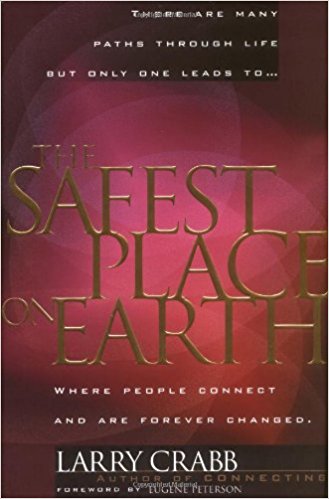
Book Review: The Safest Place on Earth

Safest Place on Earth - Crabb.jpg

Larry Crabb, The Safest Place on Earth: Where People Connect and Are Forever Changed (Nashville, TN: W Publishing, 1999), Hardback, 240 pages.

Dr. Larry Crabb is an established licensed psychologist, a well-known Christian author on marriage and biblical counseling topics, and current Distinguished Scholar in Residence at the Colorado Christian University (Morrison, CO).[1] 

Dr. Crabb earned his Ph.D in Clinical Psychology from the University of Illinois, and has been a professor of psychology since 1970. Dr. Crabb also provides workshops and weekend seminars across the United States as part of his non-profit New Way Ministries and its web presence which features interviews, video lectures, and other multimedia outlets to share resources from his School of Spiritual Direction.

Dr. Crabb has been involved in counseling and marriage, in self-help ministry, and in developing a context of “spiritual community” for over 40 years, and so has earned a place among the various “Christian voices” seeking to make the church a better place.

In 1999, Dr. Crabb released a significant but brief volume on the church as a safe spiritual community. The volume is entitled, The Safest Place on Earth: Where People Connect and Are Forever Changed (238 pages).[2] Dr. Crabb has registered his own frustration with two elements which bear upon the community of the church and its spiritual health, which he further addresses in Real Church: Does it Exist? Can I Find It? (Nashville, TN: Nelson, 2009).

In The Safest Place on Earth, however, Dr. Crabb establishes a vision for the church as a group of believers on a journey towards God, and it is within the journey that spiritual community must begin and end for spiritual healing and direction. Despite Dr. Crabb’s own training in psychology, he believes when it comes to the soul care that ought to go on within the church, such assistance must yield “to special revelation and biblically dependent thinking.”[3] Dr. Crabb is adamant,

We don’t need more churches, as we usually define the word. We need more spiritual communities where good friends and wise people turn their chairs toward each other and talk well.[4]

Structurally, The Safest Place on Earth is organized in seventeen chapters, divided into three parts, and finishes with a section of questions for each chapter. The layout follows a very clear program of development, and the content is written in a popular style. Dr. Crabb is able to articulate and shape a conceptual paradigm of what is a spiritual community and what is not a spiritual community without complex vocabulary. His illustrations, personal anecdotes, and insights from personal interactions are delivered to support his vision for a spiritual community is very clear and helpful ways.

Dr. Crabb also interacts with and depends upon the works of Dutch Catholic priest Henri Nouwen[5] (1932-1996), who focused on spiritual solitude, spiritual community, and spiritual compassion, along with Swiss Catholic philosopher Jean Vanier (b. 1928) and his work connected to L’Arche communities which have overlapping concerns.[6]

A Book Summary

In part one, Dr. Crabb develops and sharpens the idea of spiritual community and how the church needs to develop sensitivity to being the spiritual community it was intended to be. Spiritual community is, according to Crabb, at the core of what the church is.

It is people facing each other in intimate, honest, and safe ways as they journey together on their way to God. Spiritual community, however, will not occur if there is no opportunity for vulnerability and a full sense of validation from these that witness the vulnerable parts of who we are.

One of the difficulties in church community life is to wrestle with the crux,

if they knew who I really was, the church would probably not like me.

To be a spiritual community, then, we must be able to love free from ego and embrace those so broken by those things which burden our souls and even cripple us.

The health metric of a spiritual community is its ability to love the unlovable, the broken, those that can only let you love them in their brokenness.

In part two, Dr. Crabb reframes the New Testament discussion of flesh and spirit elements of our soul in terms of the analogies of the Lower Room (carnal/wretchedness) and the Upper Room (spiritual/greatness).

It is in this phase of the book that Dr. Crabb focuses on the part of the church community that needs to be addressed first — our internal struggles to be spiritual. Enter Dr. Crabb’s “two rooms” analogy which he builds from the words of Jesus:

If anyone loves me, he will keep my word, and my Father will love him, and we will come to him and make our home with him. (John 14:23)

And he amplifies these words with Paul’s regarding “Christ in you” (Colossians 1:27).[7]

In essence, the two rooms represent fully furnished environments that exist within us.

Now there are two rooms inside us, the one we built where our natural self thrives, and the one the Spirit built where our natural self suffocates and our new self flourishes.[8] 

Dr. Crabb does not explicitly use all the terms, but these “rooms” parallel the Freudian id, ego, and superego dynamics, the difference being they are spiritualized.[9] The lower room is self-furnished by our wretchedness and “dark forces” with its corruption and stench (id). The upper room is furnished by the Spirit of God only enjoyed once we open the doors of the lower room, acknowledge its stench, and celebrate the confidence to be a new us (an obedient us) empowered by God’s grace and teaching (superego?).

Finally, we consciously (ego?) take these “two rooms” within us and the internal struggles that go with them —because we prefer to be in the lower room— to receive outside help from “another room” which is the spiritual community, the church. This room is furnished by the Spirit with safety, vision, wisdom, and power.

In part three, Dr. Crabb continues his visioning for spiritual community with another analogy of “turning our chairs toward each other” but now by “turning our souls toward each other.”

In this process, the members of the church community must practice three needed things. First, spiritual community can only be done by the Holy Spirit. Second, personal holiness grounded in the Spirit influences the pursuit of personal holiness of others. Third, there must then be a safe place to “own and trace our desires to their source.”[10] 

Spiritual community, however, will only occur when spiritual passions are “supernaturally” aroused when we are together in spiritual community experiencing acceptance, mutual faith in God’s presence in our lives, affirm the “upper room” elements in our lives, and allow God to change us without applying human pressures of forced change.

It is certainly a place of risk, but risk will always be a factor when embracing the need for vulnerability. Therefore, the real question is: will we, the church, be the safe place for those being vulnerable?

Response and Review

I chose this book principally because of the title. In fact, I had seen this title on the cover of the September/October 2001 New Wineskin magazine as part of the issue theme of “Authentic Christian Community.”[11] The concept peaked my interest because I do feel the church has not been the safest place on Earth in managing people’s sin. One example will suffice. I once heard a preacher react to the exposed sins of others with the derogatory question, “where are the normal people?” That’s not a safe place for healing. Nor is the following response to a fellow congregant’s addiction any safer, “there’s a word they need to learn – repent.”

Rebuking sin is the easy work of preaching, but creating a compassionate environment to help brothers and sisters work through repentance is the harder – and in my judgment – more fruitful work of ministry.

Crabb’s book further calls the church to be the community through which Christians experience spiritual healing for spiritual problems often mistreated —according to Dr. Crabb—as psychological disorders or problems. The gospel and the New Testament teaching that the church is the dwelling place of God, and Christians are the temple of the Holy Spirit, seem to support the overall agenda that the culture of the local congregation should be more attuned to openly working through sin, temptations, and openly celebrating grace, and spiritual empowerment by God. Even Paul declares that the church is being recreated (2 Corinthians 5:17) and repurposed for ministry (Ephesians 2:10).

Dr. Crabb’s book both intrigued me and made me uncomfortable in that he elevates the spiritual components of the church where the Holy Spirit dwells. Again, it is not that I’m troubled by the Holy Spirit, it is that in many pockets of the Churches of Christ the Holy Spirit and the use of “community” have been so tinged with so-called “liberal agendas” in the latter, and doctrinal controversial hotbeds regarding the former. His emphasis that the church is specifically designed to be a spiritual community and therefore it must be that spiritual community on a journey to God is what stands out the most to me. If we are not a spiritual community, then there will not be the Spirit.

I do not agree with all of his points on the “wretchedness” of man, but Dr. Crabb has challenged me to speak more about the Spirit and the church as the community in which God does His best work to heal us from the effects of sin.

Concluding Thoughts

What I liked overall about the book is the Dr. Crabb’s challenging call to the church to be a safe place for the sort of healing love that needs to exists between God’s people, so that the Spirit of God may work through the church to heal its members as they bear each other’s burdens with the gifts of the Spirit (Galatians 5:22-26). The church must be so, because, as Dr. Crabb reminds us, we are traveling together on a journey to God.

I recommend the challenge of this book to every Christian and church leader. The reminder that Scripture centers the body of Christ as the place where the Spirit dwells, and therefore must be the safe place where the members of the body can serve each other empowered by the same Spirit. To overcome sin, the church must be, and in some cases become, the place where no one struggles with sin void of love, compassion, support, and patience as we journey to God breaking free from the bondage of sin.

Endnotes

  1. “About Larry Crabb,” http://www.newwayministries.org/larrycrabb.php.
  2. Full details: Larry Crabb, The Safest Place on Earth: Where People Connect and Are Forever Changed (Nashville, TN: W Publishing, 1999).
  3. Crabb, The Safest Place on Earth, 7.
  4. Crabb, The Safest Place on Earth, 10.
  5. “Henri Nouwen Society,” http://henrinouwen.org.
  6. “History of L’Arche,” https://www.larcheusa.org/who-we-are/history.
  7. Unless otherwise stated all Scripture quotations are taken from the English Standard Version of The Holy Bible (Wheaton, IL: Crossway, 2001).
  8. Crabb, The Safest Place on Earth, 62–63.
  9. Crabb, The Safest Place on Earth, 78–79.
  10. Crabb, The Safest Place on Earth, 121–30.
  11. Larry Crabb, “Is the Church the Safest Place on Earth?,” New Wineskins 5.4 (Sept/Oct 2001): 12–15.
The Public Reading of Scripture: Six Practical Suggestions

Reprinted with permission from the March 2017 issue of Gospel Advocate Magazine.

A vital element to the worship assembly of the body of Christ in the first century was the reading aloud of the Scriptures (1 Timothy 4:13; Acts 13:15). Today, it is probably hard to imagine a time when God’s word was accessible only when assembled with God’s people; it was a communal experience. The proliferation of Bibles today has truly made reading Scripture an individualized practice; yet, this has not always been so. In fact, the meaning of “church” (ekklesia; “an assembly”) presumes a people gathered to hear, to commit to, and to act upon the Word of God (Matthew 16:18; Deuteronomy 4:10-11; 31:9-13). Thus, hearing God’s Word is part of who we are as “the church” (Acts 11:26; 14:27).

The church needs to elevate the importance of the Scripture reading assignment in our assembly (Act 13:15; 2 Corinthians 3:14). There is a tendency to be too casual about this assignment. Perhaps it is because we take literacy for granted, though the capacity to read words is not the same as understanding the words being read. In this connection, we may then take for granted that anyone can read the Scripture aloud to the church. In some societies, reading is still regarded as a technical skill, much as it was in Bible times.

If reading the Scriptures will make a child of God “complete, equipped for every good work” (2 Timothy 3:17 ESV) when read for private devotion, then the same God-breathed writings read aloud will provide the same effect for the congregation. In the Scripture reading, God is speaking to His people. For this reason, the public reading of Scripture is a crucial element of the worship assembly and should not be taken casually or lightly.

A Note on the Context

In fact, Paul anchored to this very core principle when he wrote to Timothy to provide a strategy for the faithful to protect themselves from a departure from the faith, which will consist of Christians “devoting themselves to deceitful spirits and teachings of demons” (1 Timothy 4:1). The antidote against “irreverent, silly myths” (4:6-7) and any possible competitors to divine revelation is the healthy teaching from God (4:13). Public reading of Scripture inoculates against false teaching and invites faithful discipleship and commitment to God (Exodus 23:22; 24:7). It syncs us up with God.

Paul makes similar requests in other letters to the churches of the first century. When detailing the unveiling of the mystery of Christ, Paul anticipates and expects the church to share his understanding (Ephesians 3:4-6). After he writes on the supreme role of Christ in redemptive history, he expected the Colossian congregation to letter swap with Laodicea (Colossians 4:16). And, to the Thessalonians, he was quite strong when he placed “an oath before the Lord to have this letter read to all the brothers” (1 Thessalonians 5:27), for through the reading aloud of his letters they would be taught (2 Thessalonians 2:14-15). And in the final revelation of Jesus, the apocalyptic portrayal of divine victory through the gospel is framed as one that must be read aloud and safeguarded against addition and omission (Revelation 1:3; 22:16-19).

Reading Scripture aloud can bring the church into sync with God’s word. The more exposure, the better our biblical literacy; then, ideally, the healthier our churches will become. Let us switch gears, now, to provide practical suggestions for this powerful act of reading Scriptures aloud in our worship assembly.

Six Suggestions for Reading Scripture Aloud

There must be a spiritual gravitas connected to reading Scripture before the assembly. I had a mentor, Don W. Hinds, that would stop me when I misread a passage aloud. He would use the adage, “take heed how you read,” to instill in me the importance of properly reading the biblical text aloud. I would like to use this as a refrain as we consider some practical guideposts for reading the Scriptures aloud when the church is assembled for worship — although these suggestions can be applied in various settings of church life.

Furthermore, in many congregations, those who manage or arrange the various elements of the worship assembly (deacons, elders, etc) should seriously consider the points below as they select public readers of Scripture. We are worshipping God and engaging in spiritual and divine matters, we are not merely filling a roster. God’s word must be the centerpiece of our worship.

First, the reading should be met with a respect for proper pronunciation and performance. This is the “oral” spiritual heritage of God’s people, to hear and understand God’s word (Nehemiah 8:1-8). Not only should one practice to read clearly and distinctly, but some types of Scripture (genre) require an element of performance (cf. Psalms). For example, we should not read a psalm of lament (Psalms 51) as if it were a genealogy. Take heed how you read.

Second, we should consider the verbal skill set of those who will read before the assembly. The goal is to instill an understanding of God and to invite the church to obedience. There is no verse that prohibits individuals with speech problems from publicly reading Scripture. We should both be sensitive and inclusive. Fortunately, audio technology facilitates what requires loud speaking in other settings. Still, as long as the public reading reaches its goal then it has accomplished its purpose. Take heed who will read.

Third, the reading selection should be long enough to understand the message. This is especially true when the selection is independent from the sermon. Some congregations may design their readings to go through a book (Psalms) or a large section of Scripture (Major Prophets). Other times, they are connected to the sermon. The readings must be of sufficient length to provide context and understanding and should have a natural and intended connection to the worship service. All things being equal, we may ask, “why read from the Song of Solomon when the sermon is on the ‘second death’ of Revelation?” Take heed what you read.

Fourth, the readings must be the Scriptures free from alteration. From time to time some like to add a few impromptu thoughts in connection with the reading of the Scripture. The points may be very excellent, but they run the risk to be of another variety. It is important to keep to the task at hand, which is to read the assigned portion of Scripture. There are many reasons for this. The most significant reason is to elevate the word of God over the words of men. As Revelation 22:18-19 warns, the text must be read without omission and addition. Take heed that you read.

Fifth, the reading of Scripture must be purposeful. There should be communication before hand to prepare those who will read aloud in worship. Sometimes we can displace others when we lean upon “good readers” in a pinch. With a purposeful schedule, we can give enough notice so that our readers can prepare, become familiar with the text, and develop a comfort level. Preparation and practice are the best helps to reduce “stage fright.” Take heed before you read.

Sixth, the reader should not cause a distraction by what they wear. It is true that God seeks and looks at the heart (1 Samuel 16:7; Matthew 15:8), but one should dress for the spiritual occasion (Matthew 22:11-14). While attire may sometimes be a distraction, it is more important that the reader’s lifestyle should not be a distraction. If those who pray in assembly should have “holy hands” (1 Timothy 2:8), what of those who read Scripture. Paul told Timothy that he should be an example; this would make an additional influence when he would read aloud the Scriptures to the church (1 Timothy 4:12). Take heed by whom you read.

Concluding Thoughts

The public reading of Scripture was an essential component of the first-century worship assembly. If in today’s time, the church seeks to be in conformity with the early worship practices of the New Testament church, then it will seek to incorporate this practice and develop those who will read. Moreover, the church will grow when she integrates the three-fold instruction given to Timothy: the public reading of Scripture, the exhortation, and the teaching (1 Timothy 4:13). In a day and time when so many church groups are seeking new and innovative methods to “enhance” worship, the age-tested and inspired method to read aloud God’s word must be in the forefront of our worship assemblies. Blessings to the reader, and blessings to the hearer.

Jovan Payes preaches for the Highland Church of Christ in Bakersfield, Calif.

To subscribe to Gospel Advocate, click here.


Church: A Preliminary Survey

With so many “churches” in the religious world, people interested in visiting one are often sidelined by the inevitable question, “which church should I go to?” After all, there are as many “churches” as there are potential opinions on what a church should be like. But where should a person begin as they search for a church, should they simply jump out on a whim? Hardly.

Searching for a church should be a reverent endeavor, especially since in the New Testament the “church” is said to have been “purchased” by the very blood of Jesus Christ (Acts 20.28). Consequently, if the church was that important to Jesus and the Father, those seeking to “go to church” should realize this spiritual venture should not be taken lightly.

Where then might a person find the necessary perspective from which to begin this search? The relevant information is found in the New Testament documents, the documents which record the formative forces which began the church in the first place; moreover, the New Testament provides ample information about how people became members of the blood-bought church of Jesus, along with important church organizational references.

This piece is a primer, in a sense, on the nature of the church. There are many ways that this topic can be addressed. But, nevertheless, below are some relevant points to glean from the New Testament on the topic of the church of Christ (Rom. 16.16).

The New Testament Documents

In the New Testament, from the beginning to end, the thought and actual fact that the saved existed as a collective known as the “church” or body of Christ is clearly self-evident (Matt 16:18 and Eph 1:22, 23, 4:4; Acts 2:47). Consider a sample of the New Testament documents.

There are four accounts of the ministry of Jesus, they are called Gospels. The term “church” is found only in the Gospel of Matthew, particularly in chapters 16 and 18. In chapter 16, Jesus speaks of building His church – “my church” (16:18). He explains that death (Grk. hades – not hell, contra KJV) will be incapable of deterring his plans to bring His church into reality.[1] In chapter 18, verses 15-17 describe the disciplinarian process regarding a Christian brother living in sin, and hence, needing private correction. The final stage is to bring the sin to the public forum by telling it to the church, with the intention that it can act as a loving measure of leverage to pressure the brother to quit the sinful practice. Thus, in Matthew Jesus speaks of his church in two ways: (1) that it will be built (Matt 16:18), and (2) as the ultimate forum for maintaining moral purity among God’s people (Matt 18:15-17).

The Acts of the Apostles is the inspired historical account of the church – albeit a history with a theological focus. It is most definitely a primary source for the church, and therefore a logical document to examine in order to find the biblical church. To save space, consider what we find in only the first half of Acts (Acts 1-12). We find it was “the church”[2] that had become fearful after the Divine retribution against Ananias and Sapphira was administered by the Lord (Acts 5:11); the object of Saul of Tarsus’ brutal obsession was “the church” anywhere it assembled (Acts 8:1, 3; cf. Gal 1:13); it was “the church” at large in Samaria and Judea that enjoyed peace when the persecuting Saul became the believing Paul (Acts 9.31).

We find Barnabas and Paul (Saul) laboring in “the church,” particularly in Antioch of Syria,[3] and labeling the disciples (i.e. the individual members of the church) Christians (Acts 11:22, 26); several members of “the church” suffered persecution under the hand of King Herod (Acts 12:1, 5); “the church” in Antioch of Pisidia had prophets and inspired teachers, and sent Paul and Barnabas out to accomplish their first missionary call (Acts 13:1ff.); Paul and Barnabas had appointed elders in every “church” they established on their missionary labors (Acts 14:23), and upon their return to Antioch they recounted they travel to “the church” (Acts 14:27).

The largest sub-category of the New Testament documents is The Letter (also commonly styled, “epistle”) – 21 letters to be exact.[4] They are further divided by the prophets which God employed to pen them: Paul (13 letters), John (3), Peter (2), James (1), Jude (1), and the unknown author of the Letter to the Hebrews. This is a vast amount of literature to scan, but we can reflect on the following citations of “the church” among the letters and observe that “the church” is the redeemed body of Jesus believers. It goes without saying – at least it should be by students – that the New Testament Letters assume their audience is the redeemed body of Jesus disciples.

Ancient letter writing etiquette had the author’s name first and then the recipient’s name; thus, we read, “from me… to you.” When Paul wrote his letters, he often addressed the recipients with the nomenclature “saints” (cf. Rom 1:7; 1 Cor 1:2; 2 Cor 1:1; Eph 1:1; Phil 1:1; Col 1:2). The term “saint” is the general description of all members of “the church” in the respect that they have been sanctified in baptism, and this sanctification continues in obedience shown by a holy life (Matt 26:28; Acts 2:38; 1 Cor 6:11-13; 1 John 1:6-7). The “saints” are members of the church viewed from the perspective of consecration. In fact, many times the letters begin like this: to the church with the saints.

Some appear to use Jewish terminology, like James and Peter, to describe the people of God. The letter of James is written to “the twelve tribes in the Dispersion” (1:1); meanwhile, the audience for the Letters of Peter (if to the same audience) is depicted in the following way: “To those who are elect exiles of the dispersion” (1 Pet 1:1). However, in Peter’s second letter, he speaks of his audience as “those who have obtained a faith of equal standing with ours by the righteousness of our God and Savior Jesus Christ” (2 Pet 1:1). It seems like the language applies the covenant aspect that biblical Israel had with God, and here it is applied in a new way to demonstrate that Peter’s audience is the new covenant people of God (Jer 31:31; Heb 8:13). These are members of the biblical church.

The Letter of Jude addresses his recipients with the nomenclature “called” and “beloved” (vs. 1). Their calling seems from the simple fact that they received their invitation (a clearer meaning of the term, kleitos translated “called”) to share the “common salvation”. Moreover, they received access to the love of God actuated in the redemption of their soul accomplished through Jesus Christ, thus, they are the beloved of God. What Jude emphasized that their identity was related to their Divine relationship through obedience to the Gospel. For our purposes, we are to understand that these “saints” and “beloved” ones are members of the New Testament church.

The First Letter of John, much like Hebrews, does not begin in the traditional letter format. Some describe them as tractates or some larger form of literary work sent as a letter. Nevertheless, John assumes a relationship – a fellowship between the apostolic circle, God, and themselves – that is based on obedient living and faithful confession of sin as they strive to live a disciplined life (1 John 1:1-10). They already are in this relationship, they are saved. Again, in Hebrews 2:1-4, the evidence is provided regarding the recipients. They are encouraged to remain vigilant, not neglecting their salvation which was shown to have a supernatural origin. Likewise, these recipients are members of the biblical church.

The last document in the New Testament is the Apocalypse, the Book of Revelation. The document opens up with these words: “John to the seven churches that are in Asia” (Rev 1:4). In the doxology, it is Jesus “who loves us and has freed us from our sins by his blood, and made us a kingdom, priests to his God and Father” (Rev 1:5-6). The audience, the churches, share salvation and the love of God, are part of a kingdom, and share involvement in the priesthood of God. The message of Revelation is the victory over the enemies of God as it is revealed in the inability of these satanic forces to prevent the faithful saints from entering the New Jerusalem, wherein lies the tree of life (Rev. 22.14). The brief but spiritually dense letters sent to the churches of Asia in Revelation 2 and 3 show among other things, the audience intended for the prophecies embedded into the fabric of this symbolic book. They assume that the recipients are already Christians, members of the church.

The picture should be clear that the New Testament is a collection of 27 books which speak to or about the church of Jesus Christ. Consequently, anyone looking for a church should reverently approach the prospect with the New Testament as the guiding source for determining what the church that God established should look like and be like.

The Church: A Brief Word Analysis

We may survey some of the information from the New Testament regarding the “church” and the redeemed which make up the “church”, but what does “church” mean? The term “church” is the most common, though unclear, translation for the New Testament Greek term ekklesia. Often times, “church” is thought of as solely “the building” in which a person congregates with others to worship God; however, ekklesia does not refer to a building – hence, “church” is an unclear translation if not misleading altogether. But the term is so commonplace that it need not be shelved; after all, even modern dictionaries have various nuances for the word “church.”

The English word “church” has a peculiar history that demands some attention. Hugo McCord (1911-2004) – professor, translator, and preacher – briefly summarizes the history of the word:

Historically, the English word “church” comes from the Middle English “cherche” or “chirche,” which is from the Anglo-Saxon “circe” or “cyrce,” which is from the German “Kirche,” which is from the Greek kuriakos, meaning “belonging to the Lord.” Webster says that the Greek word doma, “house,” has to be added to kuriakos to make the word “church,” that is, a “church” is “the Lord’s house.”[5]

McCord further observes that only twice does kuriakos – “the Lord’s” – appear in the New Testament (“the Lord’s supper” 1 Cor. 11.20; “the Lord’s day” Rev. 1.10), but in neither case is the phrase “the Lord’s house” ever employed.[6]

Basically, the etymology of the word translated “church” (ekklesia) derives itself from the adjoining of two words, ek and kaleo (ek-kaleo “call out”), into one verb originally “used for the summons to an army to assemble.” As a noun, ekklesia, denoted “the popular assembly of the full citizens of the polis, or Greek city state” (cf. Acts 19:32, 41).[7] This is, in a nutshell, the Greek background of the word beneath our religious word “church.”

Its existence in the Old Testament is due to the Greek translation of the Hebrew Scriptures. In the Septuagint (abbreviated LXX), ekklesia appears about one hundred times and is frequently employed to translate the Hebrew term qahal.[8] It is not so much the frequency to translate qahal which is intriguing; instead, it is the regularity of the context when ekklesia is employed which should attract contemplation. O’Brien writes:

Of particular significance are those instances of ekklesia (rendering qahal) which denote the congregation of Israel when it assembled to hear the Word of God on Mt. Sinai, or later on Mt. Zion where all Israel was required to assemble three times a year.[9]

Interestingly, the Hebrew writer similarly speaks of the redeemed in Hebrews 12:22-24. Thus, a raw translation of ekklesia may suggest the meaning to be, “the called out ones.”[10] In the biblical tradition, however, it seems better to emphasize that it carries the spiritual depiction of an assembly of God’s people prepared to hear and be led by His word in the covenantal sense.

Stephen, the first Christian martyr, recounts how Israel was an ekklesia during the forty years of wandering in the wilderness due to their rebellion and lack of faith (Acts 7:38). And it was during this time that they were taught how to depend upon the Lord. The beautiful and yet tragic relationship between the faithful God and his unbelieving nation is set forth clearly in Psalm 78 (cf. Hos 11:1-9). The Lord’s goal was to “shepherd” and “guide” them with his powerful word and through the demonstration of his presence.

With regards to the Lord’s church which Jesus promised to “build,” it is important that we consider these thoughts in our understanding of the kind of church Jesus was thinking of; as a consequence, it should guide our assessment of how “church” should behave. Individuals gathered together to hear and abide in his teaching, so that in it, they may be shepherded and guided (1 Tim 4:13). Meanwhile, leadership in the church (i.e. elders/shepherds) is to be “able to teach” and “manage” his household, and use these skills as he executes his God’s appointed office (Acts 20:28, 1 Tim 3:1-5). When the church considers this relationship and responsibility and embraces its challenge, we will be taking strong steps to finding a congregation of the Lord – a church of Christ.

Conclusion

We find in the New Testament a consciousness the early Christians held regarding the church. Jesus was to build his church, and after his death, the church began in Jerusalem and spread throughout the Roman world through Judea, Samaria, and to the furthermost extents of known Roman world (Acts 1.8ff). As the church expanded, the apostles and other inspired authors wrote to Christians regarding the ministry of Jesus and concerning Christian living.

Through these documents, important information is related to the nature of the church. Anyone searching for a “church” to attend should not settle for any church but should study the New Testament reverently identifying the nature of the church revealed in its pages.

When examining the English word “church” we find that we are not talking about a building, but instead, the emphasis should be placed upon an assembly of people. These individuals are assembled to hear the word of God, and make those Divine words translate into everyday action – everyday living. Only until we hear and practice the Word will we become the church (ekklesia) of Christ.

Endnotes

  1. The King James Version (a.k.a. the A.V.) is quite misleading here, for the Greek text reads pulai hadou – literally, “the gates of hades.” The Analytical-Literal Translation of the New Testament (ALT) has the following descriptive rendering of the passage,”[the] gates of the realm of the dead [Gr., hades] will not prevail against it” (ATL Matt. 16.18).
  2. Again we disagree with the A.V./KJV-Byzantine tradition in Acts 2.47, where the word “church” (ekklesia) is part of a variant reading of the text. Instead, we agree with others who find that the ending better reads epi to auto, a phrase often used to refer to the “Christian body” in a collective sense (Acts 1.15; 2.1, 47; 1 Cor 11.20; 14.23; Bruce Metzger, A Textual Commentary on the Greek New Testament, 2d ed. [Germany: Deutsche Bibelgesellschaft, 2001], 264-65).
  3. Antioch of Syria is not to be confused with the Antioch of Pisidia in Asia Minor. BiblePlaces.com has good images of both Antioch of Syria (link) and of Pisidia (Link).
  4. Technically, there are a few more letters in the New Testament record, but each is embedded in other books. For example, the book of Acts has two letters (a) 15.22-29, and (b) 23.23-30; and, the book of Revelation has seven letters to the church of Asia (Rev. 1-3).
  5. Hugo McCord, The Everlasting Gospel: Plus Genesis, Psalms, and Proverbs, 4th ed. (Henderson, TN: Freed-Hardeman University, 2000), 696. This edition is known also as FHV4.
  6. McCord, The Everlasting Gospel, 696.
  7. Peter T. O’Brien, “Church,” DPHL, 123.
  8. O’Brien, “Church,” 124; TDNT 3:527; BDAG, 303.
  9. O’Brien, “Church,” 124.
  10. Etymologically, ekklesia does suggest that individuals were “called out” from their lifestyles by the Gospel (2 Thess 2:14). There is obviously a separation that occurs (2 Cor 6:17, 1 John 2:15-17). These etymological considerations corroborate with New Testament teaching on the church. However, the word has a richer heritage as is seen in its Old Testament use of the Greek language. These aspects must be appreciated in balance with each other.

Suggested Reading

  1. Wayne Jackson, “The Origin of Christianity,” ChristianCourier.com.
  2. Wayne Jackson, “The Restoration of First-Century Christianity,” ChristianCourier.com.