Changed to Serve, Living in Hope (1 Thess 1:9–10)

Christians must always be reminded of their responsibility to live out lives reflective of the high calling of God (Eph 4:1; Phil 3:14). There is a tremendous passage in 1 Thessalonians 1:9–10, which provides the Christian with the basic aspects of Christian living. Here is the passage:

For they themselves report concerning us the kind of reception we had among you, and how you turned to God from idols to serve the living and true God, and to wait for his Son from heaven, whom he raised from the dead, Jesus who delivers us from the wrath to come. (1 Thessalonians 1:9–10 English Standard Version)

Let us examine this passage, and reflect on the four aspects of this passage: (1) reception of the word, (2) conversion, (3) consecrated service and (4) hope of deliverance.

I hope to invite modern Christians to reflect on the importance of turning to God in conversion, to living a sanctified life in anticipation of the final day when Jesus comes again.

The Background

First, let us consider some background information.

After leaving the city of Philippi, Paul and Silas traveled probably on horseback some 100 miles on the Egnatian Way through Amphipolis and Apollonia only to pause their trip in Thessalonica.[1] It is highly likely this was a three-staged trek to Thessalonica: Philippi to Amphipolis (30 mi.), Amphipolis to Apollonia (27 mi.), and Apollonia to Thessalonica (35 mi.).[2] Situated on the Egnatian Way, ancient Thessalonica was at the heart of Roman travel, communication, and culture in Macedonia. So much so, that William Barclay succinctly said, “East and West converged on Thessalonica.”[3]

The Book of Acts chronicles Paul’s initial evangelistic efforts in that great city (Acts 17:1–9), as he enters the synagogue and presents various elements of the gospel message as found in the prophetic writing of the Old Testament. In fact, in Acts 17:2, Luke says Paul spent three weeks “reasoning” with the Jews on the Sabbath, the word suggesting a rigorous discussion or possibly hints at a debate style of presentation (Grk. dialegomai).

Unfortunately, in this case, Luke does not inform us which scriptures Paul uses to build his case (cf. 1 Thess 1:10; 1 Cor 15:3–5; Isa 53:2–8; Psa 22:1, 16:10; Acts 2:31). He only affirms that the suffering, death, and resurrection of Jesus of Nazareth is the embodiment of these prophetic utterings which adherents of the synagogue would have been familiar.

Luke observes the response of those that believed:

some of them were persuaded and joined Paul and Silas, as did a great many of the devout Greeks and not a few of the leading women. (Acts 17:4)

Unfortunately, a number of Jews responded to the missionaries with political manipulation and leveraging. These Jews, operating out of jealousy, enlisted the worst of society and orchestrated a riot, and attacked and arrested Jason who was hosting Paul and his company (Acts 17:5–6).

When presenting their case against Jason and the Christians, this mob describes them with politically subversive language. They are those “who have turned the world upside down” (Acts 17:6), “they are all acting against the decrees of Caesar” (Acts 17:7a), and “they are all… saying that there is another king, Jesus” (Acts 17:7b). Due to this charge, Jason is released to Paul and Silas on the conditions of payment of bail (“security”) and their departure (Acts 17:8–9). Paul later describes this as being “torn away” from them (1 Thess 2:17).

Reception of the Word

Sometime after leaving Thessalonica, Paul was restless and sent Timothy to Thessalonica for a report. Timothy returns with an encouraging report of their faithfulness (1 Thess 3:6). This faithfulness began when they believed Paul’s preaching in the synagogue (Acts 17:4). Luke notes that some Jews, and many devout Greeks (likely God-fearers) and leading women were “persuaded and joined Paul and Silas.” These are passive verbs, suggesting the work of the Spirit’s word compelled those with honest hearts to identify with the gospel proclaimers.

When Paul wrote to this young church, he recalls this moment. In fact, he frames their conversion as an example of the success of the gospel message received as God’s word:

And we also thank God constantly for this, that when you received the word of God, which you heard from us, you accepted it not as the word of men but as what it really is, the word of God, which is at work in you believers. (1 Thessalonians 2:13)

The “makings” of a Christian begin when the gospel is heard not as just another philosophy, or religious message. Instead, as Paul recalls, before one becomes a Christian it is imperative that the preaching is regarded as the very word of God. This is the foundation; if this is not believed spiritual failure is surely looming in the distance.

Conversion: Turned from Idols

The actual verb “turned” in 1 Thessalonians 1:9 (Grk. epistrépho) carries the idea of turning around and directing this move towards a new object or a person. In Acts, the noun is used for conversion to God (Grk. epistrephe). Together with its more common verb “to turn” they appear a total of twelve times in the Book of Acts (3:19; 9:35, 40; 11:21; 14:15; 15:3 [noun], 19, 36; 16:18; 26:18, 20; 28:27). Except for three instances (9:40, 15:36, and 16:18), the terms are exclusively used with reference to people turning to God in response to the Gospel.

Paul celebrates that as a result of accepting the word of God as authoritative and believing the gospel message, the Thessalonians turned to God after a life of serving “idols” (1 Thess 1:9). While Luke plants the conversion of the Thessalonians to those connected to the synagogue, in his letter Paul emphasizes a defection from the pagan background of the Greco-Roman converts.

This likely points to their lack of participation in the cults of their clans and tribes, temple, city, and “states” gods, which would have created a wedge between them and their neighbors. Albert Bell, Jr., notes that “the more gods a city worshiped, the better its chances of divine favor.”[4] It is known, for example, the people of Thessalonica worshipped Zeus, Asclepius, Aphrodite, and Demeter, and even the Egyptian gods Serapis and Isis. They were also given to the Samothrace cult of Cabrius.[5]

According to the Greco-Roman cultic mindset, Christians turning from the gods was not only difficult to understand but also came off as unpatriotic to the state. In their mind, it would not only have been subversive to the Spirit of Roma (Rome worshipped) and even the deified Caesar but also this behavior would have been seen as inviting divine disfavor (1 Thess 2:14). Paul celebrated their choice in doing this.

Children of God must remember their conversion was a choice. W. E. Vine insightfully comments on this conversion:

[It was] an immediate and decisive change, consequent upon a deliberate choice; a conversion is a voluntary act in response to the presentation of truth.[6] 

They chose to leave their sins behind; they did not take them along in their new life as God’s people.

Consecrated Service

Again, the Thessalonians did not bring their old life with them. Instead, they were changed “to serve the living and true God.” In fact, Paul later writes to them that “God has not called us for impurity, but in holiness” (1 Thess 4:7). Service to God is expressed in the rejection of “the passions” of the past which reflects a rejection and of God (1 Thess 4:5).

Christian service is a demonstration that the things which were important and governed the fundamentals of our pre-Christian lives no longer function in this way. Christians are not to lean upon their past; instead, they are called to “stand fast in the Lord” (1 Thess 3:8).

In other words, Christians are to live lives devoted to serving God over our own ambitions. This is the “how to” of our service to God, to accept God sanctifying his people. Notice this emphasis on a consecrated and holy life:

For you know how, like a father with his children, we exhorted each one of you and encouraged you and charged you to walk in a manner worthy of God, who calls you into his own kingdom and glory. (1 Thessalonians 2:11–12)

Now may our God and Father himself, and our Lord Jesus, direct our way to you, and may the Lord make you increase and abound in love for one another and for all, as we do for you, so that he may establish your hearts blameless in holiness before our God and Father, at the coming of our Lord Jesus with all his saints. (1Thessalonians 3:11–13)

For you know what instructions we gave you through the Lord Jesus. For this is the will of God, your sanctification: that you abstain from sexual immorality...  For God has not called us for impurity, but in holiness. (1 Thessalonians 4:2–3, 7)

Now may the God of peace himself sanctify you completely, and may your whole spirit and soul and body be kept blameless at the coming of our Lord Jesus Christ. (1 Thessalonians 5:23)

As a result of being converted, Christians are washed, consecrated, and remade for righteous service (1 Cor 6:9–11; Eph 2:10). Contemporary Christians need to take this message of consecration to heart.

Hope of Deliverance

Christians live in the present with a living hope which anticipates the second coming of Jesus. Paul is very clear when he affirms that there is a future point of hope and deliverance for which Christians wait for (1 Thess 1:10).

For they themselves report concerning us the kind of reception we had among you, and how you turned to God from idols to serve the living and true God, and to wait for his Son from heaven, whom he raised from the dead, Jesus who delivers us from the wrath to come. (1 Thessalonians 1:9–10)

Christians anticipate the Son to come “from heaven.” This last line is heavily loaded with theological truth. The Son is further described as the one God “raised from the dead, Jesus who delivers us from the wrath to come.” This is a statement of hope. The hope of the advent of Jesus (i.e., the second coming) is directly linked to God’s power demonstrated in the resurrection of Jesus. That God raised Jesus from the dead makes the claim that Jesus is returning from heaven a firm expectation.

With the certainty of the second coming of the Son “out from the heavens” (literal rendering of the Greek) established in the Christian mind, it affirmed that the Son, Jesus, will come with judgment for the unbelieving world (i.e., “the wrath to come”) but deliverance for the believer. Paul calls this “the day of the Lord,” a period of judgment and final consummation of God’s plan (1 Thess 4:13–5:11; 2 Thess 1:5–12).

Final Words

The gospel found fertile soils in the heart of early Thessalonian Christians. The congregation had a culturally and religiously diverse background, but they accepted the gospel as the word of God. Their faith in the God who raised Jesus from the dead was also at work as they followed their call to holy living as they anticipate Jesus coming to judge the living and the dead, and delivering those who are his.

Sources

  1. J. Carl Laney, Concise Bible Atlas (Peabody, MA: Hendrickson, 1998), 229.
  2. Colin J. Hemer, The Book of Acts in the Setting of Hellenistic History, ed. Conrad H. Gempf (Winona Lake, IN: Eisenbrauns, 1990), “The mention of Amphipolis and of Apollonia should probably be taken to imply that these were the places where the travellers [sic] spent successive nights, dividing the journey to Thessalonica into three stages of about 30, 27 and 35 miles” (115).
  3. William Barclay, The Letters to the Philippians, Colossians and Thessalonians, revised edition (Louisville, KY: Westminster, 1975), 180.
  4. Albert A. Bell, Jr., Exploring the New Testament World (Nashville, TN: Nelson, 1998), 126.
  5. Nijay K. Gupta, 1-2 Thessalonians: A New Covenant Commentary, New Covenant Commentary Series, eds. Michael F. Bird and Craig Keener (Eugene, OR: Cascade Books, 2016), 4. Russell Morton, “Samothrace” in Lexham Bible Dictionary, Logos electronic edition, ed. John D. Berry, et al. (Bellingham, WA: Lexham, 2016).
  6. W. E. Vine, Merrill F. Unger, and William White, Jr., Vine’s Complete Expository Dictionary of Old and New Testament Words (Nashville, TN: Nelson, 1984), 2:647.

Lecture: Conversion of a Gang Member

1

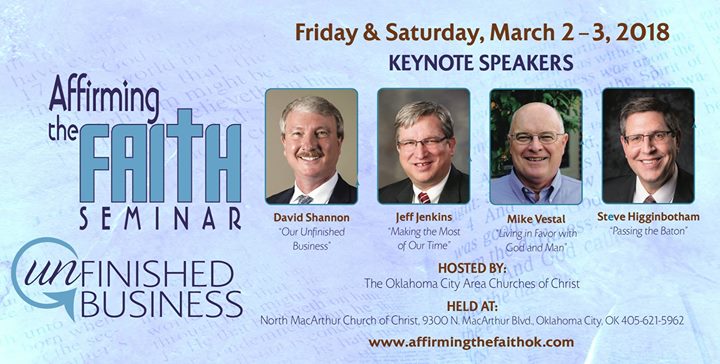
“Conversion of a Gang Member” was a part of the Conversion Series for the 11th annual Affirming the Faith Seminar held at the North MacArthur church of Christ (Oklahoma City, OK). The 2018 theme was Unfinished Business.

ATF 2018.jpg

Lecture Audio

Lesson Summary

The conversion to Christ by a gang member comes with its own challenges culturally, spiritually, socially, and developmentally. The stark contrast between the evils and perils of the world from the lives of long-time church-goers is often hard to quantify and hard to appreciate. We need a cooperative learning model that gives the church insight to enter and help their communities and provides a “training in righteousness” mentorship for the new covert.

The Lecture Presentation Slides

Notes

  • Related reading: Jovan Payes, “Leaving a Street Gang for Christ,” Gospel Advocate (April 2015).
  • “Lessons and Suggestions…”
    • I was able, for the most part, to blend and weave “lessons and suggestions” throughout the lecture.
    • Let me add a few Lessons
      • Even when we do not understand “where” our new converts are coming from socially and culturally, we can love them and plug them into the culture of the church. What we do not understand about them should not hinder us from incorporating them.
      • Shaming converts because they are urban, ethnic, or from a broken home will never do. The world no longer has the old “normal” standards or expectations. We need to be flexible with our expectations of what people know, how they think and relate, and where their pains exist – for not all scars are skin deep, some go to the soul. We do not need to add to their trauma. There are no “normal” people, there are only people.
      • In our excitement to celebrate people’s conversions to Christ, we need to be careful not to tell their story without permission. Some people are not ready emotionally to talk about where they come from, or what they’ve done in their life. Learn to embrace their new life in Christ, without forcing them to dig out their skeletons and trauma. They will do that when it is right for them to glorify God in Jesus.
    • Let me add a few Suggestions
      • We -the church- need to stop taking ourselves so seriously. We are all in need of grace and forgiveness… that includes our elderly members as well. So, we need to take Paul’s words to heart: “welcome one another as Christ has welcomed you, for the glory of God” (Romans 15:7 ESV).
      • Develop a “adopt a new Convert” program, or adopt a new convert on your own. Sometimes we wait for churches to create programs that need to happen now. Don’t wait for approval to serve… just serve. If you need permission… I permit you to serve. :) : “For whoever does the will of God, he is my brother and sister and mother” (Mark 3:35).
      • Remember the goal is to make disciples, but everyone starts at a different start line. Jesus’ words are clear, we are to not leave them to figure things out, but to develop them – give them moral and spiritual goals: “Go therefore and make disciples of all nations, baptizing them in the name of the Father and of the Son and of the Holy Spirit, teaching them to observe all that I have commanded you…” (Matthew 28:19-20).

Leaving a Street Gang for Christ

20180131_130404

Reprinted from the April 2015 issue of Gospel Advocate Magazine.

Paul writes, “Do not be conformed to this world, but be transformed by the renewal of your mind, that by testing you may discern what is the will of God, what is good and acceptable and perfect” (Romans 12:2 ESV). It has been my experience that I am often unaware of the transforming process of the gospel until I see the contrast of who I used to be and who I am now. The transformation Paul speaks of reflects a fundamental change in character, and such change does not happen except by a “renewal” of the mind over a consistent and indeterminate period of time.

My story is of one foolish soul who was transformed by the gospel. I am afraid that at times I feel that I carry the memories of another man. Nevertheless, I was what I was, and I am what I am; may God be glorified by this thorn-riddled soul only to the extent that I find closure in my weaknesses and glory in His strength (2 Corinthians 12:7-10).

Before you are the beginnings of a hoodlum who was transformed by Christ, and that hoodlum (spoiler alert) was me. This is how I tell it.

The Transformation

One day in the summer of 1996, I was sitting on a rest stop at the corner of 24th and Mission streets in San Francisco, Calif. The intersection is a major hub in the Mission District, a major Latino district. Amidst the sounds of cars and bus traffic, the commotion of people talking and shopping, and bullhorn preachers shouting aloud, I came to a personal decision that would change my life forever.

At the time, I was a member of a local gang. I used drugs and alcohol. I was a high school drop out. I tried drug dealing. I was a thief. I was violent. The picture is rather rough, and the only reason I believe it is because I still have most of the memories.

That day I just wanted to relax. I was tired of it all. I saw girls calling home informing their families that they were never coming home (prostitution). I saw children in waves seeking to join our gang because they had created enemies in their own neighborhoods. I realized that I was just exhausted by the lunacy of it all.

I found myself at a fork in the road. What I wanted was an afternoon of drinking with my friends. What happened is that I realized that I had created a life full of potential dangers that forced me to think of ways to handle them. “If I go to the park,” I was thinking, “there is a good chance that along the way I would face the potential of retaliation.” At this point, I was not afraid of dealing with the problem. It was just that I was tired of the problem.

My mind raced with other options. I could take the 14 Mission (a bus) toward downtown, headed toward Pier 39. I had spent quite a bit of time there as a younger child, breakdancing for tourists with my big “brother” Rick (technically my cousin) on Fisherman’s Wharf. That thought quickly faded with the reality that I would pass through rival neighborhoods with those who would hurt me simply because of the color of my clothes (this is gang-banger logic). Again, I just wanted to relax.

I turned my attention southward, toward Daly City, a suburb of San Francisco. The broken record continued, “I just want to relax.” The last time I was on that bus route, some friends and I were shot at. In all fairness, we instigated it; still, I felt no need to travel alone just to prove a point. So I canceled that plan. It really dawned on me how much destruction and danger surrounded me because of my choices.

I said to myself, “go home and go out tonight.” I counseled myself, “make sure no one follows you.” I have gone to people’s homes banging on their doors in order to elicit a fight, so it was not beyond the possibility that I could be followed at some point. It was a life of paranoia. It was at this point when my heart uttered the words that would change my life forever: “I just want to go to heaven.” Those words made so much sense to me.

At some point, I found a Bible under my bed. It was inexplicable. I had no idea I even possessed a Bible! I began to search and read through the Bible with the feeling that I was getting closer to God. I look back at this moment much like I do when I read the conversion story of Cornelius in Acts 10 – yet in my sins, reaching for God, searching for His words to save me.

Left: Jovan after a street fight (photo taken by SFPD). Right: Jovan during a medical mission campaign in Panama, Central America.

Many Hands

A few months later, Rick was visiting home while on leave from the Army. I didn’t know he had been baptized into Christ earlier in the year by his superior officer. He approached me in our living room with these words: “Jovan, I found the church.” I sarcastically responded, “Yeah, you found a church, great.” I was thinking in terms of the city cathedrals like St. Paul’s Catholic Church, which was down the street, or Mission Delores, or even the Cathedral of St. Mary of the Assumption. Pick a saint, we Catholics had a cathedral for them.

Rick said, “No, I found the church that you can read about in the Bible.” This intrigued me, and I asked him to tell me more. By this time, I had read most of the New Testament, and I was already trying to be “Christian.” We proceeded to talk for a few months, and a couple of days after Christmas 1996 I was convicted by the gospel. I realized I needed to follow through with my change of heart, so I was immersed in water for the remission of my sins. I was added to the redeemed (Acts 2:47).

Civic Center church of Christ (a Google Street View of the old building): Home of The College of Evangelists, the birth place of Contending for the Faith. The people who met here established the Oceanview church of Christ in Pacifica, CA.

By and by, as we say, I became a member of the Civic Center Church of Christ in San Francisco. This is where my education in the gospel would lead me to face a series of challenging events and point me down the path to prepare myself for ministry. Much like the eunuch from Ethiopia (Acts 8), I had a wonderful mentor in Donald W. Hinds. If ever I had a father in the gospel, it was him; if ever there was a troubled child in the gospel, it was me. Don received me as Christ receives us all (Romans 15:7). I am forever indebted to his influence on my life, along with his son, David Hinds; together, they planted God’s Word in my heart, watered it, and in due season it bore fruit (2 Timothy 2:2; Amos 7:14-15; Psalm 1).

The truth is, I had no aspirations of preaching. Don had another thought altogether. Don sat me down every chance he could to teach me something new – well, new to me – during our Sunday lunch break between services. From studying the Bible to inspiring me to teach the gospel to believing in me to preach the gospel, it was in a very real way a tangible experience much like Paul and Timothy. Brethren, hands-on mentoring transforms young people.

One Wednesday afternoon I faced the consequences of leaving the gang life behind. I was confronted with the decision to return to the street life I had left behind. I was surrounded by my former “associates” with an ultimatum. My conviction to Christ led me to be beaten and left lying in a driveway in some small street in the Mission. I remember telling my family that I had left the gangs behind. I remember attending Wednesday night Bible study that very night, telling my friend and mentor Don, “I sowed to the flesh, and I hope I reaped its final harvest.”

My wife has also been a transformative figure in my life. On March 3, 2001, I assumed the challenge of being the head of my own household; actually, I believe Cindy Tuggle accepted the challenge of being my wife. I would love to say that I have been the best husband ever, but I can only say that I have been a better man and husband because we have overcome so much together. The reason for our success has been trusting in God’s transforming Word to take what we have made of our lives and reform it to His glory. Today after 14 years of marriage, we are blessed with three children – something I never thought possible.

Pressing Forward

I have made many mistakes along the way, so it is hard for me to speak of transformation. God’s grace continues to inspire me to renew my mind and transform. This much is certain, transformation through the gospel is possible – no matter who you are, no matter where you have been, no matter what you have done, there is a place for you in the kingdom of God. I was a knuckle-headed thug from the streets of San Francisco who became a Christian, and through the grace of God a husband, a father, a preacher, and at times a mentor. Pray for me that I may:

“know him and the power of his resurrection, and [that I] may share his sufferings, becoming like him in his death, that by any means possible I may attain the resurrection from the dead” (Philippians 3:10-11).

Jovan Payes preaches for the Highland Church of Christ in Bakersfield, Calif.

To subscribe to Gospel Advocate, click here.