For those who live according to the flesh set their minds on the things of the flesh, but those who live according to the spirit set their minds on the things of the spirit. (Romans 8:5)
Consider the bread and butter plate. It is a small plate like the saucer. The bread plate is used to put your bread on. It helps to keep your bread away from gravies, sauces, and juices the bread may absorb. As the saucer is small and important, being a foundation, the bread and butter plate is also as important.
Contemplate this plate as where we put the Bread of Life. We know that “Jesus said unto them, I am the bread of life” (John 6:35a). This plate is to be for when and where we receive the bread of life. This would especially be when we are involving ourselves in Bible study, when we are at services, worshiping God, taking the Lord’s Supper, and praying. But also in our Christian Life.
Set your minds on things that are above, not on things that are on earth. (Colossians 3:2)
This plate is to be filled with the bread of life and only the bread of life. We do not need to let thoughts or worries of other things run through our minds at the time we are observing with this Bread of Life plate. Jesus said,
“I am the living bread that came down from heaven. Whoever eats this bread will live forever” (John 6:51a).
This plate is to be set aside where we can fully concentrate, with no other activities to be thinking of. This is the plate that we should always and continually keep of high importance.
I know this can be hard because we all at times have trouble focusing when we need to. It is hard to keep the activities of our life from going through our minds. Just as it is hard to keep that bread from getting soaked up with gravy.
As we see, we need to stay focused in the different settings of worship to God as well as our Christian walk in life. Try to keep all those other things that can absorb us or pull us away from our focus on God.
For we were so utterly burdened beyond our strength that we despaired of life itself. Indeed, we felt that we had received the sentence of death. (2 Corinthians 1:8b-9 English Standard Version)
Many have heard the saying “My plate is too full” or “I have too much on my plate.” This expression comes from someone who has too much food on their plate to eat. So this expression moved from table to everyday life. This saying is said when one has too many things to handle or deal with.
Life is always full of work, chores, cleaning, cooking, errands, sleep, recreation, hobbies, eating, and of course worshiping God. It is normal for everyone to have a fair amount of activities that need to be accomplished in a day.
Many activities or jobs can be accomplished over a longer period of time. But there are times in our lives in which we can be overwhelmed with a number of jobs, obligations or circumstances that need our prompt and urgent attention. These kinds of circumstances go beyond our normal activities and can be very stressful.
Frequently we do not know what to do first when we are extremely overwhelmed with many things. At some point, we realize we cannot get everything done.
James tells us,
Count it all joy, my brothers, when you meet trials of various kinds, for you know that the testing of your faith produces steadfastness. (James 1:2-3)
Other versions use endurance or perseverance in place of steadfastness.
Yes, at times we might have some overwhelming problems that come into our life. We might have to drop our daily normal duties to take care of these important things. All in all, this will make us stronger people. These things that hit us hard will sometimes cause us pain, worry, or lack of sleep. We will continue to remember the details and we will learn from them.
Not only that, but we rejoice in our sufferings, knowing that suffering produces endurance, and endurance produces character, and character produces hope, and hope does not put us to shame, because God's love has been poured into our hearts through the Holy Spirit who has been given to us. (Romans 5:3-5)
In pursuit of my own spiritual growth (such as it is) as a man of faith, it took me a long time to figure out where my journey was supposed to find not just the goal, but the starting point and the road map for the pilgrimage. Spiritual growth is not the result of knowing where our faith calls us to, but from the arduous journey to get there.
My journey has been massively blessed. I have had mentors, mothers, fathers – at times, even grandparent – figures. They have all given me something for my journey (perhaps, sometime, I’ll write about that), but I was only walking with them on their journey. Still, I would not be where I am, spiritually, without them.
I tried education. I figured “if I could be smarter” then I could discover all of the secrets that others are keeping to themselves behind the walls of academia – the proverbial mountain top. I found the tools and methods instead to help me navigate “the strange and yet immanent” world of Scriptures. They helped me raise questions and look at God’s word from various new angles that have indeed helped me in my journey to God. Despite its benefits of making me feel closer to the text, however, it was not the “end all” solution to my spiritual needs.
My personal life experiences, training, and those mentors in my life, all pointed me back to one thing: my journey to God only makes sense when I invest in a lifestyle of discipleship that has a consequential impact on my life. This required me to take seriously the words of the Psalmists.
I needed my desire for wisdom to mirror the Psalmist’s outcry to the Lord:
Open my eyes, that I may behold wondrous things out of your law. (Psalm 119:18)[1]
In this great Psalm, David recounts the wonders of the Law of God and exalts its beauty, richness, guidance, and its loftiness as it is grounded in God’s righteousness. It begins with the words,
Blessed are those whose way is blameless, who walk in the law of the Lord! (Psalm 119:1)
One of the empowering aspects of this Psalm is not actually found in what is written, but in the very process by which we see the Psalmist’s love for living out the Word of God, the Law of the Lord. The entire Psalm flows with a powerful example of losing oneself in the world of God’s Law.
I am not at all surprised that Psalm 119 found a communal niche at the Feast of Pentecost, as Nancy deClaissé-Walford recounts:
It is recited at the Feast of Pentecost, the spring festival observed fifty days after Passover, which celebrates the giving of the torah to Moses at Sinai during the wilderness wanderings.[2]
Nancy deClaissé-Walford in The Book of Psalms (2014)
Psalm 119 called my attention to the only true path to spiritual growth: the transformative power of the world of the scriptures. Knowing God through the scriptures, however, must lead toward discipleship, toward obedience.
The Ezra Principle
The “Ezra Principle” sounds catchy and new doesn’t it. I guarantee you it is not. I have not discovered anything hidden in plain sight. In fact, the “principle” is not just one thing, but a commitment to five values of discipleship that Ezra pursued himself.
In the fifth century B.C. (c. 458 B.C.), Ezra is commissioned by the Persian King Artaxerxes I (465–424 B.C.) in his return to Jerusalem (7:1–28). It is a time of fresh opportunity to “get things right” following the seventy years of captivity in the Babylonian due to the corruptive influence of pagan idolatry.[3] In this context, Ezra had begun a process of preparation for the task before him:
Ezra had set his heart to study the Law of the LORD, and to do it and to teach his statutes and rules in Israel. (Ezra 7:10)
The grammarian in me is interested in the verbal phrases of Ezra’s commitment: (1) “set his heart,” (2) “to study the Law,” (3) “to do it,” and (4) “to teach… in Israel.” That’s powerful. You may find other ways to divide this passage, but we will separate “study” and its object, “the Law of the Lord,” into two values themselves.
This is one of those passages that made clear to me the connection between knowing God’s word and being an authentic follower of God: the connection between personal commitment to know and to do God’s word.
Knowledge and Discipleship
This observation shifted my thinking away from just being absorbed in the Word of God. Spiritual growth must embrace knowledge but that is not the entire picture. James warns us that a people of knowledge alone is useless if not insulting because knowledge (i.e., faith) is to demonstrate itself by good works (1:22-27).[4]
James weaves together the two themes of favoritism and faith in order to illustrate just how practical saving faith must be. He illustrates this by examining the relationship between the poor and the rich in the church:
If a brother or sister is poorly clothed and lacking in daily food, and one of you says to them, "Go in peace, be warmed and filled," without giving them the things needed for the body, what good is that? (Jas 2:15–16)
What good is knowing that we are all saved in Christ, so goes the argument, if we do not care for each other in this life? How does God’s communal redemption of all impact our daily interactions? James argues that knowledge (faith) should be lived out in the community of the body of Christ in consequential ways.
For that matter, think about the community where the church meets. What good are we doing if we are strong on truth, but our community has never heard or seen us live out what the gospel is all about? The good we do should move people that thank God:
In the same way, let your light shine before others, so that they may see your good works and give glory to your Father who is in heaven. (Matt 5:16)
In other words, spiritual knowledge and discipleship are inseparable.
To return to our point, knowing is only the beginning, the end is discipleship. The process from point A to point B is our journey of applying the narrative of Scripture (how God redeems humanity through Jesus Christ) to our lives so that we may be transformed by it (Rom 12:1-2). This makes the Word of God the essential guiding force behind all of our actions.
This brings us to the “main event” of this discussion: something I call the “Ezra Principle.”
(1) We Must Set Our Hearts
is one of the clearest descriptions of a targeted mindset in the OT. If the heart is not “into it” the body and life will not follow. Paul, speaking of the Macedonian’s benevolent efforts despite their deep poverty, describes the basis of their commitment: “they gave themselves first to the Lord, and then by the will of God to us” (2 Cor 8:5). Great advancements always stem from great commitments.
In the study and application of God’s Word, the commitment which begins at our spiritual core – the heart – will continue to be the driving force throughout our life of service to God (Deut 6:5, Lev 19:18).
(2) We Must Spend Time in Study.
Near the end of the apostle Paul’s life, he requested that Timothy come to be with him and bring his cloak, his books, and the parchments (2 Tim 4:13). There are many speculations about the nature of these last two items, but at the very least the books and parchments would include copies of his letters to other churches. Paul would spend the last days of his life with those volumes he penned through inspiration to those in need of strength and faith.
The point we draw from here is that Paul was a studying man. In fact, he would encourage Timothy to be well equipped in the word of God and aptly able to “divide” the Scripture clearly and carefully (2 Tim 2:15). Ezra likewise spent renewed focus on studying the Law as he found himself and Israel back in the Land of their faith. Ezra knew, as we ought to today, that in order to rebuild our lives it must be based upon God’s word.
(3) We Must Select Only God’s Word as the Object of our Study.
There are many philosophical writings and even religious “scriptures” in the world. They often have maxims, sayings, or verses with which we would agree and commend. When building a biblical worldview as for the foundation of our spiritual growth, however, the Bible is the only set of “Sacred Writings” which are able to make a person wise to obtain salvation (2 Tim 3:14-15).
One may argue that this is an arrogant statement; however, despite the fact that such “writings” may provide insight into our lives, they pale in comparison with the never surpassed guidance given in the divine books of the Bible.
When one analyzes the Bible from the vantage point of predictive prophecy, historical accuracy, scientific foreknowledge, and literary harmony of this great anthology of 66 books in contrast to such other works, the Bible stands alone.
(4) We Must Steadfastly Practice God’s Word.
It is only by the conviction that the words inscribed on the paper we read are not mere words of human beings, but are instead the very words that God himself would breathe out (1 Thess 2:13; 2 Tim 3:16–17). Jesus teaches quite clearly that our lives are to reflect this type of respect, for in our prayers we are to express the sentiment, “your will be done, on earth as it is in heaven” (Matt 6:10). The Lord declares: “to obey is better than sacrifice” (1 Sam 15:22)
(5) We Must Share both our Learning and Experiences.
In many ways, teaching is not only the sharing of facts and principles. In various instances, anecdotal interactions with God’s word can be very revealing and helpful in understanding and teaching God’s word. For example, consider all those who continue to leave the denominational world for the practice of pure New Testament Christianity.
The process of filtering out unbiblical accretions while adding to their learning and practicing the biblical faith can be a very helpful experience to teach others going through the same process. The bottom line is that God’s word was never designed to be a mental exercise to the exclusion of action and sharing; indeed, we must make “disciples” (Matt 28:19-20).
Steven Lawson, in his own words, calls attention to the advice of Walter Kaiser:
When a man preaches, he should never remove his finger from the Scriptures, Kaiser affirmed. If he is gesturing with his right hand, he should keep his left hand’s finger on the text. If he reverses hands for gesturing, then he should also reverse hands for holding his spot in the text. He should always be pointing to the Scriptures.[5]
S. J. Lawson, “The Pattern of Biblical Preaching,” Bibliotheca Sacra 158 (2001)
The advice is striking for those that proclaim the Word of God, but it is an excellent reminder to those would-be disciples interested in taking their discipleship to the next level, namely, to be teachers.
Studying is Complicated
This may seem like an aside, but it is not. I promise. We need to be very careful how we use scripture. Sometimes there are narratives regarding God’s people which seem contrary to the high moral calling which is expected of God’s leaders or people. Historical narratives need to be read with caution, as they often make their points indirectly (with no commentary). They are not always telling us something God wants us to imitate, but what God’s people have done.[6] It teaches me to be careful when seeking to “do” and “teach” God’s word.
I have often wrestled with some of the deeds of Ezra as recorded in the sacred record, particularly the covenant he seems to have initiated among the returning exiled Jews to “put away” all their foreign wives and children (cf. Ezra 10). Was this divorce en-masse commissioned by God? If one takes the view that whatever is written is positive teaching, as an authoritative command, then the text seemingly gives justification to divorce and remarriage on the count of practicing a different faith. This seems counter to the teaching of Jesus who affirms that there is only one justifiable cause for divorce and remarriage: adultery (Matt 19:1–9).
Yet, if one takes the view that each action must be taken into consideration on its own merits, then it is possible that Ezra was convicted by the significant teaching against inter-marriage with foreigners due to their influence on their spiritual corruption (Exod 34:12–16; Deut 7:1–6; Josh 23:19–23) that he overstepped its application and persuaded the men of Israel to do something not commanded of those who were already “married with children.” This would align with the fact that there is no explicit commentary nor “word from the Lord” to demand these families to be severed.
Providing an answer to this riddle is beyond the purpose of this essay. My point is in our commitment to setting the heart, studying the word, and living out the word in our individual lives, the weight of teaching is likewise an important discipline that should be taken with the heavy responsibility that comes with it.
The Lord’s brother James wrote:
Not many of you should become teachers, my brothers, for you know that we who teach will be judged with greater strictness. For we all stumble in many ways. And if anyone does not stumble in what he says, he is a perfect man, able also to bridle his whole body. (James 3:1–2)
Humility must always accompany study and teaching (Rom 2:1–11).
Final Thoughts
I am forever grateful for those who took the time to encourage me, prod me, and guide me to appreciate the special place Bible study is in the spiritual life and growth of God’s people. I would like to give a quick hat tip to them at the close of this essay.
Donald W. Hinds (1922–2008) taught me and encouraged me to read daily and widely, to be challenged by what I read, and to meditate carefully on it. His son David Hinds taught me the importance of finding the right book and the right teacher (author), in that some have so prepared themselves that if I should listen to other voices beyond the Bible, I should find such authors. I am thankful to Wayne Jackson (1961–2017), a true preacher’s preacher, who probably shaped my passion for the study of the Scriptures more so than anyone else in my early formative years through his writings in biblical studies (The Christian Courier), biblical apologetics (Apologetics Press, Inc.), and while a member of the church where he richly and profoundly proclaimed the scriptures.
Others have guided me along the way as well. Earl D. Edwards was one of my instructors in college, an elder in the church while I attended college, and a personal mentor during my early academic development. In him, I saw how the power of God’s word can so shape a man’s life with dignity, scholarship, and humility.
I wish I could say more about others, but I’ll save that for another time. These are but a few personal encounters with those who have lived out and assisted me to see that the “Ezra Principle” is not a “cute” title, but essential for the spiritual formation that comes from following God and his word. I pray that you take its challenge.
Endnotes
Unless cited otherwise, all Scripture quotations are from the English Standard Version of The Holy Bible (Wheaton, Ill: Crossway, 2016).
Nancy deClaissé-Walford, “Book Five of the Psalter: Psalms 107–150,” in The Book of Psalms, NICOT, eds. E. J. Young, R. K. Harrison, and Robert L. Hubbard Jr. (Grand Rapids, MI: Eerdmans, 2014), 870.
M. J. Boda, “Ezra,” Dictionary of the Old Testament: Historical Books (Downers Grove, IL: InterVarsity Press, 2005), 278.
Craig L. Blomberg and Mariam J. Kamell, James, ZECNT, ed. Clinton E. Arnold (Grand Rapids, MI: Zondervan, 2008), 101.
Steven J. Lawson, “The Pattern of Biblical Preaching: An Expository Study of Ezra 7:10 and Nehemiah 8:1–18,” BSac 158 (2001): 451.
I am reminded of an “authorized” campus flyer I came across advertising a community college course on “The Bible as Literature” at the City College of San Francisco. It had a picture of the Bible with a sticker label on it that read:
—- WARNING: This is a work of fiction. Do not interpret literally.
CONTENT ADVISORY: Contains verses descriptive of or advocating suicide, incest, bestiality, sadomasochism, rape, murder, morbid violence, use of drugs or alcohol, homosexuality, criminal activity, human rights violations, and crimes against humanity.
EXPOSURE WARNING: Exposure to contents for extended periods or during formative years in children has been known to cause delusions, hallucinations, decreased cognitive and objective reasoning abilities, and in extreme cases, pathological disorders, hatred, bigotry, and violence including, but not limited to torture, murder, and genocide. —-
Are there stories in Scripture that record horrific events? Yes. Are they documented to promote such behavior? No. They are recorded to document the fallen nature of the world we live in.
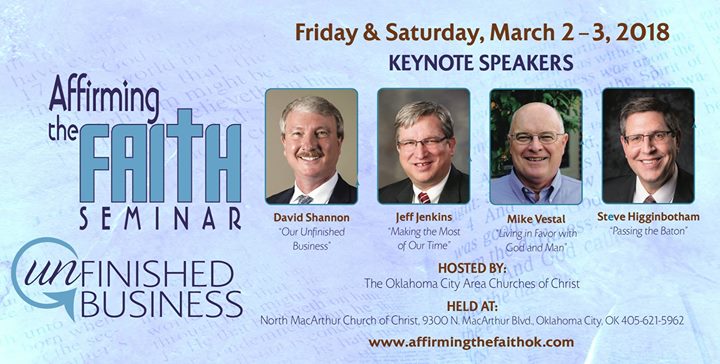
“Conversion of a Gang Member” was a part of the Conversion Series for the 11th annual Affirming the Faith Seminar held at the North MacArthur church of Christ (Oklahoma City, OK). The 2018 theme was Unfinished Business.
Lecture Audio
Lesson Summary
The conversion to Christ by a gang member comes with its own challenges culturally, spiritually, socially, and developmentally. The stark contrast between the evils and perils of the world from the lives of long-time church-goers is often hard to quantify and hard to appreciate. We need a cooperative learning model that gives the church insight to enter and help their communities and provides a “training in righteousness” mentorship for the new covert.
I was able, for the most part, to blend and weave “lessons and suggestions” throughout the lecture.
Let me add a few Lessons
Even when we do not understand “where” our new converts are coming from socially and culturally, we can love them and plug them into the culture of the church. What we do not understand about them should not hinder us from incorporating them.
Shaming converts because they are urban, ethnic, or from a broken home will never do. The world no longer has the old “normal” standards or expectations. We need to be flexible with our expectations of what people know, how they think and relate, and where their pains exist – for not all scars are skin deep, some go to the soul. We do not need to add to their trauma. There are no “normal” people, there are only people.
In our excitement to celebrate people’s conversions to Christ, we need to be careful not to tell their story without permission. Some people are not ready emotionally to talk about where they come from, or what they’ve done in their life. Learn to embrace their new life in Christ, without forcing them to dig out their skeletons and trauma. They will do that when it is right for them to glorify God in Jesus.
Let me add a few Suggestions
We -the church- need to stop taking ourselves so seriously. We are all in need of grace and forgiveness… that includes our elderly members as well. So, we need to take Paul’s words to heart: “welcome one another as Christ has welcomed you, for the glory of God” (Romans 15:7 ESV).
Develop a “adopt a new Convert” program, or adopt a new convert on your own. Sometimes we wait for churches to create programs that need to happen now. Don’t wait for approval to serve… just serve. If you need permission… I permit you to serve. :) : “For whoever does the will of God, he is my brother and sister and mother” (Mark 3:35).
Remember the goal is to make disciples, but everyone starts at a different start line. Jesus’ words are clear, we are to not leave them to figure things out, but to develop them – give them moral and spiritual goals: “Go therefore and make disciples of all nations, baptizing them in the name of the Father and of the Son and of the Holy Spirit, teaching them to observe all that I have commanded you…” (Matthew 28:19-20).
The initial basis for looking into Romans 8:12-17 was due to an interest in Paul’s use of “adoption” (huiothesia) in his Christian application of a legal technical term. Paul’s use of the term is not limited to Romans (8:15, 23; 9:4) for it is also found in the letters to the Galatian (4:5) and the Ephesian (1:5) Christians. This is the combined data of Paul’s use of the term in particular and in the New Testament in general.
In Romans 8:15 Paul assures his readers that they had received “a spirit of adoption”; similarly, but with a different nuance, in Galatians 4:5 Paul writes of an “adoption” dependent upon the redemptive work of Jesus as he frees those under the law (4:4). In Ephesians, Paul again establishes the connection between “adoption” and Jesus; specifically, the saints are to understand their “adoption” was preordained and accomplished through Jesus (1:5). However, in Romans 8:23 “adoption” is something yet to come when the body will be delivered. Lastly, Romans 9:4 calls attention to the fact that “adoption” is a possession of the Israelites along with “the glory, the covenants, the giving of the law, the worship, and the promises” (cf. Exod 4:22).
It appears that “adoption” is an important term in Paul’s argumentation in Romans to explain sonship which belonged to Israel “according to the flesh” (9:5), but belongs also to “the children of the promise” (9:8). Nevertheless, the limited use of huiothesia demonstrates that “adoption” has a specialized context of application and is not widely used by other New Testament authors. Although huiothesia holds a striking image which reflects the full inclusion of the Christian into the family of God with all its benefits, a reading of Romans 8:12-17 demonstrates that “sonship” (huiothesia, huioi theou, tekna theou) requires spiritual formation (8:13) with a view to a joint glorification with Jesus (8:17).
There are many subordinate points to be sure; however, these three generalizations serve as a critical bridge to carry Paul’s argument further from Romans 8:1-11 to 8:18 which continues a discussion about living in the spirit (contra kata sarka 8:5) and anticipating a “glory that is to be revealed to us.” These points will be borne out in the translation and reading prepared below.
Translation of Romans 8:12-17
[12] So then, brothers, we are not debtors to the flesh (namely, to live according to the flesh). [13] For if you live according to the flesh then you are destined to die, but if you put to death, by the Spirit, the deeds of the body, then you will keep yourself alive. [14] For all who are led by God’s Spirit, these are God’s sons. [15] For you have not received again a spirit of slavery towards fearfulness, but you received a spirit of adoption in which we cry out: “Abba-Father!” [16] The Spirit testifies along with our spirit that we are God’s children, [17] and if we are children, then we are heirs as well –on the one hand, God’s heirs, and on the other hand, joint heirs with Christ– if, after all, we suffer together in order that we may share in glory.
Exegesis and Reading of Romans 8:12-17
According to the 28th edition of the Nestle-Aland text, Paul begins this with the strengthened phrase Ara oun (“so then”), which is a combination of two “inferential conjunctions”[1] designed to link it with the preceding rhetoric written against living kata sarka. In Romans, Ti oun (3:1, 9; 4:1; 6:1, 15; 7:7, 13; 8:31; 9:14) or oun (5:1; 6:12; 11:1, 11; 12:1) are used to string large sections of questions and rhetoric along;[2] moreover, ara appears in the letter in its basic function as an inferential particle (“So” 7:21; “therefore” 8:1).[3]
Interestingly, Ara oun marks significant shifts to capture both the inference and the transition in the text (5:18; 7:3, 25b; 8:12; 9:16, 18; 14:12, 19).[4] Consequently, Paul is doing two things in 8:12. He is affirming an inference while transitioning his argument forward to oppose living kata sarka: “brothers, we are not debtors to the flesh (namely, to live according to the flesh)” (8:12).[5]
In reading opheiletai esmen ou te sarki Paul’s main point is established; namely, “we are not debtors with reference to the flesh.” Daniel B. Wallace states that opheiletai is a verbal-noun of personal interest formed from its cognate verb opheilo (“I owe”) which requires the dative to complete its thought (te sarki); moreover, te sarki also limits the state of the subject and verb (“we are not debtors”) which suggests this is a Dative of Reference, or Dative of Respect.[6] The next clause tou kata sarka zen is translated parenthetically because it appears best understood epexegetically.
Stanley E. Porter makes two helpful points. First, Porter writes, “when an infinitive is used as part of a prepositional phrase, this syntactical construction must be taken seriously.” Second, when the infinitive follows tou it may function “epexegetical or appositional.”[7] Since the infinitive draws out the meaning of “we are not debtors to with reference to the flesh,” it seems best to regard it epexegetical and parenthetical. This is in complete accord with his argument in Romans 8:5-8.
At this point the reader is directed (gar) to a series of cohesive conditional statements, marked off with ei, which portray the curse of living according to the flesh (8:13a) and the blessing received when led by the Spirit of God (i.e. spiritual formation; 8:13b-15). It is important to rehearse that conditional statements are two clauses which are combined to portray a contingency; they are not necessarily portrayals of reality.[8]
Usually, the first clause contains the contingency under consideration (protasis); meanwhile, the second clause is a statement – the portrayal – about what will happen, or not happen, should the contingent action occur (apodosis). In 8:13a, then, ei… kata sarka zete, mellete apothneskein, is a portrayal of the contingent curse upon unfaithful Christians: “if you live according to the flesh” (contingent), then “you are destined to die” (portrayal). There exists a cause and effect relationship portrayed in this conditional statement: death will occur if one lives fleshly. Wallace debates the idea of whether this should be viewed exclusively spiritual or literal. Although he is probably right to lean towards a literal view, this is not a grammatical question. Nevertheless, sin is accompanied with both a physical and spiritual curse of death (Gen 3:3; Rom 5:12, 6:23).
In Romans 8:13b, the text reads: ei de pneumati tas praxeis tou somatos[9]thanatoute, zesesthe. The de provides a hint that the forthcoming text is adversative but not so strong it is unrelated to the previous words. This is quite helpful, since the contingency under consideration, “if you put to death, by the Spirit, the deeds of the body,” is designed to counter life kata sarka. The verb thanatoute (“you [pl.] put to death”) is an active verb, which is significant for an understanding of how the dative pneumati functions in the apodosis. Initially, one must consider if the Dative is of Agency or of Means.
There is a key to distinguish between the two, though both, as Porter observes, “label a relationship by which (normally) a thing (and occasionally a person) brings about or enters into an action with respect to something else.”[10] The main key is found in the verb thanatoute, being a present active verb, which places the burden of the action (“I kill”) upon Paul’s readers not upon the Spirit. In order for the dative pneumati to be a “clear” grammatical demonstration of agency, Wallace states the verb must be perfect passive.[11] The protasis reads, then, “if you put to death, by means of the Spirit, the deeds of the body.” As in the previous conditional statement (13a), there is no structural marker establishing the “then” clause (apodosis); however, the semantics of the construction is obvious. The middle verb Zesesthe completes the “if-then” clause, portraying the effect: “you will keep yourself alive.” The reader should understand there is a cause and effect relationship portrayed in this conditional statement: The Christian’s life will be kept, if the Christian employs the instrumentality of the Spirit to kill off the body’s “sinful” actions. Clearly the Christian participates in their spiritual formation when they embrace the life-giving relationship of the Spirit.[12]
The reader is directed (gar) again to a series of cohesive statements (8:14-15) which provide reassurance to Christians regarding their inclusion into the Father’s family. Verse 14 appears to be an implied conditional statement since the grammatical markers are lacking to introduce the contingent clause.[13] If this is the case, there may be an ambiguity which is at play in the text. The verse reads: hosoi gar pneumati theou agontai, houtoi huioi theou eisin (“for all who are led by God’s Spirit, these are God’s sons”). In the assumption of an implied contingency, “If you are all led by God’s Spirit,” is followed by, “then, you are God’s sons.” Or, as Wallace states the converse, “If you are the sons of God, you are led by the Spirit.”[14] In either case, what is at the core in this implied contingency is spiritual formation (as “sons of God”) not conversion.
Moses E. Lard, taking eisin in a durative sense, translates and observes: “these remain sons of God. For the Apostle is not speaking of originally becoming sons, but of continuing such.”[15] The means by which this occurs is stated in the present passive + Dative of Means clause, pneumati theou agontai. The agent of Christian spiritual formation is, then, God’s Spirit – not the deeds of the body (tas praxeis tou somatos) or the flesh (sarka).
In verse 15, then, Paul extends (gar) this argument to further intertwine spiritual formation with the assurance of sonship: ougarelabetepneuma douleiaspalineisphobon allaelabetepneuma huiothesiasen hokradzomen:abba ho pater (“For you have not receive again a spirit of slavery towards fearfulness, but you received a spirit of adoption in which we cry out: Abba-Father”). In both cases of the aorist active elabete, the verb functions in a culminative sense (resultative, perfective, effective aorist), which places a “slight emphasis” upon “the conclusion or the results of the completed action.”[16]
Particularly is this true with verbs having roots which “signify effort or attempt or intention or process, and it indicates the completion or attainment of such things.”[17] In the first instance, elabete is modified by the negative particle ou and the adverb palin; whereas pneuma douleias is the condition (“benefit”) not received.[18] On the contrary (alla), Paul affirms the conclusive nature of what they have received: pneuma huiothesias. This is a statement regarding a status change. Christians are not merely “slaves” who had been freed from the servitude to sin (manumission) but are huioi theou, because they have received pneuma huiothesias. There is a logical connection between pneuma huiothesias and the prepositional phrase (taking the dative) en ho and the governing dynamic of their outcry (kradzomen). Does en ho suggest “within” (Locative), located “within the sphere of influence, control…” (Spherical), or is it manner or cause (Instrumental)?[19]
Despite the overlap in many respects, Dative of Sphere – an extension of the Locative – retains the emphasis of the Spirit’s influence. The result is spectacular for the content of the Christian outcry is: abba ho pater.[20] This is where spiritual formation and sonship/adoption interlock; namely, in affirmation.
The Christian not only affirms sonship, but “the Spirit himself” (auto to pneuma) is involved in affirming the Christian’s status before God. Paul writes: auto to pneuma summarturei to pneumati hemon hoti esmen tekna theou (8:16). The verse emphasizes the Spirit’s identity with the predicate construction auto to pneuma (cf. Rom 8:26).[21] The Spirit is involved in affirming “we are God’s children” (esmen tekna theou). There is no question Whom the subject of the verb is; however, there is a question regarding the relationship between the verb summarturei (“he testifies” to/for) and the dative-genitive construction to pneumati hemon (“to/for our spirit”).[22]
On the one hand, the Spirit’s testimony may be viewed in terms of Dative of Association which renders the reading “the Spirit testifies alongside with our spirit”; on the other hand, maintaining the dative-genitive as the indirect object the reading is “the Spirit testifies to our spirit.” Wallace states that grammatically, Dative of Association is usually based upon verbs compounded with sun but this is not an exhaustive rule. The reason being, sun may also be intensive rather than associative. Wallace, following Cranfield, recoils at the notion of the associative since the Christian spirit “has no right at all to testify” along with the Spirit.[23] This is a theological exacerbation of the grammar. Trevor Burke responds, “the compound verb… with the dative expression would more naturally mean ‘bears witness with our spirit’ as two witnesses linked together indicating that we are God’s sons.”[24] It would seem consistent with the movement of the overall thrust of the passage that the Spirit’s leading crescendos in a united confirmation (“The Spirit itself testifies along with our spirit”).
Adoptive sonship is at the heart of verses 16-17, so much so that Paul transitions from huioi theou (“God’s sons”) to tekna theou (“God’s children”) after assuring his Christian readers they have received pneuma huiothesias (“the spirit of adoption”). The transition is significant and is the basis for the eschatological conclusion of this segment of Romans 8, picked up in verse 18. The text, structured semantically as a conditional sentence,[25] reads: ei de tekna, kai kleronomoi:kleronomoi men theou, sungkleronomoi de Christou, eiper sumpaschomen hina kaisundoxasthomen. As in verse 13b, de is adversative but not so strong it is unrelated to the previous words. In fact, it further develops the argument from the previous verse with the conditional clause: “if we are children [tekna], then we are heirs as well.” The protasis is evidential not causal, and the apodosis is inferential not effectual; moreover, heirs as children is further explained: “on the one hand, God’s heirs, and on the other hand, joint heirs with Christ.”
Paul concludes this pericope with an intensive form of ei (eiper) meaning “if indeed, if after all, since, if it is true that.”[26] The strength of the closing clause is in its eschatological connection. Spiritual formation through the Spirit, and adoptive sonship with its inheritance, are connected to a joint-glorification through suffering: “if after all we suffer together in order that we will share[27] in glory.”
Concluding Words
Romans 8:12-17 is a tremendous contribution to the Gospel’s appropriation of all those freed from the lordship of sin and redeemed by the blood of Jesus. Where they were once flesh led, now Christians are Spirit led. Where once they were outside of the family of God, they are made adopted sons and confirmed as children with an inheritance. Christians are given the resources through the Spirit to use “death” to kill the deeds of the body in order to have life. The Spirit provides the context for spiritual formation. The model of slavery and emancipation from slavery were probably very vivid the Roman Christians, but perhaps the most eye opening is God taking former slaves and embracing them as members of his own household as sons and children. This is not a token adoption, but a full investment complete with inheritance, making the Christian a joint heir with Christ in suffering and glorification.
Endnotes
Archibald T. Robertson and W. Hersey Davis, A New Short Grammar of the Greek Testament, 10th ed. (1933; repr., Grand Rapids, Mich.: Baker, 1979), 317.
Stanley E. Porter, Idioms of the Greek New Testament, 2d ed. (London: Sheffield Academic Press, 1999), 305.
BDAG 103.
BDAG 104; Robertson and Davis, New Short Grammar, 317.
Unless specified the translation used in the body of this paper is that of the author.
James A. Brooks and Carlton L. Winbery, Syntax of New Testament Greek (Lanham, MD: University Press of America, 1979), 36; Harvey E. Dana and Julius R. Mantey, A Manual Grammar of the Greek New Testament (New York, NY: Macmillan, 1957), 85.
Porter, Idioms, 198.
Daniel B. Wallace, Greek Grammar Beyond the Basics (Grand Rapids, MI: Zondervan, 1996), 680-87.
The Nestle-Aland textual apparatus notes the variant reading: tes sarkos. Although there is some antiquity to the variant reading, and some linguistic consistency (sarx); in keeping with the more difficult reading which would require such a scribal adjustment, tou somatos is viewed as the best wording.
Porter, Idioms, 99.
Wallace, Greek Grammar, 163-166. Wallace concedes that a passive verb would be sufficient.
The two conditional sentences portray the outcomes of the two paths of spiritual formation. Living kata sarka leads to death, but living pneumati maintains life by killing sin at its source tas praxeis tou somatos. This is in keeping with Paul’s overall argument in Romans 8: “To set the mind on the flesh is death, but to set the mind on the Spirit is life and peace” (ESV).
Wallace, Greek Grammar, 685-86.
Wallace, Greek Grammar, 686.
Moses E. Lard, Commentary on Romans (1875; repr., Delight, AR: Gospel Light, n.d.), 264.
Brooks and Winbery, Syntax, 100.
Brooks and Winbery, Syntax, 100.
This is an adamant declaration: “you are not slaves again for you have been freed from sin” (cf. Rom 6.17-18).
Porter, Idioms, 156-58.
Robertson and Davis, New Short Grammar, 215. Robertson calls this idiomatic construction, “The Articular Nominative as Vocative”; meaning, a “vocative of address” is formed in the nominative yet its case is vocative.
Porter, Idioms, 120; Dana and Mantey, Manual Grammar, 129
Wallace, Greek Grammar, 160
Wallace, Greek Grammar, 159
Trevor J. Burke, “Adoption and the Spirit in Romans 8,” EQ 70.4 (1998): 322.
Wallace, Greek Grammar, 683.
Porter, Idioms, 209; Barclay M. Newman, Jr., A Concise Greek-English Dictionary of the New Testament (Stuttgart: German Bible Society, 1993), 53; Dana and Mantey, Manual Grammar, 262; Richard J. Goodrich and Albert L. Lukaszewski, A Reader’s Greek New Testament (Grand Rapids, MI: Zondervan, 2003), 344.
Brooks and Winbery, Syntax, 103. The grammatical reading of the passage takes the aorist passive verb as “I am glorified with,” but the hina and the anticipation inherent in the clause would suggest the aorist is functioning as a Futuristic Aorist.
Tommy South, That We May Share His Holiness: A Fresh Approach to Church Discipline (Abilene, TX: Bible Guides, 1997), paperback, 159 pages.
With the recommendation from my friend Jeremy Marshall, I purchased a copy of Tommy South’s work, That We May Share His Holiness: A Fresh Approach to Church Discipline.I was completely unaware of South’s work, and as I was reading and researching for a paper on church discipline I took it upon myself to give South’s work a “fresh” look. To my astonishment, I nearly read through the book in one night. That We May Share His Holiness should be read by every member of the church.
Before we highlight some points from the book, let us consider a little information about the author. A minister for some thirty years, Tommy South is currently a minister at the Glen Allen church of Christ and has served in that capacity since its inception in 1995 in Glen Allen, VA. South holds a Ph.D. (University of Virginia) in the New Testament & Early Christianity. South not only serves as an Adjunct Professor of Religious Studies at Virginia Commonwealth University,[1] but also frequently contributes to publications such as the Gospel Advocate.
The Book I Enjoyed Reading
That We May Share His Holiness has been in circulation for some time. However, it is a publication that is worth describing here for study and contemplation. Because we believe there are very few negative matters to discuss, we shall only describe the work and its benefits.
The book has 15 chapters, and its outline appears to have a Bible class setting in mind. The discussion questions that follow each chapter will surely lend themselves to small group studies or congregational settings.
The content is written in a popular style —avoiding technical language— yet the author demonstrates himself to be very adept at the technical matters that arise in the discussion of church discipline.[2] Reading South’s work is a breath of fresh air as it reads so smoothly, and yet it avoids theological shallowness by providing adequate analysis and exegetical insights, and by challenging the readers to spiritually deliberate on critical issues regarding church discipline.
Furthermore, the material on holiness, individual responsibility to self-purity, and the duty we share as Christians to assist others to retain their self-purity are perennial discussions.
South’s work demonstrates how God places emphasis upon personal holiness as the basis for church discipline:
All discipline is the outgrowth of God’s desire for us to share His holiness. […] It also includes disciplining ourselves. This is where “striving after holiness” comes in. […] Congregational discipline is likewise an extension of God’s desire for our holiness. Just as God expects and requires us to discipline ourselves, he calls on us to discipline each other when necessary, not arbitrarily or angrily, or vengefully, but as an outgrowth of his love and of his demand for holiness among his people.[3]
South moves from this biblical basis (Heb. 12.10) and develops many themes in this rich survey of every significant New Testament context dealing with church discipline.
Another important discussion South develops is that fellowship is to precede discipline.
Apart from fellowship, discipline is not only meaningless, it is abusive. To discipline someone with whom we have not enjoyed real fellowship is much like spanking a stranger’s child.[4]
South advocates an attempt “to create an environment of love and fellowship” in the congregation so that church discipline can do exactly what God intends for it to accomplish—restoration.[5]
When restoration of fellowship is obtained, forgiveness is to occur by the individual specifically offended, and by the community of the church.[6] The discipline was to be “effective but not vindictive” and after restoration, steps to communal restoration are forgiveness, comfort, and confirmation of love.[7]
Discipline and restoration are connected at the proverbial hip, and to this point South cautions:
The church is never at liberty to think that we’ve “done our duty” by disciplining the erring when we are unwilling to perform the equal “duty” of forgiveness.[8]
Placing the full responsibility of reconciliation upon the disciplined is a completely untenable theological conclusion. Both have responsibilities: the disciplined is to repent and show those fruits, and the church has the responsibility to forgive and strengthen.
Recommendation
For its size and scope, it is an outstanding discussion of a critical topic. Page per page, it is rich in research which gave the book its birth, clear in the development of the central message of the Scriptures on the subject, and set forth in a spirit of genuine spirituality and Christian honesty.
This book is a must-read. It will tremendously bless all those who give it attention and a healthy judicious study, with the necessary application. It will not take long for a congregation of the Lord’s people that fails to discipline, to lose its identity as the church. It is, therefore, time to give attention to this important biblical theme.
Sources
“Leadership and Staff | Glen Allen Church of Christ.” GlenAllenChurch.org. (Link). Tommy South can be contacted at gaoffice@glenallenchurch.org.
South points to the technical discussions in his work, Disciplinary Practices in Pauline Texts (Lewiston, NY: Mellen, 1992).
Tommy South, That We May Share His Holiness: A Fresh Approach to Church Discipline (Abilene, Tex.: Bible Guides, 1997), 16.






 biblicalfaith.online