Spiritual Growth: The Ezra Principle (Ezra 7:10)

In pursuit of my own spiritual growth (such as it is) as a man of faith, it took me a long time to figure out where my journey was supposed to find not just the goal, but the starting point and the road map for the pilgrimage. Spiritual growth is not the result of knowing where our faith calls us to, but from the arduous journey to get there.

My journey has been massively blessed. I have had mentors, mothers, fathers – at times, even grandparent – figures. They have all given me something for my journey (perhaps, sometime, I’ll write about that), but I was only walking with them on their journey. Still, I would not be where I am, spiritually, without them.

I tried education. I figured “if I could be smarter” then I could discover all of the secrets that others are keeping to themselves behind the walls of academia – the proverbial mountain top. I found the tools and methods instead to help me navigate “the strange and yet immanent” world of Scriptures. They helped me raise questions and look at God’s word from various new angles that have indeed helped me in my journey to God. Despite its benefits of making me feel closer to the text, however, it was not the “end all” solution to my spiritual needs.

My personal life experiences, training, and those mentors in my life, all pointed me back to one thing: my journey to God only makes sense when I invest in a lifestyle of discipleship that has a consequential impact on my life. This required me to take seriously the words of the Psalmists.

I needed my desire for wisdom to mirror the Psalmist’s outcry to the Lord:

Open my eyes, that I may behold wondrous things out of your law. (Psalm 119:18)[1]

In this great Psalm, David recounts the wonders of the Law of God and exalts its beauty, richness, guidance, and its loftiness as it is grounded in God’s righteousness. It begins with the words,

Blessed are those whose way is blameless, who walk in the law of the Lord! (Psalm 119:1)

One of the empowering aspects of this Psalm is not actually found in what is written, but in the very process by which we see the Psalmist’s love for living out the Word of God, the Law of the Lord. The entire Psalm flows with a powerful example of losing oneself in the world of God’s Law.

I am not at all surprised that Psalm 119 found a communal niche at the Feast of Pentecost, as Nancy deClaissé-Walford recounts:

It is recited at the Feast of Pentecost, the spring festival observed fifty days after Passover, which celebrates the giving of the torah to Moses at Sinai during the wilderness wanderings.[2]

Nancy deClaissé-Walford in The Book of Psalms (2014)

Psalm 119 called my attention to the only true path to spiritual growth: the transformative power of the world of the scriptures. Knowing God through the scriptures, however, must lead toward discipleship, toward obedience.

The Ezra Principle

The “Ezra Principle” sounds catchy and new doesn’t it. I guarantee you it is not. I have not discovered anything hidden in plain sight. In fact, the “principle” is not just one thing, but a commitment to five values of discipleship that Ezra pursued himself.

In the fifth century B.C. (c. 458 B.C.), Ezra is commissioned by the Persian King Artaxerxes I (465–424 B.C.) in his return to Jerusalem (7:1–28). It is a time of fresh opportunity to “get things right” following the seventy years of captivity in the Babylonian due to the corruptive influence of pagan idolatry.[3] In this context, Ezra had begun a process of preparation for the task before him:

Ezra had set his heart to study the Law of the LORD, and to do it and to teach his statutes and rules in Israel. (Ezra 7:10)

The grammarian in me is interested in the verbal phrases of Ezra’s commitment: (1) “set his heart,” (2) “to study the Law,” (3) “to do it,” and (4) “to teach… in Israel.” That’s powerful. You may find other ways to divide this passage, but we will separate “study” and its object, “the Law of the Lord,” into two values themselves.

This is one of those passages that made clear to me the connection between knowing God’s word and being an authentic follower of God: the connection between personal commitment to know and to do God’s word.

Knowledge and Discipleship

This observation shifted my thinking away from just being absorbed in the Word of God. Spiritual growth must embrace knowledge but that is not the entire picture. James warns us that a people of knowledge alone is useless if not insulting because knowledge (i.e., faith) is to demonstrate itself by good works (1:22-27).[4]

James weaves together the two themes of favoritism and faith in order to illustrate just how practical saving faith must be. He illustrates this by examining the relationship between the poor and the rich in the church:

If a brother or sister is poorly clothed and lacking in daily food, and one of you says to them, "Go in peace, be warmed and filled," without giving them the things needed for the body, what good is that? (Jas 2:15–16)

What good is knowing that we are all saved in Christ, so goes the argument, if we do not care for each other in this life? How does God’s communal redemption of all impact our daily interactions? James argues that knowledge (faith) should be lived out in the community of the body of Christ in consequential ways.

For that matter, think about the community where the church meets. What good are we doing if we are strong on truth, but our community has never heard or seen us live out what the gospel is all about? The good we do should move people that thank God:

In the same way, let your light shine before others, so that they may see your good works and give glory to your Father who is in heaven. (Matt 5:16)

In other words, spiritual knowledge and discipleship are inseparable.

To return to our point, knowing is only the beginning, the end is discipleship. The process from point A to point B is our journey of applying the narrative of Scripture (how God redeems humanity through Jesus Christ) to our lives so that we may be transformed by it (Rom 12:1-2). This makes the Word of God the essential guiding force behind all of our actions.

This brings us to the “main event” of this discussion: something I call the “Ezra Principle.”

(1) We Must Set Our Hearts

is one of the clearest descriptions of a targeted mindset in the OT. If the heart is not “into it” the body and life will not follow. Paul, speaking of the Macedonian’s benevolent efforts despite their deep poverty, describes the basis of their commitment: “they gave themselves first to the Lord, and then by the will of God to us” (2 Cor 8:5). Great advancements always stem from great commitments.

In the study and application of God’s Word, the commitment which begins at our spiritual core – the heart – will continue to be the driving force throughout our life of service to God (Deut 6:5, Lev 19:18).

(2) We Must Spend Time in Study.

Near the end of the apostle Paul’s life, he requested that Timothy come to be with him and bring his cloak, his books, and the parchments (2 Tim 4:13).  There are many speculations about the nature of these last two items, but at the very least the books and parchments would include copies of his letters to other churches. Paul would spend the last days of his life with those volumes he penned through inspiration to those in need of strength and faith.

The point we draw from here is that Paul was a studying man. In fact, he would encourage Timothy to be well equipped in the word of God and aptly able to “divide” the Scripture clearly and carefully (2 Tim 2:15). Ezra likewise spent renewed focus on studying the Law as he found himself and Israel back in the Land of their faith. Ezra knew, as we ought to today, that in order to rebuild our lives it must be based upon God’s word.

(3) We Must Select Only God’s Word as the Object of our Study.

There are many philosophical writings and even religious “scriptures” in the world. They often have maxims, sayings, or verses with which we would agree and commend. When building a biblical worldview as for the foundation of our spiritual growth, however, the Bible is the only set of “Sacred Writings” which are able to make a person wise to obtain salvation (2 Tim 3:14-15).

One may argue that this is an arrogant statement; however, despite the fact that such “writings” may provide insight into our lives, they pale in comparison with the never surpassed guidance given in the divine books of the Bible.

When one analyzes the Bible from the vantage point of predictive prophecy, historical accuracy, scientific foreknowledge, and literary harmony of this great anthology of 66 books in contrast to such other works, the Bible stands alone.

(4) We Must Steadfastly Practice God’s Word.

It is only by the conviction that the words inscribed on the paper we read are not mere words of human beings, but are instead the very words that God himself would breathe out (1 Thess 2:13; 2 Tim 3:16–17). Jesus teaches quite clearly that our lives are to reflect this type of respect, for in our prayers we are to express the sentiment, “your will be done, on earth as it is in heaven” (Matt 6:10). The Lord declares: “to obey is better than sacrifice” (1 Sam 15:22)

(5) We Must Share both our Learning and Experiences.

In many ways, teaching is not only the sharing of facts and principles. In various instances, anecdotal interactions with God’s word can be very revealing and helpful in understanding and teaching God’s word. For example, consider all those who continue to leave the denominational world for the practice of pure New Testament Christianity.

The process of filtering out unbiblical accretions while adding to their learning and practicing the biblical faith can be a very helpful experience to teach others going through the same process. The bottom line is that God’s word was never designed to be a mental exercise to the exclusion of action and sharing; indeed, we must make “disciples” (Matt 28:19-20).

Steven Lawson, in his own words, calls attention to the advice of Walter Kaiser:

When a man preaches, he should never remove his finger from the Scriptures, Kaiser affirmed. If he is gesturing with his right hand, he should keep his left hand’s finger on the text. If he reverses hands for gesturing, then he should also reverse hands for holding his spot in the text. He should always be pointing to the Scriptures.[5]

S. J. Lawson, “The Pattern of Biblical Preaching,” Bibliotheca Sacra 158 (2001)

The advice is striking for those that proclaim the Word of God, but it is an excellent reminder to those would-be disciples interested in taking their discipleship to the next level, namely, to be teachers.

Studying is Complicated

This may seem like an aside, but it is not. I promise. We need to be very careful how we use scripture. Sometimes there are narratives regarding God’s people which seem contrary to the high moral calling which is expected of God’s leaders or people. Historical narratives need to be read with caution, as they often make their points indirectly (with no commentary). They are not always telling us something God wants us to imitate, but what God’s people have done.[6] It teaches me to be careful when seeking to “do” and “teach” God’s word.

I have often wrestled with some of the deeds of Ezra as recorded in the sacred record, particularly the covenant he seems to have initiated among the returning exiled Jews to “put away” all their foreign wives and children (cf. Ezra 10). Was this divorce en-masse commissioned by God? If one takes the view that whatever is written is positive teaching, as an authoritative command, then the text seemingly gives justification to divorce and remarriage on the count of practicing a different faith. This seems counter to the teaching of Jesus who affirms that there is only one justifiable cause for divorce and remarriage: adultery (Matt 19:1–9).

Yet, if one takes the view that each action must be taken into consideration on its own merits, then it is possible that Ezra was convicted by the significant teaching against inter-marriage with foreigners due to their influence on their spiritual corruption (Exod 34:12–16; Deut 7:1–6; Josh 23:19–23) that he overstepped its application and persuaded the men of Israel to do something not commanded of those who were already “married with children.” This would align with the fact that there is no explicit commentary nor “word from the Lord” to demand these families to be severed.

Providing an answer to this riddle is beyond the purpose of this essay. My point is in our commitment to setting the heart, studying the word, and living out the word in our individual lives, the weight of teaching is likewise an important discipline that should be taken with the heavy responsibility that comes with it.

The Lord’s brother James wrote:

Not many of you should become teachers, my brothers, for you know that we who teach will be judged with greater strictness. For we all stumble in many ways. And if anyone does not stumble in what he says, he is a perfect man, able also to bridle his whole body. (James 3:1–2)

Humility must always accompany study and teaching (Rom 2:1–11).

Final Thoughts

I am forever grateful for those who took the time to encourage me, prod me, and guide me to appreciate the special place Bible study is in the spiritual life and growth of God’s people. I would like to give a quick hat tip to them at the close of this essay.

Donald W. Hinds (1922–2008) taught me and encouraged me to read daily and widely, to be challenged by what I read, and to meditate carefully on it. His son David Hinds taught me the importance of finding the right book and the right teacher (author), in that some have so prepared themselves that if I should listen to other voices beyond the Bible, I should find such authors. I am thankful to Wayne Jackson (1961–2017), a true preacher’s preacher, who probably shaped my passion for the study of the Scriptures more so than anyone else in my early formative years through his writings in biblical studies (The Christian Courier), biblical apologetics (Apologetics Press, Inc.), and while a member of the church where he richly and profoundly proclaimed the scriptures.

Others have guided me along the way as well. Earl D. Edwards was one of my instructors in college, an elder in the church while I attended college, and a personal mentor during my early academic development. In him, I saw how the power of God’s word can so shape a man’s life with dignity, scholarship, and humility.

I wish I could say more about others, but I’ll save that for another time. These are but a few personal encounters with those who have lived out and assisted me to see that the “Ezra Principle” is not a “cute” title, but essential for the spiritual formation that comes from following God and his word. I pray that you take its challenge.

Endnotes

  1. Unless cited otherwise, all Scripture quotations are from the English Standard Version of The Holy Bible (Wheaton, Ill: Crossway, 2016).
  2. Nancy deClaissé-Walford, “Book Five of the Psalter: Psalms 107–150,” in The Book of Psalms, NICOT, eds. E. J. Young, R. K. Harrison, and Robert L. Hubbard Jr. (Grand Rapids, MI: Eerdmans, 2014), 870.
  3. M. J. Boda, “Ezra,” Dictionary of the Old Testament: Historical Books (Downers Grove, IL: InterVarsity Press, 2005), 278.
  4. Craig L. Blomberg and Mariam J. Kamell, James, ZECNT, ed. Clinton E. Arnold (Grand Rapids, MI: Zondervan, 2008), 101.
  5. Steven J. Lawson, “The Pattern of Biblical Preaching: An Expository Study of Ezra 7:10 and Nehemiah 8:1–18,” BSac 158 (2001): 451.
  6. I am reminded of an “authorized” campus flyer I came across advertising a community college course on “The Bible as Literature” at the City College of San Francisco. It had a picture of the Bible with a sticker label on it that read:

    —-
    WARNING: This is a work of fiction. Do not interpret literally.

    CONTENT ADVISORY: Contains verses descriptive of or advocating suicide, incest, bestiality, sadomasochism, rape, murder, morbid violence, use of drugs or alcohol, homosexuality, criminal activity, human rights violations, and crimes against humanity.

    EXPOSURE WARNING: Exposure to contents for extended periods or during formative years in children has been known to cause delusions, hallucinations, decreased cognitive and objective reasoning abilities, and in extreme cases, pathological disorders, hatred, bigotry, and violence including, but not limited to torture, murder, and genocide.
    —-

    Are there stories in Scripture that record horrific events? Yes. Are they documented to promote such behavior? No. They are recorded to document the fallen nature of the world we live in.


Lecture: Conversion of a Gang Member

1

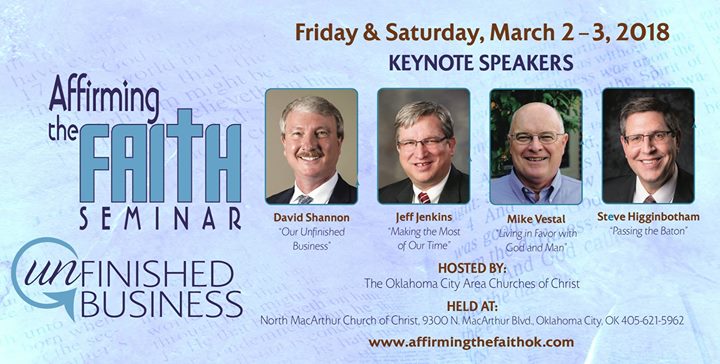
“Conversion of a Gang Member” was a part of the Conversion Series for the 11th annual Affirming the Faith Seminar held at the North MacArthur church of Christ (Oklahoma City, OK). The 2018 theme was Unfinished Business.

ATF 2018.jpg

Lecture Audio

Lesson Summary

The conversion to Christ by a gang member comes with its own challenges culturally, spiritually, socially, and developmentally. The stark contrast between the evils and perils of the world from the lives of long-time church-goers is often hard to quantify and hard to appreciate. We need a cooperative learning model that gives the church insight to enter and help their communities and provides a “training in righteousness” mentorship for the new covert.

The Lecture Presentation Slides

Notes

  • Related reading: Jovan Payes, “Leaving a Street Gang for Christ,” Gospel Advocate (April 2015).
  • “Lessons and Suggestions…”
    • I was able, for the most part, to blend and weave “lessons and suggestions” throughout the lecture.
    • Let me add a few Lessons
      • Even when we do not understand “where” our new converts are coming from socially and culturally, we can love them and plug them into the culture of the church. What we do not understand about them should not hinder us from incorporating them.
      • Shaming converts because they are urban, ethnic, or from a broken home will never do. The world no longer has the old “normal” standards or expectations. We need to be flexible with our expectations of what people know, how they think and relate, and where their pains exist – for not all scars are skin deep, some go to the soul. We do not need to add to their trauma. There are no “normal” people, there are only people.
      • In our excitement to celebrate people’s conversions to Christ, we need to be careful not to tell their story without permission. Some people are not ready emotionally to talk about where they come from, or what they’ve done in their life. Learn to embrace their new life in Christ, without forcing them to dig out their skeletons and trauma. They will do that when it is right for them to glorify God in Jesus.
    • Let me add a few Suggestions
      • We -the church- need to stop taking ourselves so seriously. We are all in need of grace and forgiveness… that includes our elderly members as well. So, we need to take Paul’s words to heart: “welcome one another as Christ has welcomed you, for the glory of God” (Romans 15:7 ESV).
      • Develop a “adopt a new Convert” program, or adopt a new convert on your own. Sometimes we wait for churches to create programs that need to happen now. Don’t wait for approval to serve… just serve. If you need permission… I permit you to serve. :) : “For whoever does the will of God, he is my brother and sister and mother” (Mark 3:35).
      • Remember the goal is to make disciples, but everyone starts at a different start line. Jesus’ words are clear, we are to not leave them to figure things out, but to develop them – give them moral and spiritual goals: “Go therefore and make disciples of all nations, baptizing them in the name of the Father and of the Son and of the Holy Spirit, teaching them to observe all that I have commanded you…” (Matthew 28:19-20).

The Public Reading of Scripture: Six Practical Suggestions

Reprinted with permission from the March 2017 issue of Gospel Advocate Magazine.

A vital element to the worship assembly of the body of Christ in the first century was the reading aloud of the Scriptures (1 Timothy 4:13; Acts 13:15). Today, it is probably hard to imagine a time when God’s word was accessible only when assembled with God’s people; it was a communal experience. The proliferation of Bibles today has truly made reading Scripture an individualized practice; yet, this has not always been so. In fact, the meaning of “church” (ekklesia; “an assembly”) presumes a people gathered to hear, to commit to, and to act upon the Word of God (Matthew 16:18; Deuteronomy 4:10-11; 31:9-13). Thus, hearing God’s Word is part of who we are as “the church” (Acts 11:26; 14:27).

The church needs to elevate the importance of the Scripture reading assignment in our assembly (Act 13:15; 2 Corinthians 3:14). There is a tendency to be too casual about this assignment. Perhaps it is because we take literacy for granted, though the capacity to read words is not the same as understanding the words being read. In this connection, we may then take for granted that anyone can read the Scripture aloud to the church. In some societies, reading is still regarded as a technical skill, much as it was in Bible times.

If reading the Scriptures will make a child of God “complete, equipped for every good work” (2 Timothy 3:17 ESV) when read for private devotion, then the same God-breathed writings read aloud will provide the same effect for the congregation. In the Scripture reading, God is speaking to His people. For this reason, the public reading of Scripture is a crucial element of the worship assembly and should not be taken casually or lightly.

A Note on the Context

In fact, Paul anchored to this very core principle when he wrote to Timothy to provide a strategy for the faithful to protect themselves from a departure from the faith, which will consist of Christians “devoting themselves to deceitful spirits and teachings of demons” (1 Timothy 4:1). The antidote against “irreverent, silly myths” (4:6-7) and any possible competitors to divine revelation is the healthy teaching from God (4:13). Public reading of Scripture inoculates against false teaching and invites faithful discipleship and commitment to God (Exodus 23:22; 24:7). It syncs us up with God.

Paul makes similar requests in other letters to the churches of the first century. When detailing the unveiling of the mystery of Christ, Paul anticipates and expects the church to share his understanding (Ephesians 3:4-6). After he writes on the supreme role of Christ in redemptive history, he expected the Colossian congregation to letter swap with Laodicea (Colossians 4:16). And, to the Thessalonians, he was quite strong when he placed “an oath before the Lord to have this letter read to all the brothers” (1 Thessalonians 5:27), for through the reading aloud of his letters they would be taught (2 Thessalonians 2:14-15). And in the final revelation of Jesus, the apocalyptic portrayal of divine victory through the gospel is framed as one that must be read aloud and safeguarded against addition and omission (Revelation 1:3; 22:16-19).

Reading Scripture aloud can bring the church into sync with God’s word. The more exposure, the better our biblical literacy; then, ideally, the healthier our churches will become. Let us switch gears, now, to provide practical suggestions for this powerful act of reading Scriptures aloud in our worship assembly.

Six Suggestions for Reading Scripture Aloud

There must be a spiritual gravitas connected to reading Scripture before the assembly. I had a mentor, Don W. Hinds, that would stop me when I misread a passage aloud. He would use the adage, “take heed how you read,” to instill in me the importance of properly reading the biblical text aloud. I would like to use this as a refrain as we consider some practical guideposts for reading the Scriptures aloud when the church is assembled for worship — although these suggestions can be applied in various settings of church life.

Furthermore, in many congregations, those who manage or arrange the various elements of the worship assembly (deacons, elders, etc) should seriously consider the points below as they select public readers of Scripture. We are worshipping God and engaging in spiritual and divine matters, we are not merely filling a roster. God’s word must be the centerpiece of our worship.

First, the reading should be met with a respect for proper pronunciation and performance. This is the “oral” spiritual heritage of God’s people, to hear and understand God’s word (Nehemiah 8:1-8). Not only should one practice to read clearly and distinctly, but some types of Scripture (genre) require an element of performance (cf. Psalms). For example, we should not read a psalm of lament (Psalms 51) as if it were a genealogy. Take heed how you read.

Second, we should consider the verbal skill set of those who will read before the assembly. The goal is to instill an understanding of God and to invite the church to obedience. There is no verse that prohibits individuals with speech problems from publicly reading Scripture. We should both be sensitive and inclusive. Fortunately, audio technology facilitates what requires loud speaking in other settings. Still, as long as the public reading reaches its goal then it has accomplished its purpose. Take heed who will read.

Third, the reading selection should be long enough to understand the message. This is especially true when the selection is independent from the sermon. Some congregations may design their readings to go through a book (Psalms) or a large section of Scripture (Major Prophets). Other times, they are connected to the sermon. The readings must be of sufficient length to provide context and understanding and should have a natural and intended connection to the worship service. All things being equal, we may ask, “why read from the Song of Solomon when the sermon is on the ‘second death’ of Revelation?” Take heed what you read.

Fourth, the readings must be the Scriptures free from alteration. From time to time some like to add a few impromptu thoughts in connection with the reading of the Scripture. The points may be very excellent, but they run the risk to be of another variety. It is important to keep to the task at hand, which is to read the assigned portion of Scripture. There are many reasons for this. The most significant reason is to elevate the word of God over the words of men. As Revelation 22:18-19 warns, the text must be read without omission and addition. Take heed that you read.

Fifth, the reading of Scripture must be purposeful. There should be communication before hand to prepare those who will read aloud in worship. Sometimes we can displace others when we lean upon “good readers” in a pinch. With a purposeful schedule, we can give enough notice so that our readers can prepare, become familiar with the text, and develop a comfort level. Preparation and practice are the best helps to reduce “stage fright.” Take heed before you read.

Sixth, the reader should not cause a distraction by what they wear. It is true that God seeks and looks at the heart (1 Samuel 16:7; Matthew 15:8), but one should dress for the spiritual occasion (Matthew 22:11-14). While attire may sometimes be a distraction, it is more important that the reader’s lifestyle should not be a distraction. If those who pray in assembly should have “holy hands” (1 Timothy 2:8), what of those who read Scripture. Paul told Timothy that he should be an example; this would make an additional influence when he would read aloud the Scriptures to the church (1 Timothy 4:12). Take heed by whom you read.

Concluding Thoughts

The public reading of Scripture was an essential component of the first-century worship assembly. If in today’s time, the church seeks to be in conformity with the early worship practices of the New Testament church, then it will seek to incorporate this practice and develop those who will read. Moreover, the church will grow when she integrates the three-fold instruction given to Timothy: the public reading of Scripture, the exhortation, and the teaching (1 Timothy 4:13). In a day and time when so many church groups are seeking new and innovative methods to “enhance” worship, the age-tested and inspired method to read aloud God’s word must be in the forefront of our worship assemblies. Blessings to the reader, and blessings to the hearer.

Jovan Payes preaches for the Highland Church of Christ in Bakersfield, Calif.

To subscribe to Gospel Advocate, click here.


Leaving a Street Gang for Christ

20180131_130404

Reprinted from the April 2015 issue of Gospel Advocate Magazine.

Paul writes, “Do not be conformed to this world, but be transformed by the renewal of your mind, that by testing you may discern what is the will of God, what is good and acceptable and perfect” (Romans 12:2 ESV). It has been my experience that I am often unaware of the transforming process of the gospel until I see the contrast of who I used to be and who I am now. The transformation Paul speaks of reflects a fundamental change in character, and such change does not happen except by a “renewal” of the mind over a consistent and indeterminate period of time.

My story is of one foolish soul who was transformed by the gospel. I am afraid that at times I feel that I carry the memories of another man. Nevertheless, I was what I was, and I am what I am; may God be glorified by this thorn-riddled soul only to the extent that I find closure in my weaknesses and glory in His strength (2 Corinthians 12:7-10).

Before you are the beginnings of a hoodlum who was transformed by Christ, and that hoodlum (spoiler alert) was me. This is how I tell it.

The Transformation

One day in the summer of 1996, I was sitting on a rest stop at the corner of 24th and Mission streets in San Francisco, Calif. The intersection is a major hub in the Mission District, a major Latino district. Amidst the sounds of cars and bus traffic, the commotion of people talking and shopping, and bullhorn preachers shouting aloud, I came to a personal decision that would change my life forever.

At the time, I was a member of a local gang. I used drugs and alcohol. I was a high school drop out. I tried drug dealing. I was a thief. I was violent. The picture is rather rough, and the only reason I believe it is because I still have most of the memories.

That day I just wanted to relax. I was tired of it all. I saw girls calling home informing their families that they were never coming home (prostitution). I saw children in waves seeking to join our gang because they had created enemies in their own neighborhoods. I realized that I was just exhausted by the lunacy of it all.

I found myself at a fork in the road. What I wanted was an afternoon of drinking with my friends. What happened is that I realized that I had created a life full of potential dangers that forced me to think of ways to handle them. “If I go to the park,” I was thinking, “there is a good chance that along the way I would face the potential of retaliation.” At this point, I was not afraid of dealing with the problem. It was just that I was tired of the problem.

My mind raced with other options. I could take the 14 Mission (a bus) toward downtown, headed toward Pier 39. I had spent quite a bit of time there as a younger child, breakdancing for tourists with my big “brother” Rick (technically my cousin) on Fisherman’s Wharf. That thought quickly faded with the reality that I would pass through rival neighborhoods with those who would hurt me simply because of the color of my clothes (this is gang-banger logic). Again, I just wanted to relax.

I turned my attention southward, toward Daly City, a suburb of San Francisco. The broken record continued, “I just want to relax.” The last time I was on that bus route, some friends and I were shot at. In all fairness, we instigated it; still, I felt no need to travel alone just to prove a point. So I canceled that plan. It really dawned on me how much destruction and danger surrounded me because of my choices.

I said to myself, “go home and go out tonight.” I counseled myself, “make sure no one follows you.” I have gone to people’s homes banging on their doors in order to elicit a fight, so it was not beyond the possibility that I could be followed at some point. It was a life of paranoia. It was at this point when my heart uttered the words that would change my life forever: “I just want to go to heaven.” Those words made so much sense to me.

At some point, I found a Bible under my bed. It was inexplicable. I had no idea I even possessed a Bible! I began to search and read through the Bible with the feeling that I was getting closer to God. I look back at this moment much like I do when I read the conversion story of Cornelius in Acts 10 – yet in my sins, reaching for God, searching for His words to save me.

Left: Jovan after a street fight (photo taken by SFPD). Right: Jovan during a medical mission campaign in Panama, Central America.

Many Hands

A few months later, Rick was visiting home while on leave from the Army. I didn’t know he had been baptized into Christ earlier in the year by his superior officer. He approached me in our living room with these words: “Jovan, I found the church.” I sarcastically responded, “Yeah, you found a church, great.” I was thinking in terms of the city cathedrals like St. Paul’s Catholic Church, which was down the street, or Mission Delores, or even the Cathedral of St. Mary of the Assumption. Pick a saint, we Catholics had a cathedral for them.

Rick said, “No, I found the church that you can read about in the Bible.” This intrigued me, and I asked him to tell me more. By this time, I had read most of the New Testament, and I was already trying to be “Christian.” We proceeded to talk for a few months, and a couple of days after Christmas 1996 I was convicted by the gospel. I realized I needed to follow through with my change of heart, so I was immersed in water for the remission of my sins. I was added to the redeemed (Acts 2:47).

Civic Center church of Christ (a Google Street View of the old building): Home of The College of Evangelists, the birth place of Contending for the Faith. The people who met here established the Oceanview church of Christ in Pacifica, CA.

By and by, as we say, I became a member of the Civic Center Church of Christ in San Francisco. This is where my education in the gospel would lead me to face a series of challenging events and point me down the path to prepare myself for ministry. Much like the eunuch from Ethiopia (Acts 8), I had a wonderful mentor in Donald W. Hinds. If ever I had a father in the gospel, it was him; if ever there was a troubled child in the gospel, it was me. Don received me as Christ receives us all (Romans 15:7). I am forever indebted to his influence on my life, along with his son, David Hinds; together, they planted God’s Word in my heart, watered it, and in due season it bore fruit (2 Timothy 2:2; Amos 7:14-15; Psalm 1).

The truth is, I had no aspirations of preaching. Don had another thought altogether. Don sat me down every chance he could to teach me something new – well, new to me – during our Sunday lunch break between services. From studying the Bible to inspiring me to teach the gospel to believing in me to preach the gospel, it was in a very real way a tangible experience much like Paul and Timothy. Brethren, hands-on mentoring transforms young people.

One Wednesday afternoon I faced the consequences of leaving the gang life behind. I was confronted with the decision to return to the street life I had left behind. I was surrounded by my former “associates” with an ultimatum. My conviction to Christ led me to be beaten and left lying in a driveway in some small street in the Mission. I remember telling my family that I had left the gangs behind. I remember attending Wednesday night Bible study that very night, telling my friend and mentor Don, “I sowed to the flesh, and I hope I reaped its final harvest.”

My wife has also been a transformative figure in my life. On March 3, 2001, I assumed the challenge of being the head of my own household; actually, I believe Cindy Tuggle accepted the challenge of being my wife. I would love to say that I have been the best husband ever, but I can only say that I have been a better man and husband because we have overcome so much together. The reason for our success has been trusting in God’s transforming Word to take what we have made of our lives and reform it to His glory. Today after 14 years of marriage, we are blessed with three children – something I never thought possible.

Pressing Forward

I have made many mistakes along the way, so it is hard for me to speak of transformation. God’s grace continues to inspire me to renew my mind and transform. This much is certain, transformation through the gospel is possible – no matter who you are, no matter where you have been, no matter what you have done, there is a place for you in the kingdom of God. I was a knuckle-headed thug from the streets of San Francisco who became a Christian, and through the grace of God a husband, a father, a preacher, and at times a mentor. Pray for me that I may:

“know him and the power of his resurrection, and [that I] may share his sufferings, becoming like him in his death, that by any means possible I may attain the resurrection from the dead” (Philippians 3:10-11).

Jovan Payes preaches for the Highland Church of Christ in Bakersfield, Calif.

To subscribe to Gospel Advocate, click here.