Your Mission Matters

It is not unusual for businesses and enterprises to have “mission statements” to outline their objectives, goals, philosophy, and proposed impact their products or services are intended to have.

When you think about it, the “statement” is a great way to bring focus to an image about an outcome, or the goal of an organization. It is also a way for there to be creative control over how we would like people to envision us, our message, and our ethics and values as we seek our mission. In short, our mission statement holds us accountable for what we seek to accomplish and it includes the culture we seek to generate in the process of reaching this mission.

What’s Your Mission?

Do you have a mission statement? Are you involved in something where you have “bought-in” to its image, message, and mentality? If you are employed then to a degree you share something of the company’s “mission” whether it be in baby care, athletic activewear, intellectual property law, or even that entrepreneurial zest.

Being on Mission at Work

When I worked at NikeTown, San Francisco in the Union Square of San Francisco, CA, as a sales floor associate, I was all in. Everything was Nike. Socks, shoes, T-shirts, jackets, watches, even my gifts were Nike. I was all in on the apparel, the knowledge of our products, and its work culture. What was my mission? To find out what our customer’s athletic needs were and match them with the proper activewear so they can achieve their goals. So when I had track and field athletes, we went over to running wear, and when I worked with the head coach of a major league soccer club we went over soccer wear. I was all in on our mission and committed to it. I loved my time there.

Then there were those jobs I had no investment in its mission. It was just a job, just a paycheck, and I did as little as possible. I came in late. I

It is not even about personal aspirations.

So the question posed here again is: Do you have a “mission statement”? Yes, this is a spiritual double entendre – I have another meaning in mind.

A Line of Thought on the Mission

First, let us begin with a few ideas. Everything around us that we see on Earth and in the universe is the result of a Creator. It is unfortunate that some do not acknowledge this truth but suppress it (Rom 1:18).

To this point, the apostle Paul writes:

For what can be known about God is plain to them, because God has shown it to them. For his invisible attributes, namely, his eternal power and divine nature, have been clearly perceived, ever since the creation of the world, in the things that have been made. So they are without excuse. (Romans 1:19–20 ESV)

The world is evidence within itself that there is a creator of limitless power and intelligence, and he is to be acknowledged by us – the product of his creation (Psa 8:3–8) – in the way we live.

The quote ends with the strong indictment that if we do not acknowledge His existence we are “without excuse” (Rom 1:20). The word has a litigious background, and essentially means that in the cosmic courtroom such are “without defense” (Gk. anapologetos).

No words, no smooth arguments, no loopholes, nothing will be grounds for a mistrial; there is simply no excusable rationale for rejecting the existence of a Creator as revealed in nature which bears the marks of intelligent design and infinite power.

Moreover, such a Creator by virtue of His very nature has the right to demand faithful service from His creative progeny – humanity (Gen 1:26–30, Rom 1:18, 21–23; 9:19–21). If we mortal parents may expect by virtue of our position to hold authority over our children, how can we expect the Father of all to hold any less authority?

Second, every expectation to obey God’s will (= Law/commandment) is a reflection of His holiness and the expectation that humanity will take upon themselves the freedom to make a choice to obey or to disobey.

This freedom of choice is reflected very clearly in the historical narrative of Adam and Eve as they are given everything in the Garden of Eden save the right to eat from the tree of the knowledge of good and evil. The stated consequence should such an infraction occur, the Lord said, is “death.”

It is not told to us how long or short the first family lived in compliance with this expectation of behavior in the garden; however, it is revealed to us that unfortunately Eve gave in to temptation as did Adam. As the initial consequence, the first couple was expelled from the Garden and lost access to the Tree of Life (Gen. 3).

Sin it is said by John, the apostle, is the rejection of God’s law (1 John 3:4). In fact, it is an expression of a lack of love and a lack of fidelity to God (1 John 5:2). Hence, what we have been given in this freedom of choice is an ability to decide our relationship with God – will we show love and fidelity, or will we show a lack thereof?

Freedom of choice is a powerful instrument of human behavior. With it, we fall from grace and the stature of one made in the image of God (Rom 3:9–18, 23), and by it we return to God and submit our powers of decision into the hands of a forgiving and holy God (Rom 2:4; 3:26).

At every instance, then, we have a choice. Will we make those choices that inherently become less as we expend more earthly time on His service or our own selfish ambitions? Surely, our plans can only be enhanced by submitting to the Mind of God (Prov 16:25; Isa 55:8–9).

Third, while we may enjoy the blessing of freedom of choice it is a privilege that swings two ways. Much like the tongue, by our choices, we may praise God or reject him (Jas 3:45). As a consequence of our decisions, sin is a common problem to all accountable individuals (Ezek 18:20). And yet, in Jesus we are given the saving message of rebirth (John 3:4), of salvation (1 Thess 1:10), and a new creation (2 Cor 5:17).

If in our sinful choices, we have lost our identity as the image of God, then surely our choices which reflect our recreation in Christ amount to a new plan of action in our lives. Paul, the apostle, writes that when we are saved we are remade to walk in certain works He has assigned us to accomplish (Eph 2:10).

Back to Our Question

What’s your mission statement? While we have freedom of choice, when a person chooses to become a Christian that person has committed to live as God directs, as Christ reflects, so that our living connects His mission with our mission in this world.

The Lord’s mission was to reconcile the world back to Himself:

[I]n Christ God was reconciling the world to himself, not counting their trespasses against them, and entrusting to us the message of reconciliation. Therefore, we are ambassadors for Christ, God making his appeal through us. We implore you on behalf of Christ, be reconciled to God. (2 Corinthians 8:19–20 ESV)

Notice how Paul acknowledges that his mission is the same as God’s mission: to appeal to others through the message of the Gospel to announce how God is reconciling the world to himself.

Christians are those recreated in Christ, and our “mission” is to help other people see God’s abundant love found in the Gospel. Our mission matters because our mission is supposed to be His mission. So how does your “mission” add up?

Keep Moving Forward… on Purpose

Around here, however, we don’t look backwards for very long. We keep moving forward, opening up new doors and doing new things, because we’re curious… and curiousity keeps leading us down new paths.

Walt Disney, quoted in Meet the Robinsons (2007), ending scene


If you’re going to turn a ship, there are going to be people who did things a certain way to get them into this mess. Some can make the change. Some can be retrained. But not everybody can make the turn.

Mark Rutland, Relaunch, 174


You must be shapeless, formless, like water. When you pour water in a cup, it becomes the cup. When you pour water in a bottle, it becomes the bottle. When you pour water in a teapot, it becomes the teapot. Water can drip and it can crash. Become like water my friend.

Bruce Lee

Change is a funny thing. Most people I know hate change. I hate change. Not all change, just the uncomfortable kind that I know will make me a better person. Ironically, however, every person must be able to change and adapt in order to survive. Think about it. Even in the most regimented schedule, there are always variables that must be adapted. The kick to dealing with change is the ability to find a new equilibrium and to find it fast enough to keep up with the change.

The thing is, we adapt to change without even thinking about it. But, change is hard when we chose to do it on purpose.

Changing on Purpose

When we think about change, overthink about change, and obsess about change, change can become a burden. Especially, when we are accustomed to how we always do things. In times like these change is like giving birth — you know it needs to happen but the labor and reality are terrifying.

Perhaps one of the keys to change is understanding that it requires two particular factors: flexibility and reassessment. If the needed change occurs, it is because we are willing to be flexible with our behaviors, approaches, decisions, and methods. Such change also demands that we constantly reassess our behaviors, approaches, decisions, and methods.

These two basic principles are so basic we’ve assumed them into our subconscious. So when we bring them forward into the theater of our decision-making processes, I usually see that’s when we become clumsy or robotic to tackle the problem at hand or reach our goals. We fall into a pitfall of rigidity, forgetting that adjusting to change allows us to be flexible to reach our goals by constantly reassessing and adjusting to new situations.

It’s really the hardest thing to realize that adjusting to change is an ongoing process, and the ability to be flexible actually translates into our reaction time and success in an ever-changing world. This is true for the individual, an organization, a church, and the market. This requires a healthy measure of reassessment.

When I think of adjusting to change, I often think about the time when I was a member of an urban congregation in San Francisco, CA, and we made the move out of the city, due to some civic pressures, to the suburban environment of Pacifica, CA. This transition was paved with flexible adjustments to new needs in order to reach our goal of planting a new church. The season of this transition taught me many lessons about leadership and change, especially as I watched our leadership move forward to meet this challenge that was new to all of us.

We had to rent a meeting place while building a new meeting place. We had to re-envision a new ministry team while maintaining an existing ministry team. We had to face a new environment (new meeting times, new responsibilities, etc.) while desiring to maintain the congregational environment we had been used to (teaching, preaching, worship, eating together). So many things to balance.

There was no way this would be accomplished without flexibility and the vision to reassess behaviors, approaches, decisions, and methods. We were on the verge of a powerful transition for the congregation. We knew things were happening all around us, and in some measure —if not in whole— we were dreaming new dreams not knowing exactly how this would turn out.

Leadership

How you lead in times like this speaks volumes of your vision casting skill set in order to adjust to changes. When we moved to Pacifica our leadership did a great job helping us envision the benchmarks which needed to be met in order to make this transition a success. We would meet in a firehouse meeting building, and we would meet on Sundays, but our mid-week Bible study times were either on a Tuesday night or a Thursday night. In order to keep the church together, we would need to bus members from San Francisco who did not have rides to church in Pacifica. We would also be reassessing our ministry team by adding a new ministry family. The leadership invited the church members into the process.

Creativity and Delegation

Creativity and delegation are powerful skills that provide a healthy environment for growth. When a group can think creatively and take ownership of its actions, then a powerful and healthy environment is created to facilitate growth. They have taken the challenge to change on purpose. Every Sunday in the firehouse in Pacifica was filled with the sort of energy aroused because we were being creative by solving problems and everyone had a unique role to fill. For example, the firehouse hall had no classrooms but in time canvass sheets were clamped to beams in the ceiling in order to create barriers for Bible classes. We were able to see what was not physically there and brought it into existence through creativity.

Everyone participated in the setting up and storing of the metal chairs we sat in during assembly. No one person did everything, no micro-managers, we were a collective flexible group using our creativity to adjust to our new environment. When the congregation finally entered into the new building and was poised to use all that energy of collective flexibility to continue to be the church that could meet any challenge because it had become accustomed to change. Consequently, the goal was reached.

Ira North in his book, Balance, speaks to the potency of delegating responsibilities within a church context. When brethren in a local congregation have “responsibility” in their hands for specific “church-related” tasks, it alleviates the entire burden from being on a small group of people. More work can be accomplished, and it can be accomplished better by those with specialized skill sets whether it be practical or professional.

Read my Book Review on Balance “Why Balance Still Resonates”

The Challenge

I often think about the moment after we reach our goals. Reaching a goal is usually the result of not just tackling the known challenges but also of being flexible enough to be able to reassess during the journey to adjust to new changes. Too many times we lose something after we reach our goals. Many times we think we have arrived and no longer need to drive towards reaching our goals.

Heraclitus is famous for saying,

No man ever steps in the same river twice, for it’s not the same river and he’s not the same man.

There is a tendency to stop being creative, to stop being flexible, and to reconsolidate power so that the energy that was so instrumental now begins to wane. Some believe the “success” of the good ole days (i.e., the past) is the key to “success” in the present; that it can be duplicated today by holding on to the past. But, I would argue that in doing so we quickly forgot that past successes are many times the result of the product or message itself and not the means (i.e., the strategy) of how we delivered it. They seem to never take into consideration that they were engaged in the touching points of their niche culture or times — things that always change.

An energized church or group becomes a stagnant, rigid, micromanaged place that no longer has the reaction time to adjust to the changes around them or to dream another dream. Why? It’s not usually about the product or the message they share, it is usually about failing to meet the challenge to change on purpose.

Concluding Thoughts

So, I’m chasing to end where I started. Change. It’s a funny thing. We do it all the time to great success, particularly when we do not give it much thought. Yet, the moment we change on purpose the temptation rises to over-analyze and micromanage how to change. When we do this, we often lose the powerful elements which allow us to successfully adjust to change —our need to reassess our behaviors, approaches, decisions, and methods, and our need to be flexible in order to keep moving forward.

So if you have a goal to meet, let me encourage you with a word. Stop overthinking change! It’s healthy, it’s normal. Be flexible and willing to constantly reassess behaviors, approaches, decisions, and methods. If you can do that, you just might be the force you were meant to be.


Book Review: Relaunch

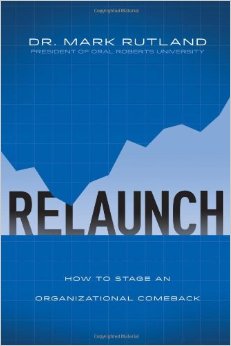
Relaunch - Rutland - Cover

Mark Rutland, Relaunch: How to Stage an Organizational Comeback (Colorado Springs, CO: Cook, 2013), hardback, 206 pages.

A walk in the clearance section (because I hate paying full price) of my local Lifeway Christian bookstore led me to the present volume on leadership. The price, packaging, and presentation of this David C. Cook book persuaded me to purchase it. I am very thankful I did and now I feel I’m playing catch-up on leadership insights from Dr. Mark Rutland.

Dr. Mark Rutland has 13 books under his belt that can be obtained in many formats, and he also maintains an active teaching, humanitarian and blogging presence through his National Institute of Christian Leadership and Global Servants organization. In Relaunch, Rutland provides insights into his ministerial roles as Associate Pastor (Mt. Paran Church of God) and Senior Pastor (Calvary Assembly of God), and his presidential posts (Southeastern University, Oral Roberts University). These experiences serve as a springboard to show his credibility to speak to leaders about the core issues of turnaround leadership in a variety of settings.

ReLaunch: A Survey

ReLaunch is about turnaround leadership. It is comprised of 14 chapters, arranged in three parts followed by an epilogue all wrapped within 206 pages. In Part 1 (chapters 1-4), Rutland casts a common-sense vision for understanding the intangible nature of leadership. Leadership is, in a nutshell, the art and skill to understand an organization’s goal and dream and to connect all its actions into realizing the dream, so that when the leader’s work is “done” the organization is in a better position for the next person to lead. Leadership then is to make the dream a reality by being the everyday “driving force” behind this achievement.[1] Here, Rutland spends some time surveying key experiences within three organizations’ turnarounds (Calvary Assembly of God, Southeastern University, and Oral Roberts University).

In Part 2 (5-11), Rutland articulates and sets forth seven steps that are critical to turnaround leadership within a failing organization. Turnaround leadership, according to Rutland, cannot be accomplished without facing institutional reality and communicating the organization’s vision relentlessly from top to bottom (Steps 1-2). Turnaround leadership must focus on alignment for the organization within the correct niche market, by its message, and through the most effective medium (Step 3). This requires creating an executable strategy by finding which system within your organization that can make the most impact (Step 4). Rutland demonstrates that in a turnaround you must either restore or create the organization’s dream and this is done by shifting its internal culture so that its members can support the organization’s promise to the world (Step 5); moreover, this fuels the need to keep an eye on quality, which is to say it that the organization clearly delivers what it publically promises (Step 6). Finally, Rutland underscores the psychological importance of measuring and celebrating success within a turnaround because these actions promote meaning and value, and generate higher levels of positive energy within the members of the organization as they drive towards turnaround (Step 7).

In Part 3 (12-14), Rutland closes ReLaunch with a section on how to build a turnaround team. I believe these chapters alone would be worth the purchase of the book. The premise of building a turnaround team is to have the proper alignment within the organization. In such a case, adding new members (“hiring”) who fit the goals, vision, and culture of the turnaround is critical because, otherwise, you are starting “the old cycle over again.”[2]  This boils down to finding the right person, at the right time, for the right reason (“job”). Rutland spends time developing a system he uses to put the right people in the right roles (his helpful Finder-Binder-Minder-Grinder system). Unfortunately, the changes which take place during a turnaround are hard for the established members (employees, board members, volunteers, etc.) of the organization. Rutland discusses, then, the last resort a turnaround leader must face when preexisting employees can not adjust – he talks about the troubling art of firing. Rutland shows compassionate insight. It is important to clearly promote your new vision and continue to hold everyone accountable to this turnaround goal to recapture the old dream (or create a new one). He counsels, “Some can make the change. Some can be retrained. But not everyone can make the turn.”[3] Finally, Rutland addresses the importance of forming a board and sketches the difference between an emotional (undependable) board, a legalistic (robotic; holds to if-then thinking) board, and a holistic (balances the tensions found in emotional/legalistic thinking) board. Rutland praises those boards which respect their limits, support their leader’s role in the organization, and “empowers” their leader to do their best.

ReLaunch ends with the Epilogue where Rutland speaks to the inner life of the turnaround leader. It is honest, frank, and interwoven with experience of a leader who has “nosedived” and had his own inner turnaround within his life and family. Rutland warns that a leader must keep pushing forward and never fall into the trap that defeat or victory are final experiences. Also, leadership is costly because it is all-consuming: “There is always a cost.”[4] I found a sense of great depth when Rutland discusses “the most important truth” he has learned: to be a healthy leader, “stay free in God’s hand.” In other words, be willing to take the roles you are “called” into, execute its duties faithfully, but understand that you do not need to have it; moreover, learn that you can be “good” (acceptance) if you have to leave that role. Your identity should not be tied to your role, but instead, tied to your God.

Strengths and Weaknesses

ReLaunch is about turnaround leadership and Rutland succeeds in providing the key principles and steps which can deliver what he himself has accomplished and promises – turnaround. Rutland clearly articulates, with a narrator’s voice, addressing the philosophical terrain of turnaround realities. There is no fluff in this book, it is direct honesty, based on real-life examples and personal illustrations. If anything, ReLaunch provides excellent insights on how to point out the turnaround benchmarks when discussing the future of your congregation, school, and organization. This is not a book on theory alone, but practice, and framed by someone who has lived on the front lines. The seven steps are “shovel ready” and await a bold leader to employ them when faced with the need to stage an organizational comeback. ReLaunch is a real book for real leaders.

I found the leadership insight focused as Rutland epitomizes his definition of leadership as tethering all of an organization’s parts to its dream and goals. This is particularly displayed in this compassion and awareness when discussing hiring and firing team members during the turnaround. Also, Rutland’s experience with working with a board demonstrates the common problems felt not only in the business world but also in the church. It illuminates that even within churches elderships (“boards”) may not always embrace a healthy culture (emotional, legalistic). Too many times, we tie such roles with a right to be right, but Rutland shows that boards and elderships may be vulnerable to being imbalanced. Rutland is spot on.

If I had to make a critique regarding ReLaunch it would be in terms of its top-down leadership approach (as assumed in the book) and its application to the leadership model of the church as revealed in the New Testament. Dr. Rutland assumes the equivalent role of pastor and preacher which is common in many circles of Christendom.[5] The New Testament does not make these equivalent roles, instead, a pastor (= elder, overseer) is a distinct responsibility that applies to a very uniquely qualified man, as he serves within a group of other men of equal caliber. This does not apply to the role of preacher or evangelist.[6] This is not to say that mentors cannot shepherd their fellow believers, but in terms of a distinct church role, the terms are not equivalent. Still, this does not undermine the richness and essence of the book, but it does begin the leadership discussion from a different point than the New Testament. Rutland would probably disagree with that assessment.

Of course, Rutland addresses a readership from a broad spectrum. ReLaunch is not specifically a church leadership book, it is a book that may apply to a ministerial context like mine among churches of Christ. Nevertheless, the preacher often finds the need to be the Chief Culture Officer (CCO) of the congregation; consequently, a preacher can within their role help lead an organizational comeback with the cooperative efforts of their overseeing eldership. But, as Ron Clark observes, “few books are written specifically for ministers about our style of ministry” where the pastor and the preacher are distinct ministries in the body of Christ. Clark observes that most church leadership material is based upon church models which are dissimilar to churches of Christ, or based upon business models which have been given a Christian spin.[7] Again, this is not to say the principles are not applicable, nor does this speak to the quality of ReLaunch. The quality of the content of the book exceeded my expectations.

Recommendations

Aside from the exception and critique provided above, Dr. Mark Rutland provides a leadership model that is exceptional. An administrator, board member, president, father and mother, elder, preacher, deacon, and if there is anyone in between can yield a great deal of practical wisdom for a turnaround in their public and professional lives but also in their private lives. The principles in ReLaunch and their capacity to effect meaningful change have broad applications.

I would recommend this book to every leader in any context. I would also recommend ReLaunch to every incoming preacher entering an established church, and to every incoming administrator entering a new organization. I would also recommend this book to every elder and leader who believe their church, ministry, or organization is in decline. The truth is, every organization needs to ReLaunch at times. We must at times create a new dream, but most of the time we must recapture the dream and relaunch it to do so. Jesus even told the church in Ephesus to relaunch, “But I have this against you, that you have abandoned the love you had at first. Remember therefore from where you have fallen; repent, and do the works you did at first” (Rev 2:4-5 ESV).[8]

Endnotes

  1. Rutland says, “Some dream well. Some define well. Others may tether well or excel at organizing. The art, though -the great craft of leading others- is the connection between the dream, its proclamation, and making the dream the driving force of everything that is done” (23).
  2. Rutland warns, “You can’t let the people who are devoted to the old ways do the hiring, or else you’ll just start the old cycle over again. You’re cultivating the soil in which your new vision and culture can grow” (161).
  3. Rutland counsels, “when you are honest about your expectations, and your team members are honest about their ability and their commitment, parting ways doesn’t have to be a crisis or a drama. In the end, you have to articulate exactly what you expect from your employees. You have to hold people accountable. If you’re going to turn a ship, there are going to be people who did things a certain way to get them into this mess. Some can make the change. Some can be retrained. But not everybody can make the turn. You need to communicate this to your staff long before it becomes an issue” (174).
  4. Rutland frankly says, “There is always a cost. If we don’t consider it before we begin to lead, then the cost may catch us by surprise midcourse. Emotional and mental exhaustion can lead to a dangerous level of toxicity” (198).
  5. By Christendom I mean to describe all religious groups (denominations, non-denominations, etc.) which historically follow Jesus of Nazareth as God’s Messiah (Christ), and accept the Bible as the revealed word of God. I make a distinction between Christendom and Christianity revealed in the New Testament and supported by the Hebrew Scriptures.
  6. I have written several essays in connection to elders, overseers (“guardians”), and pastors. They are available on my blog: “‘Is the Pastor In?’: A Brief Look at a Misnomer,” “Guardians of the Church: A Reading of 1 Timothy 3:1-7,” and “Organizing God’s House in 1-2 Timothy and Titus.”
  7. Ron Clark, Emerging Elders: Developing Shepherds in God’s Image (Abilene, TX: Leafwood Publishers, 2008), 9; Jovan Payes, “Book Review: Emerging Elders,” BiblicalFaith.wordpress.com.
  8. English Standard Version of the Holy Bible (Wheaton, IL: Crossway, 2001).