The Word of God among the Denominations

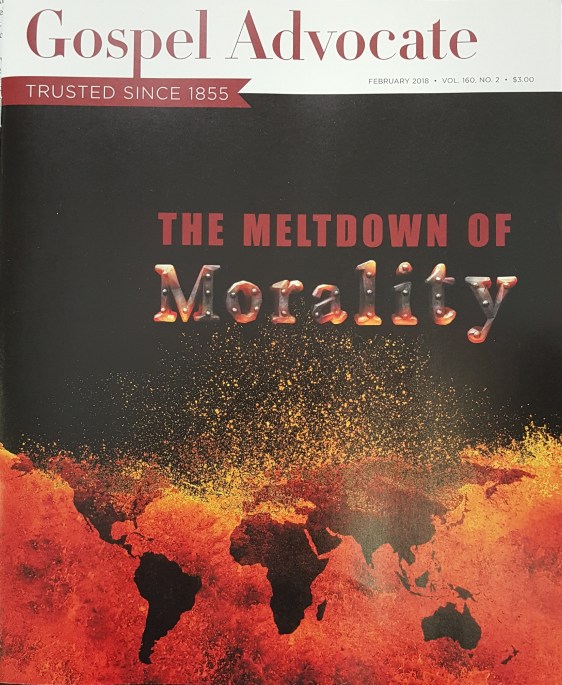
Reprinted with permission from the February 2018 issue of Gospel Advocate Magazine.

20180124_150851.jpg

Hebrews affirms, “For the word of God is living and active, sharper than any two-edged sword, piercing to the division of soul and of spirit, of joints and of marrow, and discerning the thoughts and intentions of the heart” (4:12 ESV). This is part of a warning in Hebrews, which affirms that Christians who defect from God will fail to meet their rest as their Israelite counterparts did (vv. 1-11). God holds his people —and His creation— accountable by His presence (“sight”) in the word of God (Hebrews 4:13). This is a raw incontrovertible truth.

This passage makes no caveats; it makes no attempt to remedy a distinction between God’s word and God’s presence. They are both manifested at the same time. God is involved with real life (time and space) with Israel and with Christians. God makes promises and keeps his word regarding their “rest,” and God holds His people and creation accountable to His word. God is Lord of heaven and earth and everything in between, and He holds it together by the power residing in Jesus (Hebrews 1:3; Colossians 1:17). The word of God is connected not only to the authority of God but also to His nature and how He reveals Himself to the world.

Let me say the above in a differently. Our God, who is beyond time and space (God’s transcendence), enters our earthly “realm” bound by time and space (God’s immanence) with His divinity and authority (sovereignty) intact; furthermore, God enters into relationship with His creation (Abraham, Israel, Christians) by revealing Himself in creation and in His word. God is active both in creation and in His word. Creation reveals God’s existence and hints at elements of His attributes (natural theology), but it is His word that reveals God and His “will” so that humanity can enter into covenant with God. The word of God was both proclaimed orally through particular spokesmen (patriarchs, prophets, kings, apostles), but the prophetic word was not only through oracles but also in written communiqués embedded with the same divine authority (2 Peter 1:16–21). These writings reveal the mind of God (1 Corinthians 2:11–16), His purposes and mystery (Ephesians 3:1–6), His involvement in human events (Acts 17:26–27), and the righteousness by which He will bring justice to the world (Acts 17:30–31).

To say it bluntly, the Bible is the word of God set in a permanent written form. Paul declared, “all scripture is breathed out by God” (2 Timothy 3:16). The Scripture bears the character of God and is no “dead” codebook, for it transforms every “man of God” into a competent, equipped servant (2 Timothy 3:17). The profitability of all Scripture is due to its quality as “God’s breath.” There is no pecking order between the spoken or written word of God. The inspired written word is as inerrant as God’s character. There is no source outside of the Holy Spirit-given Scripture that speaks God’s transforming work since it is the depository of the gospel’s message. What the word of God promises, God will do; what God proclaims, God’s holds His creation accountable to (1 Thessalonians 2:13).

The above may seem to belabor the point, but as anticipated by the title of this piece, we will sketch how the word of God is handled among Liberal (Modern) and Neoorthodox influences. It is essential for the church to reflect on these twentieth-century influences because dialogue is healthy, truth has nothing from which to hide, and any redefinition of biblical Christianity must be given due consideration (Galatians 1:6-7).

The following historical sketches will probably not satisfy everyone, but they will be enough to see their direction and how they redefine significant elements of historic Christian beliefs and their tendency to subvert scriptural authority.

Liberalism/Modernism

The word “liberal” is a very loaded word. It is often used with contempt to show disapproval of someone else thought to be progressive (instrumental music, expanded role of women, etc.). But this is not the historic sense of the word. Liberalism emerged in the late nineteenth century through the interplay of many players, thinkers, and philosophical trends. The influence of Liberalism, or Modernism, is seen in three levels: (1) revelation is not the final answer to reality, (2) naturalism is the key to reality and religion, and (3) since the Christian documents are built on ancient myths and superstitions, the historic supernatural claims of Christianity is immaterial. To be a “Christian” is a matter of experience and the “essence” of its teaching.

Liberalism, as an intellectual revolution, is a child of the Age of Reason (the Enlightenment). The “Age” saw the elevation of human reason over the institutional “church,” which wielded divine revelation. It was “the church” that dictated to the people what to believe about reality. Divine revelation was the final answer to determining truth and what really happened in the past. This was displaced with rationalism, scientific history (criticism), and naturalism as final answers to genuine and authentic history and truth. In essence, as Stanley Grenz and Roger Olsen point out, the maxim “I believe in order that I may understand” was turned to “I believe what I can understand.”[1] Faith was overturned by a reason informed by modern findings — thus, this point of view is called “Modernism.”

Everything that was received as genuine knowledge, now, was shaped by the natural world. This was further supported by what is called “the principle of analogy,” popularized by the liberal theologian Ernst Troelsch (1865–1923), which argued that the present is the best way to understand the past. The consequence was detrimental in the extreme on the trustworthiness of Scripture. The supernatural elements interwoven in Scripture are, by definition, myths and superstitions. This meant that there are no miracles, no supernatural interventions by God, and no resurrection of Jesus Christ. Thus, many new schools of “criticism” emerged to study Scripture with mixed results.

This naturally led to an embrace of “the essence of Christianity” so long as reason and experience allowed. “Liberals” are open to the modern findings from the natural world, open to a religious humanism and science —in particularly embracing Darwinian evolution as the process by which God created. If God exists, He could only be revealed through religious “experience.” It was also immaterial if the events of Scripture happened or not because religion is a condition of the heart. Yet, the apostle Paul makes it abundantly clear that if the resurrection event has not occurred, both our preaching and faith are in vain and we are still in our sins (1 Corinthians 15:14, 17).

Another arm of Liberalism is the demythologizing of the New Testament pioneered by the “Form Critic” Rudolf Bultmann (1884–1976). Bultmann argued that historic person of Jesus is built on untrustworthy sources. The New Testament is Christian propaganda shrouded in the imagery of the Greek myths and Roman legends. As such, they are not relevant for faith nor spiritual truth claims. It is the symbolism that matters. Today, one only need to watch the latest “history” programming to find modern theological liberals interviewed. Theological liberalism has significant questions that need to be answered, but it brings Christianity to a logical dead end.

Neoorthodoxy

The Swiss theologian Karl Barth (1886–1968) ignited a movement when he published his commentary on Romans in 1919. It charted a new theological direction away from Liberalism/Modernism. Barth (pronounced “bart”) was not fond of the misnomer “neoorthodoxy,” but his strand of thinking regarding the meaning of “revelation” and “the word of God” would rival the prevailing traditional belief held historically by the church. As a consequence, many regard Barth as one of the great theologians and the father of modern theology.

Orthodoxy affirms the teaching of historic Christian truth based on Scripture. This includes, for example, the following concepts: the inerrant inspiration of scripture, the triune Godhead, the deity and virgin birth of Christ, the historic creation and fall of humanity, the bodily resurrection and ascension of Christ, the return and final judgment. Barth argued, on the other hand, that “revealed truth” was not written, but was the outcome of an encounter (an experience) with God. Thus, instead of scripture as being the objective word of God, Barth argued for a subjective experience with God initiated by reading the Bible.

Barth was offering a completely different course of thought altogether. “Revelation” does not appear in the form of propositional truths. Arguing book, chapter, verse, or appeals to the very words of scripture is insufficient to reveal God. Revelation (the word of God), it is argued, is an “event” in which God acts in history (God’s immanence). Barth even argued that revelation is not found in natural theology (Acts 17; Psalm 19; Romans 1) but, instead, in events like the call of Abraham, the exodus, and the resurrection. Millard Erickson is spot on when he classifies Neoorthodoxy as an illumination theory divorced from an objective standard.[2]

Although Neoorthodoxy is not a unified movement, there are three interconnected witnesses (modes/forms) that shape its view on revelation.[3] First, Jesus is the word of God in the truest sense, for He reveals God in the event of His incarnation, life, ministry, death and resurrection. This is true revelation, the very gospel. Second, Scripture points to Jesus but it is a flawed human (read “errant”) attempt to provide a witness to divine revelation. It is instrumentally God’s word but not properly. Third, the proclamation within the faith community —Barth preferred “community” to church— is likewise instrumentally God’s word. The Bible, then, only becomes God’s word when God uses it to reveal Jesus Christ in the encounter, contrary to 2 Timothy 3:16.

In fact, Neo-orthodoxy is quite a popular approach to handling the Word of God, even among churches of Christ. A popular theological branch of this movement is “Canonical Criticism,” popularized by the late American scholar Brevard Childs (1923–2007). It seeks to broadly bypass much of the liberal destructive criticism of the twentieth century by accepting the texts of Scripture as literary units. Nevertheless, this point of view struggles, as did Barth’s, to embrace the Bible as a very human (errant) book while appealing to its authority for theological thought as if they were inerrant. They seek, in the words of one sympathetic Abilene Christian University professor, to “articulate a doctrine of Scripture that recognizes human flaws in it.”[4] Treating the Bible as an inerrant text is simply a form of bibliolatry.

Keeping the Faith

Today, the phrase “Word of God” means different things to different believers, and that includes preachers. Liberalism ultimately rejects a supernatural Christian faith, and is at home with amputating its historic claims of a resurrected ascended Lord Jesus, in exchange for a subjective diluted Christianity. Neoorthodoxy, on the other hand, embraces a supernatural Christian faith, but it rejects the supernatural origin, inerrancy, and authority of the Scriptures which undergird its claims. The Word of God has always been a manifestation of God’s presence in our lives, in His proclamation, and in His Scripture without pecking order. Let us join Paul who declares, “Let God be true though every one were a liar” (Romans 3:4).

Notes

  1. Stanley J. Grenz and Roger E. Olsen, 20th Century Theology (Downers Grove: InterVarsity, 1992), 17.
  2. Millard J. Erickson, Christian Theology, 3rd ed. (Grand Rapids, Baker Academic, 2013), 220–21.
  3. Karl Barth, Evangelical Theology: An Introduction, trans. G. Foley (New York: Holt, 1963), 26–36.
  4. Christopher Hutson, “Scripture as the Human Word of God: Why Faith Contradicts Inerrancy,” Lexington Theological Quarterly 44.1 (2011): 210–21. Hutson serves as a professor of ministry and missions at Abilene Christian University.

To subscribe to Gospel Advocate, click here.


Be the Gift (1 Peter 4:10-11)

It is a staggering thought when you think about it. Christians have gifts to share with their neighbors. Much like the old nativity hymn of the three orient kings, who came from the far east with rich gifts for the newborn king Jesus, Christians have gifts to share with the people they come in contact with every day. In a word, we have a calling. It is greater than Toys for Tots, it is greater than Secret Santa, it is greater than the presents carefully wrapped and laid under the Christmas tree. The gifts Christians have are those which come from God, they are packaged by him and must be shared.

When the apostle Peter wrote to the beleaguered Christians in the northeastern Roman provinces of Asia (1 Peter 1:1), he wrote to encourage them to embrace the slander and the social persecution with the reminder that they walk in the footsteps of Jesus (1 Peter 2:21). For example, should they suffer unjustly —as did Jesus— the suffering will bring about the opportunity to extend grace to the world. Furthermore, the Christian must not focus on the momentary suffering but instead upon God’s validation and vindication. As God vindicated the suffering servant Jesus, so will He vindicate his suffering people (4:1).

As You Have Received God’s Gift

As an extension of this moral encouragement, the apostle goes on to address very practical aspects of Christian living in chapter 4. Here is an excellent moment to pause and reflect upon the truth that doctrinal purity is important, but these Christians are called to practice godliness in the face of persecution. In one of the summarizing passages of this exhortation, Peter writes the following:

As each has received a gift, use it to serve one another, as good stewards of God’s varied grace: whoever speaks, as one who speaks oracles of God; whoever serves, as one who serves by the strength that God supplies—in order that in everything God may be glorified through Jesus Christ. To him belong glory and dominion forever and ever. Amen. (1 Peter 4:10–11 ESV)

A point that is not readily notable from the English version is the connection between gift (charisma) and grace (charitos) in verse 10. They are built on the same word root, which was interconnected at the social level. It portrays God as a benefactor —a gift giver— for his people and asks them (us) to also be gift-givers (benefactors) as well.

This makes the term “good stewards” (oikonomoi) equally enlightening. It is a word that has domestic and political usage, and this usage is seen in the New Testament documents. In the ESV, the word is translated as “manager” of domestic affairs (Luke 12:42, 16:1, 3, 8; Gal 4:2), and once as “treasurer” which would have been a political office in Rome (Rom 16:23). As here in 1 Peter 4:10, “steward” in passages that emphasizes a conservatorship over a given responsibility (1 Cor 4:1-2, Tit 1:7). It was a well known Greco-Roman phenomenon that members of a benefactor’s household were also “brokers” of the gifts of the head of their household. The imagery of Peter’s message is parallel to this type of behavior.

Christians as members of God’s house are blessed by their Father’s gifts so that they may be brokers of God’s grace. We are in a very real way representatives of God’s house and what we offer in a variety of ways is the very gift of God — Jesus Christ and the gospel message. We are to teach it, we are to proclaim it, but most importantly we are to live it. Below, we will consider the points left behind in this section by the Spirit through Peter in verse 11.

Whoever speaks…

One of the overarching themes of the film, Waiting for Superman, a 2010 documentary on the American education system, is that many within the system are waiting for someone to fix it, to do the hard work to shore up its failures. Instead, such systemic problems will only be fixed by teachers and educational leaders working together and initiating helpful and creative programs. There is no one person who can fix the educational system of America, all resources must come together. The same is true with sharing the gift of Jesus and His gospel.

Every Christian (woman and man) must remember that our gift is a gift of words. Not just words, but words of God. For this reason, when a Christian shares the gospel it truly is God’s gift of grace we are sharing. We must not speak our words. We must not speak from our own anger. We must not speak our theories of the word. We must not speak our “pet” religious opinions. We must not speak from any other basis other than from the depository of God’s word — found only in the Scriptures. Our words must be as if it were God talking. God’s word is the only true gift (1 These 2:13).

Whoever serves…

Christian activity is always dramatically presented as services rendered as one who waits on tables, doing as told by their superior (Acts 6:2; John 2:5). Every Christian (woman and man) must remember that our gift is also a gift of action — of service. Christians broker God’s grace with others with the service we render to other people. Edgar Guest was spot on with this passage when he penned the opening lines of his poem, “I’d rather see a sermon than hear one any day; I’d rather one should walk with me than merely tell the way” (“I’d Rather See a Sermon Than Hear One Any Day”). Indeed, there is no greater opportunity in life than to serve as an example of God’s grace to others.

Words can be misunderstood. Actions, however, are less so. But, serving others often comes with a tall price. Service is not convenient emotionally, or physically. It is perhaps for this reason that Peter says that Christians who serve others do so and are empowered by the strength supplied by God. We do not serve others based on our own merits. It is a hard lesson for so many of us, but we need to trust in God for Him to be God when we are serving others. Whether it is food, clothing, or shelter that we offer as expressions of God’s varied graces, we do so, trusting that God will make our service His gift and that alone should empower us to serve.

Concluding Thoughts

Whether it’s the best of times or the worst of times, Christians can make a mark in the world and in the times in which they live. My prayer for all of us is to be the Christians we are called to be. Be the best gift you can be to your family and friends in word and service. Let it be the kind that brings glory to God and not to self. Remember, to say, “it’s not about me… it’s about Him.” “To him belong glory and dominion forever and ever. Amen” (4:11).


The Gospel of Luke

Reprinted with permission from the July 2017 issue of Gospel Advocate Magazine.

20170626_144252.jpgThe Gospel of Luke, like Matthew, Mark, and John, provides a narrative of Jesus that dramatically emphasizes the story and significance of His life and ministry, His rejection and crucifixion, and His resurrection and exaltation. Yet, despite bearing strong similarities with the other inspired accounts, Luke’s approach expands our understanding of Jesus and the working out of God’s plan to bring salvation into the Jewish and Gentile world.


In fact, Luke is the first book of a two-volume set. Luke and Acts are joined at the proverbial hip by their prologues styled in the manner of ancient historical accounts (Luke 1:1-4; Acts 1:1-3). If one is to truly appreciate Luke, one must understand that the ministry of Jesus is but a beginning —a prelude— to the establishment and expansion of the church. Luke is the only Gospel Account that has a sequel (i.e., Acts). Said another way, in relation to Acts, Luke is a prequel. From this broad perspective, then, we can see that Luke purposefully expanded the stories of Jesus’ ministry to include more genuine details, to provide unique emphases, and to show that the ascension was not the end of the redemption story but that it was to be continued by the church.

The Prologue and Purpose

When one pauses to appreciate how each gospel accounts begins, Luke’s prologue to “book one” is set with a series of unique features. In Luke 1:1-4, the inspired text reads in such a way that the reader should see early on that this account is framed along different lines than previous accounts:

Inasmuch as many have undertaken to compile a narrative of the things that have been accomplished among us, just as those who from the beginning were eyewitnesses and ministers of the word have delivered them to us, it seemed good to me also, having followed all things closely for some time past, to write an orderly account for you, most excellent Theophilus, that you may have certainty concerning the things you have been taught. (ESV)

This one sentence in the Greek outlines very clearly the overarching concern of Luke’s gospel account, and it does so in a formal way consistent with ancient Greek historians and medical writers according to Graham N. Stanton in his classic work, The Gospels and Jesus.[1]

Here, Luke acknowledged the presence of other narratives preexisting his own account (Gk. diégesin). Despite their existence, it appeared to be the right time to provide his own inspired account. Luke told us explicitly that his gospel is in keeping with three aspects of early Christian testimony: (1) these preexisting accounts, (2) earliest eyewitness testimony, and (3) those who served to deliver the Word to the world. To be clear, Matthew, Mark, and John demonstrate to have the same concerns, but regarding emphasis, Luke’s account is the clearest. And this feature is most likely due to the sort of audience he seeks to reach that is, people like Theophilus who are interested in the certainty of the events of Jesus’ life and ministry, death and resurrection, and the progress of those who followed Him afterward.

Luke’s Author and Audience

Two more unique feature of Luke is seen in both its author and its recipient, and this speaks to Luke’s heavy emphasis on providing a closely followed and orderly account. Luke, a physician by profession (Col 4:14), is the only known gentile author in Scripture period. That alone is a spectacular fulfillment of the end goal of the gospel to reach the Jews first, and then to the Gentiles (Rom 1:16; Acts 1:8, 13:46-48). Accordingly, Luke became a participant in the work of the Apostle Paul at some point before entering the province of Macedonia (Acts 16:10). Luke includes himself in many of the journeys of Paul, marking them with the terms “we” and “our” or “us” (Acts 16:10-17, 20:5-15, 21:1-18, 27:1-37, 28:1-16).

These “we” sections tell us something very rich about Luke. He is not just an author. Luke was a collaborator and eyewitness of the continuing story of the redemption in the church, who then investigated the origins and narratives regarding Jesus by interacting with eyewitnesses and early teaching of the Word. Luke was a Gentile convert who joined Paul’s missionary fellow workers, and now offered an inspired history of the full gospel story. For this reason, Luke bears many similarities with Matthew and Mark, gospel accounts based upon eyewitness testimony. And, the book of Luke shows that his missionary itinerary screeches to a halt in Jerusalem when Paul is arrested in the Temple and after meeting with James the brother of Jesus (Acts 21:17). It is within reason to point out that Luke had over two years in the Judean region to collect eyewitness accounts while Paul is detained in Caesarea, Philippi, until Paul appealed to Caesar (Acts 21:1-26:32). 

Moreover, unlike Matthew, Mark, and John, Luke names the immediate recipient of his two-volume work, Theophilus (Acts 1:1; Luke 1:1). Many theories and speculations abound regarding the nature of the relationship Theophilus had with Christianity in general and Luke in particular. While his name means “lover of God” or “friend of God,” this was not uncommon in the ancient world, nor in the New Testament (cf. Diotrephes, “nourished by Zeus,” 3 John 9). So, it is not as reasonable as one might think to suggest it is a “code name” for a believer.

What helps our understanding of Theophilus’s connection to Luke is the way he was honored with the term “most excellent” (Gk. kratiste). The word is used four times in the New Testament and all by Luke (Luke 1:3; Acts 23:26, 24:2, 26:25). In Acts, it used when addressing the governors Felix and Festus respectively. In Luke 1:3, there is not enough evidence to suggest such a political status, but it points to, at minimum, the upper-class status of Theophilus and his social circle. This would not be the first time Christianity intersected this social sphere (Romans 16:1-2; Acts 13:1; Philippians 4:22). Thus, Luke’s audience is probably of the intellectual kind, and this fits with his stated purpose and the “better” Greek he used.

It is not surprising then, given Luke’s research and experience, his relationship to Theophilus, and his social circles, that Luke would “write an orderly account for you… that you may have certainty concerning the things you have been taught” (Luke 1:3-4). Luke promises that he is framing his account with an attention to detail —that is, with a strong historical emphasis.

Luke’s Unique Framework

Not a lot of disagreement exists concerning the general outline of Luke. The narrative is relatively straightforward. The following outline of Luke not only provides a survey of the book, but also points out the unique features of this gospel. The Gospel of Luke cannot be understood a part from an emphasis upon the intertwining of history and faith.

Book One: Prologue (1:1-4). As emphasized thus far, Luke begins with a prologue all its own. Like John 20:31, Luke 1:1-4 states the purpose of his Gospel. This is reinforced by Acts 1:1-3, which summarizes that Luke is but the beginning story of “all that Jesus began to do and teach.” There is more to the story of Jesus, and Luke provides a detailed account of it.

Birth Narratives of John and Jesus (1:5-2:52). It is not without significance that Luke provides interwoven birth and youth narratives of John the Baptist and Jesus of Nazareth. Matthew recounts elements of the nativity story during the period of Herod the Great as does Luke. Luke intertwines divine events surrounding John and his family, and Jesus and Mary, anchoring them to real life with the historical lead in “in the days of Herod, king of Judea” (Luke 1:5) and “in those days a decree went out from Caesar Augustus” (2:1). Such passages like Mary’s magnificat (1:46-55) and the two stories of Jesus in the temple (2:22-52) are recorded only here.

Anticipating the Ministry of Jesus (3:1-4:13). Among the “time stamps” Luke employs, 3:1-2 is layered with seven political figures that suggest a window from 27 to 29 for the beginning of the ministries of John the Baptist and the Lord. The intertwining of their stories continue, as John is set up as the voice to anticipate the coming of the “salvation of God” —Jesus (v. 6). Jesus is again anchored to not just history but biblical history and creation itself, as His genealogy begins with his adoptive father’s lineage down to Adam, “the son of God” (3:38), the phrase Jesus would identify with (1:35, 4:3, 9, 41, 20:36, 22:70; Acts 9:20). These are significant unique elements of Luke.

Jesus Ministers in Galilee (4:14-9:50). If one were to read Mark, this section would have many similar events recorded, but Luke expands on them or gives them a fresh twist. One event that is of particular importance for its uniqueness is Jesus reading the Isaiah scroll (Luke 4:17-21; Isaiah 61) in the synagogue, during which He not only declared its fulfillment in Himself, but also revealed what His ministry would look like. It will be a series of reversals (blind see, captives free, etc.). Jesus’ concern for the disenfranchised is witnessed in all the Gospel Accounts, but Luke strongly emphasizes it.

Jesus Travels to Jerusalem (9:51-19:44). This section is often called the “central section” of Luke as it roughly covers ten of its twenty-four chapters. Jesus has “set his face to go to Jerusalem” in anticipation of being “taken up” (9:51). It is unique in that Luke is the only gospel account to record Jesus’ travel route on the eastern side of the Jordan River. It contains some of the most memorable events (rejection in Samaria, the seventy-two sent), parables (Good Samaritan, the Rich Fool, Prodigal Son, Rich Man and Lazarus), encounters (Mary and Martha), and sayings of our Lord (return of the unclean spirit, sign of Jonah). This section is bursting with teaching and events unique among the gospel accounts.

The Passion Week in Jerusalem (19:45-21:38). Here, Luke recounts a series of controversial events leading up to his betrayal and rejection. One immediately sees the unity between the way Matthew, Mark, and Luke chronicle the “passion week.” This includes the challenge of Jesus’ authority, paying taxes to Caesar, the resurrection, the question regarding the lordship of Christ, and the prediction of the destruction of the temple in AD 70. The section concludes with a summary statement.

From Shame to Exaltation (22:1-24:53). One of the unique elements in this section is the portrayal of the institution of the Lord’s Supper and the cup-bread-cup scenario. It is not that Luke makes a mistake here, but that it perhaps reflects the practice of having four cups employed during the Passover. Another unique feature of this section is in the resurrection appearances —in particular, on the road to Emmaus where two disciples find a Jesus “in hiding.” They recount this event along with their sense of a loss of hope until they connect the dots that this was Jesus. These are the details that provide a sense of uniqueness of Luke’s gospel.

Conclusion

Luke, along with Acts, were probably published and sent to Theophilus around AD 70. Acts ends with Paul under house arrest for two years in Rome, awaiting his case to be heard by Caesar (Acts 28:30-31). This is a few years before his death, which is traditionally dated to the time of Nero (AD 54-68; Eusebius, Ecclesiastical History 2.25.5). At the time of publication, we should picture Luke as a veteran evangelist, an experienced missionary who has researched the ancient origins of the faith. He was addressing those engaged by the story of Jesus who wish more details and certainty. His inspired record, then, is offered as a powerful demonstration of the historical basis of the claims of Christianity.

Endnotes

  1. Graham N. Stanton, The Gospel and Jesus, eds. Peter R. Ackroyd and Graham N. Stanton (Oxford: Oxford University Press, 1989), 83.

Jovan Payes preaches for the Highland Church of Christ in Bakersfield, California.

To subscribe to Gospel Advocate, click here.

Regarding the Divide Between the Christ of Faith and the Jesus of History

college papers

There is a long-standing view that an impassible divide exists between the Jesus of history and the Christ of faith. This paper is about crossing this epistemic divide centered on what can be known about Jesus. Many scholars believe this divide cannot be bridged, but this paper argues that it can. This challenge reminds me of two cautionary tales.

Growing up in San Francisco, I was surrounded by bridges. Traveling northbound from the San Francisco peninsula, one crosses the Golden Gate Straight by virtue of the world-famous Golden Gate Bridge. Traveling eastbound, out of “the city,” there is the less famous double-stacked Oakland Bay Bridge, which is the workhorse among the Bay Area bridges. There are two events connected to these bridges that have taught me two relevant lessons.

First, few know that many said the Golden Gate straight could not be bridged. In fact, engineering experts said a bridge would never be built because the straight was too long, the winds were too strong, the waters would be a nightmare for construction, and the fog would further hamper the process. Yet, four years of construction (1933-1937) later, the impossible expanse was built. Sometimes, the naysayers give you the planks upon which to build your bridge.

Second, during the 6.9m 1989 Loma Prieta earthquake, a large section of the top-level (outbound) of the Bay Bridge collapsed. I watched, on a small battery-powered radio/tv, a news report of a vehicle attempting to jump the divide, only to fail tragically. The vehicle had no ability to jump the gap. I learned that day that hope is not enough to cross a wide gap. We must evaluate the evidence to “look before we leap.”

Christianity and the Impassable Divide

These anecdotes inspire me to challenge the so-called “impassable” ditch at hand. It is not a small challenge, for the claim has been made by some of the sharpest minds in “thinking” history. It is, nevertheless, part of the calling of every Christian to be “prepared to make a defense to anyone who asks you for a reason for the hope that is in you” (1 Pet 3:15 ESV).[1] Peter was aware that Christians will be called upon to explain the connection between their behavior and their conviction in Jesus as Lord (1 Pet 4:1-5). Life and faith converge in Jesus. What some would argue is an impassable gulf -reality and value/significance- was the connective tissues of a Christian ethical apologetic. It may be argued, then, that first-century Christians were already crossing the “impassable” bridge between the Jesus of history and the Christ of faith.

Peter anticipated no epistemic difficulty -no crisis- explaining how “Jesus as Lord” connects with significance to the everyday issues of his life and his future. Accordingly, this early text assumes that the full identity of Jesus held an immediate significance to the lives of struggling Christians. It is the result of both his historic existence and his spiritual Lordship viewed as one tightly interwoven reality. This “interwoven reality” is not, however, the view of many within the academic circles of biblical and philosophical criticism.

This issue at hand is multifaceted and complicated, but it is not insurmountable nor impassable. One must evaluate the evidence and acknowledge the complexity of the problem at hand in order to offer a solution. For instance, there is a large time-gap between today and the first-century. This raises a lot of genuine historical questions all by itself concerning sources which provide any measure of access to Jesus. Further, those ancient sources must be evaluated to test their genuineness to weigh their authenticity and accuracy to verify if they are primary or secondary sources, literary or non-literary sources. These and many other questions are used to evaluate ancient sources that allow the historian to reconstruct a probable and revisable picture of the ancient past. If the current matter were simply an issue regarding sources, then there are numerous literary sources from the first-century which point to Jesus, the events and personalities surrounding his ministry, his death, and the belief and practices of early Christians. Many have discussed and debated these sources,[2] but the tension at hand focuses on a level a bit “deeper” than literary sources (though they will be considered).

At its core, the problem at hand is epistemic; that is, it centers on “how” knowledge is obtained, how knowledge connects the self “within” (internal) to the world “without” (external).[3] David Lipe briefly summarizes it as, “the study of the origin, nature, extent and reliability of knowledge.”[4] Vergilius Ferm points out that epistemology seeks to answer the following questions:

What is the source of human knowledge? What are its limitations? How do we come by our knowledge of the external world, of ourselves, of others? How can we trust our ideas as valid?[5]

“Epistemology,” in Twentieth Century Encyclopedia of Religious Knowledge, ed. Lefferts A. Loetscher (Baker Books, 1955)

Schools of thought, such as empiricism and rationalism, and the debates which they create have formed the basis of the dichotomy that pits the “historical Jesus” against the Christ faith-claim. In particular, with rationalism (Decartes, Spinoza, Leibniz), mind (a priori) is regarded as being given authority/primacy over the senses (a posteriori); that is, a priori knowledge is superior to a posteriori knowledge. Conclusions drawn would be deductively reasoned knowledge such as Aristotle’s “laws of thought.” On the other hand, empiricism (Locke, Berkeley, Hume) approaches knowledge from the other direction -the senses/experience; that is, a posteriori knowledge is regarded superior to a priori knowledge. This would be inductively experienced knowledge grounded in life.[6]

Enter Immanuel Kan (1724-1804). In the late eighteenth century, Kant would attempt to split the difference by attempting to synthesize and hold both in tension. That is, we can know “how” we know something, but the knowledge is completely subjective. Knowledge is only a perception, a “representation,” and not actually real to life (the thing in-itself).[7] Kant develops the thought this way:

all our intuition is nothing but the representation of appearance; that the things that we intuit are not in themselves what we intuit them to be, nor are their relations so constituted in themselves as they appear to us; and that if we remove our own subject or even only the subjective constitution of the senses in general, then all constitution, all relations of objects in space and time, indeed space and time themselves would disappear, and as appearances they cannot exist in themselves, but only in us. What may be the case with objects in themselves and abstracted from all this receptivity of our sensibility remains entirely unknown to us.[8]

Michael Rohlf, “Immanuel Kant,” https://plato.stanford.edu/index.html

Yet, as Norman Geisler points out, Kant’s epistemology results into a self-defeating “philosophical agnosticism.”[9] Attempts like these to explain how we obtain knowledge is at the core of the so-called impassable gulf between the Jesus of history and the Christ of faith.

The Contours of the Impassable Divide

This debate fundamentally represents the struggle between connecting the tangible to the intangible, life and significance, the historic and the historical. In addition to a number of certain epistemic concerns, the divide is infused with an anti-supernatural bias which has manifested in at least five forms.[10] They are summarized briefly here, with the danger of oversimplification:

  • Gotthold E. Lessing (1729-1781) argued that there is an “ugly ditch” between historical contingent truths and the eternal necessary truths. His “ugly ditch” language has essentially framed the whole conversation.
  • Immanuel Kant (1724-1804) argued that there is a gulf between facts (contingent truths) and values (experience/reasons) that cannot be bridged but by faith (not knowledge).
  • Martin Kähler (1835-1912) expressed his concern for a reconstructed (historical) Jesus that must be mediated by the trained hands of critical scholarship. Kähler affirmed an impassable divide between the historical (reconstructed) Jesus and the historic (real) Jesus that cannot be cross unless by faith evoked by the historic Jesus. 
  • Søren Kierkegaard (1813-1855) viewed that the “historical” has no connection to the eternal, so real history is immaterial to the “leap of faith” toward the spiritual/eternal.
  • Rudolph Bultmann (1884-1976), argued that Jesus —as built on untrustworthy sources (Christian testimony, myths, and legends)— is not relevant for faith nor spiritual truth claims. It is the symbolism that matters at an existential level, that is, the meaning intended by such “sources.”

These all reflect a gap, a ditch, a divide, for which it is claimed that they cannot be bridged. It will be, then, the approach of this paper to first briefly critique the arguments for this impassable gap. Then, attention will be given to ancient sources, both within the New Testament canon and outside the New Testament canon to demonstrate that history and value claims must be intertwined to make sense of evidence. From this, provisional conclusions will be made that are reasonable and consistent with this evidence.

Critique of the Impassable Gap of the Historical Quest

The problem with the arguments used to articulate the dichotomy of the Jesus of history and the Christ of faith are typically self-defeating and beg the question at the methodological level. The “gap” issue significantly touches on the crux of the quest for historical Jesus. Albert Schweitzer (1875-1965) points to Lessing’s publication of Herman S. Reimarus’ Fragments in which Reimarus separates what the apostles said about Jesus from what Jesus said about himself.[11] Since Schweitzer, the publication of Fragments has been viewed as the early stages of the quest for the historical Jesus.

Gotthold E. Lessing

Reimarus influenced Lessing, and who in turn, affirmed a tension between the relationship of history and revelation. Lessing states this as “the ugly broad ditch”; namely, “accidental truths of history can never become the proof of necessary truths of reason [and revelation].”[12] For Lessing, a Spinozan pantheistic deist, there is no supernaturalism in the world. So, events are fortuitous (accidental) and have no meaning/significance of themselves. Why, because like Spinoza, Lessing argues that since God is immanent and extends throughout creation, he naturally governs the world with its unbreakable natural law. Accordingly, supernatural activity (miracles, providence, etc) is impossible because to do so would violate his own nature as expressed in natural law. Thus, miracles are impossible and God does not reveal himself in history. Thus, Jesus the real-person (a posteriori) is not associated with the faith-truth as the Christ (a priori) by definition. In fact, no religious claim can be absolutely true.

Lessing’s argument, however, presumes that “natural law” is inflexible. A further problem in Lessing’s epistemology is its self-defeating agnosticism that not only arbitrarily forces a divide between history and truth. For, in order to make the observation (a posteriori) that history and value (a priori) are detached from one another, Lessing must make an absolute value statement based on how history and value relate to each other historically. So, Lessing is doing what his thesis says is impossible to do: to intertwine history and evaluative judgments.

Immanuel Kant

This is essentially the same fundamental flaw in Immanuel Kant’s agnosticism (that he knows that one can perceive but not know a thing in itself). Again, Kant says,

We are acquainted with nothing except our way of perceiving them, which is peculiar to us, and which therefore does not necessarily pertain to every being, though to be sure it pertains to every human being.[13]

Quoted in Rohlf, “Immanuel Kant.”

People only know what they think they know, and what they know is not necessarily true “in itself.” This is the tension of his contradictions (“antinomies”) which, therefore, force him to reject a priori (and ontologically) arguments for believing a thing to be true in itself. For example, what is logically necessary, is not actually necessary.[14] Consequently, the Bible is not the result of God adapting to human finiteness (which is logically necessary) but is instead a book of mythology. It is not actually necessary that the Bible be from God, and such a truth claim is only a perception. Instead, what has more logical value and tangible significance to Kant is one’s duty to their neighbor.[15] Thus, the events of Jesus portrayed in the Gospels, then, is a subjective statement of a spiritual truth-claim that Jesus is the Christ of faith.

In order for Kant to make this claim (that we only know perceptions, no what is real in-itself), he is must make an absolute truth (a priori) claim in a world that he has argued can only be perceived in a subjective manner. Kant self-defeats himself by crossing the divine he denies is possible cross. Would not the argument, “I know for certain that it is impossible to know a thing in itself” argue that Kant knows this as a historical truth claim in itself? Kant derails himself.

Søren Kierkegaard

Kierkegaard argued for a dichotomy which “real history” is unimportant to faith, or rather, that it is impossible to move from the historical toward the spiritual. Kierkegaard finds no causation between a historical event and meaning (its value, or truth). In fact, this is his great paradox when it comes to truth claims since human knowledge is unable to have certainty about meaning and significance. Thus, for example, spiritual truth is beyond human rationality. For Kierkegaard seeking how to explain or understand the nature of God, one enters a paradox/contradiction. The act to explain the nature of God, is in effect, to limit a full understanding of God. To be certain about something is to limit what can be known about something.

In this sense faith —in particular, Christian faith— is a different beast altogether, for it carries within it a built-in certainty to its truth claims. In Kierkegaard’s view, it is purely nonsense that by understanding what happens in history (Jesus of history), one can obtain knowledge of the contradiction — the non-historical (Jesus of faith). Therefore, fact and history are not as important to Kierkegaard as the “leap of faith.” The problem is, as Geisler sums up, “while the historical as such does not bring one into contact wth the eternal, neither can the eternal be divorced from real history.”[16] Yet, Kiekergaard’s case proves too much on this point, for “the shift in emphasis from fact to value leads to the denial of fact and its support of faith.” It is not that all of his observations are to be dismissed, but he undermines the role of fact to understand value-claims.

Martin Kähler

Martin Kähler, who builds on Kant, also voiced his concern that the “real Christ” is not the Christ of Faith. This point is easily misunderstood. Kähler rightly argued that historical research should inform faith, so he was loved by liberals but hated by conservatives. Kähler also rejected attempts to separate the Jesus of history from the Christ of faith and was loved by conservatives and hated by liberals. He served, therefore, as a middle ground historical critic, who was “loved” and “hated” by conservative and liberals but for different reasons. Kähler coined the phrases “historical Jesus” (historische) and “historic Jesus” (geschichtliche), yet what he meant by the terms is not how most employ the term today. The “historical Jesus,” according to Kähler is a reconstructed Jesus based on scholarship which may, or may not correspond to the “historic Jesus” — that is, the real-life Jesus. Kähler took issue with equation the two.[17]

It came down to two problems. First, there is limited knowledge, or the lack thereof, to sufficiently “reconstruct” Jesus. Second, believers are at the mercy of the “fluid results” of scholarly reconstructions about Jesus. Jesus was, therefore, mediated by the elite scholars. For this reason, Kähler declares, “the real Christ, that is, the influential Christ, with whom millions in history have had fellowship in a childlike faith… is the preached Christ.”[18] The proclaimed Christ solved this problem. For this reason, Kähler made a distinction between the “historical Jesus” from the “historic Jesus.”

The line he draws on this point, between the two, is too strong and undermines the fact that the New Testament builds its case upon sources which are built on eyewitness accounts (Luke 1:1-4; Acts 1:1-3). Even if one were to argue that there is a minimal amount of authentic evidential sources about Jesus, then to that degree a faithful reconstruction of the historic Jesus can be made and understood. Which in many respects is the case for everything that could be said about Jesus of Nazareth has not been recorded (John 20:30; 21:25).

Rudolf Bultmann

One of the most significant contributors to the dichotomy of the Jesus of history and the Christ of faith is Bultmann. Bultmann’s significance for New Testament criticism and theology are, according to Ricard N. Soulen and R. Kendall Soulen, equaled by few and excelled by none in the areas of form-criticism and the practice of demythologizing the New Testament.[19] Working on his form-critical methodology, Bultmann differentiated between the sayings of Jesus and the deeds of Jesus (e.g. Reimarus), between the pre-scientific worldview of Jesus’ day and today, and the fact that to accept this worldview would be to sacrifice one’s intellect. Thus, he argued for a non-historical symbolism based upon kerygmatic (proclamation) themes.

What matters from the New Testament point of view, he argued, are the transcendent truths of faith (existential meaning). Thus, the resurrection “myth” did not happen, but what matters is the transcendent truth the “resurrection” is suppose to provide.[20] However, form-criticism, when properly applied is about finding genres and even sub-genres of types of literature within a text(s). It is not inherently anti-supernatural as Bultmann wielded it. In one way, it is a tool for genre classification. In another, it provides the framework for what tools an exegete may require for interpretation.[21]

Yet, Bultmann infused his approach with a naturalism which rejects the supernatural by definition. Consequently, at the methodological level, Bultmann begs the question that miracles are not possible and builds an interpretive framework in which miracles do not make sense. However, if one employs a theistic worldview that leaves the possibility open that miracles are possible,[22] then Bultmann’s approach would not have created his mythological approach to understanding Jesus, which his student Ernst Kasemann viewed as docetic.

Ancient Sources on Jesus of Nazareth

Turning now to consider sources within the New Testament canon and those outside the New Testament canon. The New Testament documents clearly emphasize a concern for and establish the historical underpinnings of the gospel message. It is the presentation of Jesus as a historic, and not mythic, figure which leads Edward M. Blaiklock to affirm that “Christianity triumphed over its most serious opponent, the soldiers’ worship of the soldierly Mithras, largely because Christianity could oppose to the legendary Mithras the historical reality of Christ.”[23]

Canonical Christian Sources

Broadly, though, there are three tests of historicity, according to James P. Moreland, that establish that New Testament documents are “as reliable as, superior to, most other ancient documents.”[24] These general tests are: bibliographical tests, internal tests, and external tests.

First, is the bibliographical test, which establishes the number of extant manuscripts and how far removed they are from the originals. In the case of the New Testament documents, the extant Greek manuscript copies exceed 5,000 (not including quotations, ancient translation, lectionaries), in fragmentary or complete form, many of which are from the second-century. In this regard, the New Testament is the most attested document of the ancient world.[25]

Second, the internal tests evaluate any claims of representing eyewitness history. The Gospel accounts and Acts reflect eyewitness testimony (Luke 1:1-4; 3:1-2; ). Luke tells us explicitly that his Gospel is in keeping with three aspects of early Christian testimony: preexisting accounts, earliest eyewitness testimony, and those who served to deliver the Word to the world. Moreover, Luke chronicles his involvement as a collaborator with Paul (Acts 16:10-17, 20:5-15, 21:1-18, 27:1-38, 28:1-10). The letters reflect personal encounters with Jesus (1 John 1:1-4; 2 Pet 1:16-17; 1 Cor 9:1; 15:1-11), or with those close to first-generation disciples of Jesus (Gal 1:18-19; 2:1-14).

Third, the external test verifies if there is material evidence to confirm the reliability of the document. Edwin M. Yamauchi demonstrates that despite a long-standing skepticism against the historicity of New Testament, there are numerous significant and “insignificant” confirmation of the social, political, and geographical background of the New Testament and demonstrates the literary source to be reliable.[26] One instance may illustrate these observations. In Acts 18:12-17,  Paul stands before the tribunal of the governor (proconsul) of Greece (Achaia), one L. Junius Gallio. There is an inscription was found from Delphi with Gallio’s name on it. Most likely it refers to his proconsulship during July 51 to July 52, which means Paul’s year-and-a-half stay began a year or so before this time (ca. 50-51).[27]

Non-Christian Sources

The other side of this issue is ancient testimony outside of the New Testament. Rudolf Bultmann belief that the quest for the historical Jesus lacked non-Christian sources. He ignored Christian sources specifically because they eyewitness documents which he believed inserted legendary and mythological elements, and therefore, cannot be trusted. While the extant sources are not all the kinds which a historian might like (legal documentation, birth records, etc.), what is available serve as independent literary reinforcement of that Jesus of History and Christ of faith are one interwoven as one figure.

E. M. Blaiklock surveys the sort of extant ancient sources available from the first-century. The majority of which are not focused on the region of Judea nor on history. In fact, he writes, “Bookends set a foot apart on this desk where I write would enclose the works from those significant years. Curiously, much of it comes from Spanish emigrants in Rome.”[28] Yet, what is available impressively corroborates with the historical framework of the New Testament and the significance they assert for Jesus of Nazareth.

Non-Christian sources, moreover, may be grouped into six categories of various weight and detail.[29] There are ancient historians (Tacitus, Suetonius, Josephus, Thallus), government official correspondence between (Pliny the Younger, Emperor Trajan, Emperor Hadrian), Jewish sources (Talmudic references to Jesus, Toledoth Jesu document), other Gentile sources which do not speak favorably of Christianity (Lucian, Mara Bar-Serapion), and gnostic sources (Gospel of Truth, Apocryphon of John, Treatise on Resurrection). The latter certainly have their theological slants, but they to point to Jesus as a historical figure.

Of these non-Christian sources, two sources will receive particular attention: first-century references to Jesus in the Roman historian Cornelius Tacitus (ca. AD 56-121) and Jewish historian Flavius Josephus (ca. AD 37-100).

Cornelius Tacitus

Tacitus was a Friend of Pliny and Suetonius. He began writing history in AD 98 with a volume about his father-in-law, Argicola, and another about Germany, Germania. Then early in the second-century, Tacitus published two more volumes, Histories (ca. AD 100-109) and Annals (ca. AD 109-116).[30] The Histories focus on the political troubles of Rome during A.D. 69-96, including the destruction of Jerusalem (Histories 5). The Annals chronicle the reign of Augustus to Nero (AD 14-68). In describing the depravity of the Caesars, Tacitus digresses with a note about the burning of Rome:

Consequently, to get rid of the report, Nero fastened the guilt and inflicted the most exquisite tortures on a class hated for their abominations, called Christians by the populace. Christus, from whom the name had its origin, suffered the extreme penalty during the reign of Tiberius at the hands of one of our procurators, Pontius Pilatus, and a most mischievous superstition, thus checked for the moment, again broke out not only in Judaea, the first source of the evil, but even in Rome, where all things hideous and shameful from every part of the world find their centre and become popular.[31]

(Annals 15.44)

Robert L. Wilken explains the usage of the term “superstition” (Lat. superstitio) in its common and familiar sense, “the term superstition referred to beliefs and practices that were foreign and strange to the Romans… that had penetrated the Roman world from surrounding lands.”[32] This is how Tacitus and other Romans felt about such groups.

More to the point, Tacitus is a Roman historian with no interest in proving Jesus existed; however, he knew the basic facts of his death as he “suffered the extreme penalty” and during the proper time frame and location while Pilate was procurator in Judea (AD 26–36).

Flavius Josephus

Flavius Josephus is a self-described first-century Pharisee and Jewish rebel during the early Jewish rebellion against Rome, who surrendered to Rome.[33] He wrote of the Jewish and Roman dynamics of the Jewish War provides a retelling of Jewish history in Antiquities of the Jews, an autobiography (Vita), and a defense of Judaism (Against Apion). There are three references in his works which are of interest, Antiquities 18:63-64, 18.116-119 and 20.200. The latter two are rather straightforward as they reference John the Baptist and James the brother of Jesus.

The first reference is Antiquities 18.116–117, in which John the Baptist is mentioned:

Now, some of the Jews thought that the destruction of Herod’s army came from God, and that very justly, as a punishment of what he did against John, that was called the Baptist; for Herod slew him, who was a good man, and commanded the Jews to exercise virtue, both as to righteousness towards one another, and piety towards God, and so to come to baptism; for that the washing [with water] would be acceptable to him, if they made use of it, not in order to the putting away [or the remission] of some sins [only], but for the purification of the body; supposing still that the soul was thoroughly purified beforehand by righteousness.

The reference is strikingly similar to the way the Gospel accounts outline the fate of John the Baptist (Mark 6:14-29).

The second reference is Antiquities 20.200, in which the Christian leader, James, is mentioned in passing as a digression to Josephus’s discussion of Ananus’s ambition to exercise his authority. Josephus mentions him as “the brother of Jesus, who was called Christ… James”:

Festus was now dead, and Albinus was put upon the road; so he assembled the Sanhedrin of judges, and brought before them the brother of Jesus, who was called Christ, whose name was James, and some others; and, when he had formed an accusation against them as breakers of the law, he delivered them to be stoned.

Jesus is James’s “famous” brother. The Gospel accounts describe Jesus as having siblings (Matt 13:55; Mark 6:3; John 6:42) and the apostle Paul acknowledged James as “the Lord’s brother” (Gal 1:19). Interestingly, Origen (ca. 184-253) comments on this reference, “though he [Josephus] did not accept Jesus as Christ, he yet gave testimony that the righteousness of James was so great” (Comm in Matt 10.17).[34]

The third reference, known as the Testimonium Flavianum (18:63-64), is complicated by Josephus’ favorable description of Jesus. The passage includes such descriptions of that question whether one should call Jesus “a man,” “he was [the] Christ,” “a doer of wonderful works,” “for he appeared to them [the disciples] alive again the third day,” and “as the divine prophets had foretold.” The textual strength of the passage is strong, but it appears to be out of balance with what is know about Josephus’s belief about Jesus (Origen above).

Origen, who appears knowledgeable of this material in Josephus, curiously does not seize upon the passage as it stands today. Eusebius appears to be the first ancient author to cite the testimonium in its present form (Ecclesiastical History 1.11).[35] James South argues, along with many scholars, that this passages is evidence of a tampering with the passage, the “culprit” most likely being an unknown Christian scribe.[36] The general approach, then, is to redact the passage to eliminate the positive language from the passage.[37] Like the following redaction of William Whiston’s translation:

Now, there was about this time, Jesus a wise man. He drew over to him both many of the Jews, and many of the Gentiles; and when Pilate, at the suggestion of the principal men amongst us, had condemned him to the cross, those that loved him at the first did not forsake him; and the tribe of Christians, so named from him, are not extinct at this day.

Nevertheless, historical scholarship agrees that Josephus said something about Jesus here. What is clear, though, is that Josephus, a premier historian of first-century Judea is fully aware of Jesus, as he is aware of Pilate, Herod, John the Baptist, and James.

Concluding Thoughts

A study like this needs to come to a sense of balance with regards to objectivity. Norman Geisler reminds that “if objective means, ‘a fair but revisable presentation that reasonable men and women should accept,’ then the door is open to the possibility of objectivity.”[38] The goal has been to cross the impassable epistemic gulf believed to exist between the Jesus of history and the Christ of faith. It is believed that the goal has been reached. There are just a few general observations which should be made in conclusion. First, E. P. Sanders makes an important point and warning about sifting through the available sources concerning Jesus:

Ancient history is difficult. It requires above all common sense and a good feel for sources. Our sources contain information about Jesus, but we cannot get at it by dogmatically deciding that some sentences are completely accurate and some are fiction. The truth will usually lie somewhere in between. As I have already said more than once, and may repeat several more times, we have very good knowledge of Jesus at a somewhat general level. With regard to chronology, we know that he was active during some part of the period 26-36 C.E. It is wrongheaded to try to turn the gospels – and, for that matter, Josephus – into modern encyclopaedia [sic] articles, or to suppose that one sentence is dead right, and the others are completely wrong.[39]

Only when we seek to establish by the ancient evidence what can be established historically, then we are in the position to intertwine reliable history (a posteriori) and the significance (a priori) of the life of Jesus of Nazareth. The impossible bridge, then has been made. Second, despite the complexity of historic inquiry, a worldview and framework can be articulated that is objective and not be anti-supernatural.

Third, both Christian and non-Christian sources do provide evidence and information that is objective and informative regarding what was believed to have occurred by eyewitnesses and historians. Finally, at minimum here, it can be affirmed that historical evidence points to Jesus as a “wise man” who “drew over to him both many of the Jews, and many of the Gentiles,” died under the proconsulship of “Pilate” who was influenced by the “principal men” among the Jews to condemned Jesus “to the cross;” nevertheless, Jesus had disciples “that loved him at the first who did not forsake” and they are may thought of as “tribe of Christians… so named from him… [and] … are not extinct at this day.” Bridge toll paid.

Endnotes

  1. Unless otherwise stated all quotations are taken from the English Standard Version of The Holy Bible (Wheaton, IL: Crossway, 2001).
  2. Gary R. Habermas, The Historical Jesus: Ancient Evidence for the Life of Christ (Joplin, MO: College Press, 1996), 187–228; F. F. Bruce, Jesus and Christian Origins Outside the New Testament (Grand Rapids, MI: Eerdmans, 1974); Edward M. Blaiklock, Jesus Christ: Man or Myth? (1974; repr. Nashville, TN: Nelson, 1984),19–31; Craig Blomberg, The Historical Reliability of the Gospels (Downers Grove, IL: InterVarsity, 1987), 190–233; Graham N. Stanton, The Gospels and Jesus (Oxford: Oxford University, 1989), 139–49.
  3. C. Stephen Evans, Pocket Dictionary of Apologetics and Philosophy of Religion (Downers Grove, IL: InterVarsity, 2002), 39–40.
  4. David L. Lipe, Values in Thought and Action (Henderson, TN: Hester Publications, 2001), 7.
  5. Vergilius Ferm, “Epistemology,” in Twentieth Century Encyclopedia of Religious Knowledge, ed. Lefferts A. Loetscher (Grand Rapids, MI: Baker Books, 1955), 1:385.
  6. Ferm, “Epistemology,” 386.
  7. Michael Rohlf, “Immanuel Kant,” https://plato.stanford.edu/entries/kant/#TraIde.
  8. Rohlf, “Immanuel Kant.”
  9. Norman L. Geisler, Baker Encyclopedia of Christian Apologetics (Grand Rapid, MI: Baker Books, 1999), 401–05.
  10. Geisler, Encyclopedia of Christian Apologetics, 141–42.
  11. Geisler, Encyclopedia of Christian Apologetics, 385–86
  12. Ricard N. Soulen and R. Kendall Soulen, Handbook of Biblical Criticism, 3rd ed. (Louisville, KY: Westminster John Knox, 2001), 102.
  13. Rohlf, “Immanuel Kant.”
  14. Geisler, Encyclopedia of Christian Apologetics, 402.
  15. Lipe, Values, 78.
  16. Geisler, Encyclopedia of Christian Apologetics, 409.
  17. Soulen and Soulen, Biblical Criticism, 92.
  18. Martin Kähler, “Martin Kähler on the Historical Jesus,” in The Christian Theology Reader, 2d ed., ed. Alister E. McGrath (Malden, MA: Blackwell Publishing, 2001), 294.
  19. Soulen and Soulen, Biblical Criticism, 28, Evans, Apologetics and Philosophy, 18–19.
  20. Geisler, Encyclopedia of Christian Apologetics, 517–18; Colin Brown, “Quest of Historical Jesus,” DJG 334–35.
  21. Stephen H. Travis, “Form Criticism,” in New Testament Interpretation: Essays on Principles and Methods, ed. I. Howard Marshall (1977; repr., Grand Rapids, MI: Eerdmans, 1979), 153–64.
  22. Geisler, Encyclopedia of Christian Apologetics, 320–30.
  23. Blaiklock, Jesus Christ, 11.
  24. James P. Moreland, Scaling the Secular City: A Defense of Christianity (1987; repr., Grand Rapids, MI: Baker Books, 1988), 133–57.
  25. Moreland, Scaling the Secular City, 135-37; Philip W. Comfort, Encountering the Manuscripts: An Introduction to New Testament Paleography and Textual Criticism (Nashville, TN: Broadman & Holman, 2005), 103–98.
  26. Edwin Yamauchi, “Archaeology and the New Testament,” in The Expositor’s Bible Commentary, ed. Frank E. Gæbelein (Grand Rapids, MI: Zondervan, 1979), 1:647–69.
  27. Everett Ferguson, Backgrounds of Early Christianity, 3rd ed. (Grand Rapids, MI: Eerdmans, 2003), 545-86; Mark Cartwright, “Corinth,” http://www.ancient.eu/corinth/.
  28. Blaiklock, Jesus Christ, 11-12; see, Wayne Jackson, “Jesus Christ: Myth or Genuine History,” https://www.christiancourier.com/articles/1061-jesus-christ-myth-or-genuine-history.
  29. Habermas, The Historical Jesus, 187–228; Geisler, Encyclopedia of Christian Apologetics, 381–85; James T. South, Just Jesus: The Evidence of History, Kindle ed. (Chillicothe, OH: DeWard Publications, 2012), loc. 237–555.
  30. Albert A. Bell, Exploring the New Testament World (Nashville, TN: Nelson, 1998), 289.
  31. Tacitus, Annals 15.44. http://www.perseus.tufts.edu/hopper/text?doc=urn:cts:latinLit:phi1351.phi005.perseus-eng1:15.44.
  32. Robert L. Wilken, The Christians as the Romans Saw Them (New Haven, CT: Yale University Press, 1984), 50.
  33. Bell, New Testament World, 289.
  34. Origen, “Commentary on the Gospel of Matthew Book 10.” http://www.newadvent.org/fathers/101610.htm.
  35. Ken Olsen, “Eusebius Reading of the Testimonium Flavianum,” http://chs.harvard.edu/CHS/article/display/5871.
  36. South writes, “What we have here is likely a legitimate text from Josephus, in which he mentioned Jesus, but which has been re-worked by a Christian editor” (Just Jesus, loc. 318); Charles K. Barrett, New Testament Background: Selected Documents (1956; repr., New York, NY: Harper & Row, 1961), 198.
  37. Olsen, “Eusebius Reading of the Testimonium Flavianum”; Bruce, Jesus and Christian Origins, 39.
  38. Geisler, Encyclopedia of Christian Apologetics, 320–30.
  39. E. P. Sanders, The Historical Figure of Jesus (repr. London: Penguin Books, 1995), 55–56.

Bibliography

Barrett, Charles K. New Testament Background: Selected Documents.1956. Repr., New York, NY: Harper & Row, 1961.

Bell, Albert A. Exploring the New Testament World. Nashville: Nelson, 1998.

Blackburn, Simon. Oxford Dictionary of Philosophy. 2d edition. Oxford: Oxford University, 2005.

Blaiklock, Edward M. Jesus Christ: Man or Myth? 1974. Repr., Nashville, TN: Nelson, 1984.

Blomberg, Craig. The Historical Reliability of the Gospel. Downers Grove, IL: InverVarsity, 1987.

Brown, Colin. “Quest of Historical Jesus.” DJG 326–41.

Bruce, Frederick F. Jesus and Christian Origins Outside the New Testament. London: Hodder and Stoughton, 1974. Grand Rapids, MI: Eerdmans, 1974.

Bultmann, Rudolf. History of the Synoptic Tradition. Translated by John Marsh. Revised edition. Repr., Peabody, MA: Hendrickson, n.d.

Comfort, Philip W. Encountering the Manuscripts: An Introduction to New Testament Paleography and Textual Criticism. Nashville, TN: Broadman & Holman, 2005.

Craig, William Lane. “‘Noli Me Tangere’: Why John Meier Won’t Touch the Risen Lord.” http://www.reasonablefaith.org/noli-me-tangere-why-john-meier-wont-touch-the-risen-lord.

Evans, C. Stephen. Pocket Dictionary of Apologetics and Philosophy of Religion. Downers Grove, IL: InterVarsity, 2002.

Evans, Craig A. “Do the New Testament Gospels Present a Reliable Portrait of the Historical Jesus?CTR n.s. 13.2 (Spring 2016): 17–26.

Farnell, F. David. “Three Searches for the ‘Historical Jesus’ but no Biblical Christ: The Rise of the Searches (Part 1).” Master’s Seminary Journal 23.1 (Spring 2012): 7–42.

Farnell, F. David. “Three Searches for the ‘Historical Jesus’ but no Biblical Christ (Part 2): Evangelical Participation in the Search for the ‘Historical Jesus.’” Master’s Seminary Journal 24.1 (Spring 2013): 25–67.

Ferguson, Everett. Backgrounds of Early Christianity. 3rd edition. Grand Rapids, MI: Eerdmans, 2003.

Ferm, Vergilius. “Epistemology.” Pages 385-87 in vol. 1 of Twentieth Century Encyclopedia of Religious Knowledge. Edited by Lefferts A. Loetscher. Grand Rapids, MI: Baker Books, 1955.

Geisler, Norman L. Baker Encyclopedia of Christian Apologetics. Baker Reference Library. Grand Rapids, MI: Baker Books, 1999.

Habermas, Gary R. The Historical Jesus: Ancient Evidence for the Life of Christ. Joplin, MO: College Press, 1996.

Habermas, Gary R. “The Minimal Facts Approach to the Resurrection of Jesus: The Role of Methodology as a Crucial Component in Establishing Historicity.” Southeastern Theological Review 3.1 (Sum 2012): 15–26. Repr., http://www.garyhabermas.com.

Jackson, Wayne. “Jesus Christ: Myth or Genuine.” https://www.christiancourier.com/articles/1061-jesus-christ-myth-or-genuine-history.

Jackson, Wayne. “The Nature of History.” https://www.christiancourier.com/articles/1332-nature-of-history-the.

Kähler, Martin. “Martin Kähler on the Historical Jesus.” Pages 292-95 in The Christian Theology Reader. 2d edition. Edited by Alister E. McGrath. Malden, MA: Blackwell Publishing, 2001.

Lipe, David L. Values in Thought and Action. Henderson, TN: Hester Publications, 2001.

Moreland, James P. Scaling the Secular City: A Defense of Christianity. 1987. Repr., Grand Rapids, MI: Baker Books, 1988.

Olsen, Ken. “Eusebius Reading of the Testimonium Flavianum.” http://chs.harvard.edu/CHS/article/display/5871.

Rohlf, Michael. “Immanuel Kant.” https://plato.stanford.edu/entries/kant.

Sanders, E. P. The Historical Figure of Jesus. New York, NY: Penguin Books, 1993.

Soulen, Richard N., and R. Kendall Soulen. Handbook of Biblical Criticism. 3rd edition. Louisville, KY: Westminster John Knox, 2001.

South, James T. Just Jesus: The Evidence of History. Kindle edition. Chillicothe, OH: DeWard Publishing, 2012.

Stanton, Graham N. The Gospel and Jesus. Oxford Bible Series. Edited by Peter R. Ackroyd and Graham N. Stanton. Oxford: Oxford University Press, 1989.

Travis, Stephen H. “Form Criticism.” Pages 153-64 in New Testament Interpretation: Essays on Principles and Methods. Edited by I. Howard Marshall. 1977. Repr., Grand Rapids, MI: Eerdmans, 1979.

Wilken, Robert L. The Christians as the Romans Saw Them. New Haven, CT: Yale University, 1984.

Yamauchi, Edwin M. “Archaeology and the New Testament.” Pages 647–69 in vol. 1 of The Expositor’s Bible Commentary. Edited by Frank Gæbelein. Grand Rapids, MI: Zondervan, 1979.


Book Review: Love Must Be Tough

Love must be tough

James C. Dobson, Love Must Be Tough: New Hope for Families in Crisis (1983; repr., Tyndale Momentum, 2007), hardback, 238 pages.

Dr. James Dobson (1936-) is a well known and established licensed psychologist (Ph.D., University of Southern California), who has addressed social and family issues from an evangelical perspective for about 40 years. He held a teaching post at USC’s School of Medicine as Associate Clinical Professor of Pediatrics and was on staff at the Children’s Hospital in Los Angeles for many years. And he served on a number government advisory panels and testified at several government hearings.[1]

Dr. Dobson is perhaps known more for the ministry network Focus on the Family he founded in 1977 through which he has provided a steady evangelical voice with regards to social issues on radio, television, print, and online. Since 2010, however, Dr. Dobson formally transitioned away from Focus on the Family and established another multi-media ministry venture, Dr. James Dobson’s Family Talk.

Love Must Be Tough to Save Families

The book under review, Love Must be Tough, is not a new contribution. Dr. Dobson wrote it in 1983 and because of its popularity, it is often reprinted. I read this book as part of a family ministry class. I found it to be an insightful and highly useful volume designed to provide a strategic proposal to help restore marriages struggling under the burden and crisis of marital infidelity. Dr. Dobson argues that his strategy strikes at the heart of the recovery from marital infidelity better than those provided by the then-current advice by counselors and literature.

What appears to be at the heart of the problem lies at a spouse’s passivity and allowance for the other spouse to have all the control in the relationship. This imbalance is subversive to the marriage. Dr. Nancy M. Rockstroh, M.D., who often recommends Love Must be Tough agrees:

when the balance of power switches so that one person has undue control, the potential for abuse of that power becomes imminent. Once individuals have the opportunity to do anything with the tacit acceptance of their partner, they have carte blanche to engage in destructive patterns of behavior without fear of losing the benefits of the relationship.[2]

Nancy Moultrie Rockstroh, “Love Must Be Tough: Proven Hope for Families in Crisis,” Primary Care Companion to the Journal of Clinical Psychiatry (2000)

It is not just theories or bad counseling which Dobson believes to be destructive and subversive to marital restoration. Marriage culture also is to blame, in particular, those which are so co-dependent that there is a loss of self-respect and the mutual respect which should exist within a marriage. Or, as Dobson argues, what marriages in crisis really need is the application of a simple principle: love must be tough.

Book Overview

Dr. Dobson develops his thesis by first showcasing the destructive nature of common approaches advised for reclaiming an unfaithful spouse. But, perhaps most instructive is the fact that he shares real experiences of infidelity and how the wounded spouse attempts to restore the marriage. According to Dobson, counselors tend to advise self-loathing, fault assuming, affair indulgent, and spiritually careless strategies. But even still further, wounded spouses often attempt to regain their unfaithful spouse through strategies (planned or not) that can be summed in the phrase: a complete lack of self-respect and identity (Panic, appeasement, etc).

This behavior must be stopped. Dobson argues strongly that this lack of self-respect and identity is a leading contributor for both the circumstances for a spouse to become unfaithful and for the pushing away of a cheating spouse. Dobson explains this character “defect” can be permissive as it “allows” flirtation with a potential lover, or it passively “allows” the spouse to continue dangerous relationships with a would-be lover. And once suspicion (or infidelity) occurs, the concerned spouse begins to tighten their grasp upon their beloved in order to keep them, but this often times pushes them farther away. The distrusted spouse feels caged and develops a need to escape. The spouse needs freedom. To further aggravate the situation, the worried partner who cannot feel complete without their spouse loses their individual identity and panics only to try to appease their unfaithful spouse. This behavior feels more like constrictions around the unfaithful spouse’s neck, and continue to fuel the desire for freedom (extramarital freedom).

Case upon actual case is rehearsed as testimonial evidence to support Dobson’s thesis that love must be tough. Consequently, if Dobson is right that popular counseling has it wrong in its strategic opinions, and that a consistent lack of self-respect and identity provide the stimulus for infidelity, then a new approach must be considered. Dobson argues therefore that the marriage relationship must include a number of applied principles. Despite the concept of “union” in marriage, each partner must exist with their sense of individuality intact, and each partner must be able to respect themselves. This sets forth the building blocks for a healthy sense of mutual accountability needed in a marriage that will allow it to thrive.

Thus, should signs of a potential extramarital affair begin to loom in the distance, a perceptive spouse can be grounded in their self-respect and identity, provide strong warnings set forth in love, self-respect, freedom, and independence (example: “I love you, but if you continue this course, then I will leave”). Spouses must be able to hold their ground, despite loving their spouse and not wishing them to depart. This “willingness to end a relationship,” says Dr. Rockstroh, “is the very essence of freedom and independence.”[3] Yet, this principle must be, according to Dobson, practiced with caution (see below).

Chapter 12 provides a timeline of eleven benchmarks showing how good marriages end in abandonment, adultery, divorce, and guilt. Side-by-side, the storyline of a husband and wife is unfolded. It shows how emotional starvation experienced by a loving spouse can lead to frustration and depression, only to work the heart into fertile soil for an extramarital affair. Preoccupations, such as work, only blind them of their beloved’s pain and that they too have contributed to this isolation. Eventually, an affair does ensue and is discovered. At this point, Dobson argues, the marriage can still be saved if both partners want to use “tough love” to regain themselves and restore their marriage. In this scenario that Dobson narrates, the cheating spouse leaves and a divorce is finalized. As in many cases which Dobson is aware of, at the end, the love affair turns mundane, the enabling but wounded spouse lives in ignorance of their contribution and the guilt for the children’s situation overshadows their heart.

Here Dobson makes one more appeal to confront misunderstandings that affect marital happiness. He appeals to the fact that culture essentially lies to our young ladies and young men in the aspect of who provides the happiness in the home. For the women, the lie is simple but devastating: “that marriage is a lifelong romantic experience.”[4] Moreover, the husband is entirely responsible for making this a reality; hence, women enter marriage with unrealistic expectations. And when these expectations are not met, it is her husband’s fault. For the men, the lie is relatively clear: “his only responsibility is to provide materially for his family.”[5] The love must be tough principle affirms individual responsibility for one’s happiness, and each spouse must play a role in creating marital happiness.

Of many of the valuable aspects of the book, is Dobson’s honesty that as much as the love must be tough principle is valuable and helpful, it can also be dangerously misapplied. The development of self-respect, individual identity, of creating a culture of freedom, of forgiveness, and many other traits can be so developed to the point where the wounded spouse uses them to destroy the marriage. For example, a person may become so independent that they want nothing to do with their spouse. Another spouse might defend their self-respect to the point where they become so outspoken that there is no mutual accountability. Dobson, therefore, warns against running wild with this strategy.

A Critique on Dobson’s Divorce and Remarriage View

There is no debate that Dr. Dobson’s book is valuable; however, his discussion on divorce and remarriage is perhaps the most egregious section in an otherwise well-developed book.[6] To Dobson’s credit, he inserts a disclaimer that he knows some Bible students will disagree with him. I register here as one who finds Dobson’s discussion of what constitutes a scriptural divorce and remarriage completely lacking biblical support.

Dobson affirms three matters to keep in mind in the discussion of divorce and remarriage. We agree with his discussion on what constitutes adultery in Matthew 19:9 so we will focus on the second passage discussed.

First, Dobson alleges that 2 Corinthians 5:17 sanctions the notion that it “includes divorce prior to salvation,” leading him to conclude:

when the marriage and divorce occurred prior to salvation, I believe God grants His “new creation” the freedom to remarry.[7]

James Dobson, Love Must Be Tough: New Hope for Families in Crisis (1983)

Dobson’s view hinges upon a phrase in this passage, namely “old things.” “Old things” as part of the “new creature” is typological imagery that supports the real emphasis of the verse, namely, that of a new creation. The personnot his/her marital situation– is made “new.” Paul had said previously to the Corinthian church that some of them had been adulterers (1 Cor 6:9-10) but not anymore because of their conversion (1 Cor 6:11). They changed their behavior. Conversion requires a change in behavior (Acts 2:38), it is not a simply a status change.

The third discussion Dobson enters is based upon a misrepresentation of 1 Corinthian 7:25-40. Dobson alleges that if a Christian is abandoned the believer has a right to remarry. Maybe there are other circumstances involved in the abandonment (i.e., adultery), but that is not discussed in this passage. Paul, however, argues that the abandoned spouse is not under an obligation -enslaved- to follow the departing spouse. The emphasis here is about fidelity to God’s sexual and marital laws (cf. 7:1ff). In fact, earlier in the passage Paul addresses “the married” and the potential of a legal separation,[8] to which he clearly gives two options: remain separated or be reconciled (1 Cor 7:10-11).

These are significant drawbacks from an otherwise really helpful book. I further understand that many would disagree with my critique of Dobson’s view. Still, neither conversion nor mere abandonment is biblical grounds for divorce and a subsequent remarriage.

Concluding Thoughts

In the final analysis, the book is generally sound and very helpful. But, because of the material on divorce and remarriage, I would recommend an alternative to sharing its articulation Dobson’s love must be tough strategy. Perhaps create a series of handouts (with due credit) with the strategies listed and illustrated. Or, recommendations to people well versed in the scriptural teachings on marriage, divorce, and remarriage. The material on self-worth and boundaries is the relevant and helpful element of Dobson’s work.

Dobson tackles a hard issue but the counsel he offers is advantageous. It is dated somewhat. For that reason, I would use Love Must Be Tough as a supplemental work to the more current volume by Henry Cloud and John Townsend, Boundaries in Marriage.[9] “Boundaries,” as Cloud and Townsend articulate, help to develop the issues Dobson is concerned with: a healthy sense of identity, personal responsibility, and mutual accountability. So, in the end, I offer a limited recommendation of Dobson’s book for the counselor and minister.

Endnotes

  1. James Dobson,” Wikipedia.org.
  2. Nancy Moultrie Rockstroh, “Love Must Be Tough: Proven Hope for Families in Crisis,” Primary Care Companion to the Journal of Clinical Psychiatry 2.6 (Dec. 2000): 229.
  3. Rockstroh, “Love Must Be Tough.”
  4. James Dobson, Love Must Be Tough: New Hope for Families in Crisis (1983; repr., Waco, TX: Word, 1996), 176.
  5. Dobson, Love Must Be Tough, 176.
  6. Dobson, Love Must Be Tough, 129-33.
  7. Dobson, Love Must Be Tough, 130.
  8. It is documented by R. L. Roberts, Jr., very clearly that the passive phrase “to be separated” (Grk. choristhenai) in these verses is a “technical expression for divorce” as it exists in ancient legal documents before and during the apostolic era (“The Meaning of Chorizo and Douloo in 1 Corinthians 7:10-17,″ Restoration Quarterly 8.3 [1965]: 179-80). Consequently, those that only see a “separation” as we commonly conceive of it as temporary “space” between spouses are unreasonably limiting the meaning of this word here.
  9. Henry Cloud and John Townsend, Boundaries in Marriage (Grand Rapids, MI: Zondervan, 1999).

Book Review: Exploring the New Testament World

bell-the-new-testament-world-book-cover

Albert A. Bell, Jr., Exploring the New Testament World: An Illustrated Guide to the World of Jesus and the First Christians (Nashville, TN: Nelson, 1998), paperback, 336 pages.

As a New Testament student, I have a deep interest in the social, cultural, political, and religious world from which my faith and these documents, in particular, have emerged. I always like books that help me better understand this world.

This review is focused on a popular volume from Dr. Albert A. Bell, Jr., who is current faculty and professor of history at Hope College in Holland, Michigan, which he joined in 1978. Bell is an eclectic author who has been published in academic circles (Jewish QuarterlyThe Classical WorldThe Classical Journal), as well as being an accomplished mystery novelist, and fiction and non-fiction author.

One of Bell’s passions is the New Testament and its world, and in 1998, he published an expanded and revised edition of his Guide to the New Testament World (Herald Press, 1994) with Thomas Nelson Publishing under the title, Exploring the New Testament World (abbreviated here as ENTW). It is a fairly well-known volume, and over the course of nearly 20 years, is has served as a required textbook in various colleges and university settings.

I initially purchased this volume while an undergrad. I did so because I recognized the name on the “Foreward” by-line as the venerable Bruce M. Metzger. With his endorsement that Bell’s book was the new standard,[1] I ante-ed up and added this volume to my personal library. Since then, I have read chapters and sections here and there, using them in college papers, sermons, or for insight. But recently, I read the book cover to cover, as part of my graduate coursework covering the New Testament World.

The following is a brief survey of the book and some thoughts about its strengths and weaknesses. Here we go.

Survey of Exploring the New Testament World

Bell organizes ENTW to cover nine chapters. There are ten total chapters, plus two appendices (a glossary of ancient writers, genealogies of the Julio-Claudian Caesars, and the Herods), but in terms of NT world material, there are only nine sections. In the first chapter, Bell provides a straightforward argument explaining the importance of placing the NT writings and narratives within the context of the Greco-Roman world, and the importance of the ancient sources that inform students of this first-century world in order to provide an accurate picture of the ancient realities early Christians faced.

Chapter Two develops several important contours of first-century Judaism. It surveys the issues of Hellenism and its tensions within the Jewish community, the importance of oral traditions, the various sects of the Jews (Pharisees, Sadducees, Herodians, etc.), and some of the tensions between the Jesus movement and early Judaism.

Chapters three to nine cover the Greco-Roman world and its social, political, religious, and philosophical contours, and their impact and interaction with early Christianity. The chapters provide context and provide significant high points in each of these areas. The Roman political structure is introduced, along with the emergence of the Caesars, and how a little city-state managed an empire that includes Judea. The benefits and penalties of Roman law it was applied to citizens and non-citizens, to the aristocracy and the lower class, along with the government’s concern for subversion. A concern, the Christians easily could arouse.

The interests and concerns for religions and philosophies in the Greco-Roman world are much different than modern concerns, as one could be religiously pluralistic, but such flexibility was not held among the philosophies. Religion was not about relationships nor morality, per se, but about personal success and the appeasement of the gods. Philosophy was about framing the proper worldview for justice, truth, and reality, and building a lifestyle consistent with that philosophy (Epicureanism, Stoicism, the Cynics, etc.).

In the Greco-Roman world, status was everything, and even then, the social world was immanently connected (patronage, slavery, free classes). The NT language of dichotomy –slave or free, male or female, Jew or Greek, etc.– comes alive, when one appreciates the first-century world’s penchant for status. Moreover, the Roman concern for “property” is equally of value as it plays out in the social and family life of the Romans (pater familias). Finally, the volume closes with attention to the “approximate” view of time versus the modern obsession with millisecond accuracy view of time, the way distances were measured, and the various means and methods of traveling — and yes, they did sight-seeing and had vacations, and the “they” are typically the rich.

I could not agree more with Dr. David A. deSilva’s Logos.com review on ENTW, “this is a great point of entry into the NT world. It covers a great deal of ground in a short compass.” deSilva is no slouch when it comes to studying the NT world.

Strengths and Weaknesses

First, the strengths. Bell offers a volume that is not intended for the scholar, but for a “lay readership.” In fact, he clearly says, “I don’t assume anything on the part of the reader except an interest in the New Testament and an openness to exploration.”[2] So it strikes me odd that Andreas J. Köstenberger “roughs up” Bell regarding the concern for the “general reader” as being an example of “a lack of focus.”[3] That’s why I bought the book in the first place. Mission accomplished.

This is where Bell’s a folksy, novelist, writing style serves as a major asset and strength. Bell is fun to read. He provides common sense illustrations. He is not encumbered with “scholar speak.” The material covered in ENTW can be dry and dull, but Bell’s popular writing style really makes the materials appealing and memorable. Is that not the mark of a good teacher?

Clearly, “the most outstanding feature,” as Köstenberger states,[4] is the robust bibliographies at the end of each chapter which allow the emerging NT world student ample “next step” resources and direction for further study. Even though now 20 years old, the bibliographies are still helpful because many of the articles cited are still primary resources that must be consulted today anyways. I had thought about placing the “dated” bibliographies only in the weaknesses column, but they are still valuable.

Second, the weaknesses. I still have to list that while bibliographies in ENTW are excellent, there have been 20 years of research since 1998. This research may push an understanding of a Greco-Roman or Jewish phenomenon in different, more accurate directions. So, in light of newer contributions to understanding the New Testament World, Bell’s work is dated by comparison.[5] An updated revision would certainly be welcomed.

Bell’s knowledge of the Greco-Roman world is certainly evident but it comes at a cost. Bell is disproportionate in his treatment of the Greco-Roman world compared to his treatment of the Jewish world, demonstrated by seven chapters to one chapter on the Jewish milieu.[6] ENTW would certainly be a much larger and different book if Bell provided equal space.

Finally, there is a limitation built into ENTW. The volume is an introductory volume for a readership at the very beginning of the New Testament and background study. For this reason, many of his discussions need refinement.[7] Other topics Bell brings up are irrelevant or vaguely touch on New Testament background research, such as his inclusion of the Shroud of Turin.[8] It would seem this speaks to his intended audience, but this does suggest the limits of the volume.

Recommendations

I loved reading ENTW, but by the above tally, there are several strengths and weaknesses to consider. While I have profited from the book, I would agree that it should not bear the sole burden of the main textbook without supplements. As E. P. Sanders says, “Ancient history is difficult. It requires above all common sense and a good feel for sources.”[9] Still, Bell’s achievement is a resource that is easy to read, well researched, and it serves its purpose well to be a “point of entry” (daSilva). For being nearly twenty years old, the book has stood out well. It has accomplished its task.

In this vein, then, I would recommend ENTW to the average churchgoer and those new to reading the New Testament illuminated by understanding the world its documents emerged from. It would certainly provide illustrative help for teachers and preachers of the New Testament documents. And perhaps, in this segment of New Testament students, Bell’s work will still have much life and longevity.

If, however, we are thinking in terms of college reading then, if there is no revision in sight to update the discussions or to reassess its attention to the Jewish world, then either make ENTW supplemental reading, not the core (because it reads so easily) or replace it with a more complete and scholarly work like Everett Ferguson’s Backgrounds of Early Christianity, 3rd ed. (Grand Rapids, MI: Eerdmans, 2003). Or, a blend of the two.

References

  1. Metzger’s “Foreword” begins like this, “Previous generations of students were instructed and entranced by T. R. Glover’s classic book, The World of the New Testament […] That book, now longer in print, will no be replaced for other generations of readers by the present volume written by Dr. Albert A. Bell, Jr.” (ix). That is a pretty intense opening line, and I experienced it like the opening word-crawl from Star Wars.
  2. Bell, Exploring, xii.
  3. Andreas J. Köstenberger, “Exploring the New Testament World. Albert A. Bell, Jr. Nashville; Nelson, 1998, xiv + 322 pp., $14.99,” JETS 42.4 (Dec 1999): 754.
  4. Köstenberger, “Exploring,” 754.
  5. Newer resources like Joel B. Green and Lee Martin McDonald, eds., The World of the New Testament: Social, Cultural, and Historical Contexts (Grand Rapids, MI: Baker Academic, 2013) would certainly have “fresher” insights.
  6. Köstenberger, “This may reflect more the author’s area of expertise than a conscious presupposition concerning the preeminence of a Greco-Roman over against a Jewish background for the NT. Nevertheless, it would have been helpful to acknowledge this focus at some point in the volume as well as in the title of the book” (754).
  7. Köstenberger points out a footnote comment, regarding the largely controverted discussion regarding the authorship of Paul’s letters to Timothy and Titus (754). Bell seems to keep open the option for pseudonymity (Exploring, 150, n. 7), without qualification.
  8. Bell, Exploring, 13.
  9. E. P. Sanders, The Historical Figure of Jesus (London: Penguin Books, 1995), 55.

On the Relationship between 2 Peter and Jude

college papers

Introduction

It has been suggested that in recent years the epistolary genre has received greater academic attention among scholars than in previous generations.[1] These advancements in the nature, function, and composition conventions which have been made in the last century, are demonstrated by the works of  E. Randolph Richard (1991, 2004), Jerome Murphy-O’Connor (1995), William G. Doty (1988), and Stanley K. Stower (1989).[2] The overall impact of the New Testament genre of the letter is demonstrated by Simon Kistemaker’s observation that in the letters, “the writers develop the teachings of the gospels and apply those teachings to churches and individuals,” and with regard to 2 Peter and Jude, they “address themselves to the perseverance of the saints and to the doctrine of the last things.”[3] This importance embedded within them, in addition to canonical considerations, has called attention to this genre, providing an impetus to analyze this part of the New Testament canon.[4]

Among the 21 New Testament letters, eight of them are normally called “Catholic,” or “General,” because the Christian audiences of the epistles have been taken to be universal in scope.[5] They are Hebrews, James, 1 Peter, 2 Peter, 1 John, 2 John, 3 John, and Jude. Despite the recognition of their universal application for Christian living, it appears that, in both academic and ministerial circumstances, they have been neglected considerably for their individual contributions and context. This is not to say the General Epistles have been totally abandoned, but that in comparison to the Gospel accounts and Pauline literature, they have suffered practical orphanage.[6] So much so that J. Daryl Charles applies Rowston’s infamous declaration that 2 Peter is the most neglected book in the New Testament to the entire General group.[7] Unfortunately, due to this lack of attention, the General letters are a troublesome spot in New Testament analysis; especially, because these letters “are sufficiently different from one another to preclude any general treatment of those historical features that may group these letters into a discrete and coherent collection.”[8]

Of the several trouble spots within the General letters is the relationship between 2 Peter and Jude. The basic problem of this relationship is the similarities that exist in 2 Peter 2 and Jude regarding their treatment of certain libertine opponents (2 Peter 2:1-3:3; Jude 2-16). It is this relationship that this paper will address itself; however, this is simply one among a number of problems. For example, within some academic circles, the authorship of 1 and 2 Peter is questioned and the conclusions drawn from that study impacts how one examines the relationship between the latter and Jude.[9] Moreover, Jude’s use and reliance on certain Hebrew sources (pseudepigrapha) move some to call into question the use of Jude by an inspired apostolic author;[10] thus, granting a rationale to see non-apostolic authorship of 2 Peter. This paper by necessity will hint at these issues; however, they cannot be discussed at length, as they do not necessarily bear upon the investigation at hand.[11]

The basic problem being addressed is as follows: how shall the similarities of 2 Peter and Jude be explained. Academic circles are divided, as is common with any issue of a critical nature, but many sources I am aware of assert or assume that these similarities are best explained by Judaic priority. This priority is typically advanced to mean that the author of 2 Peter depends upon Jude for the bulk of his denunciation of the false teachers. As will be described below, this position is not unassailable; furthermore, there are other solutions to the evidence. This critical matter shall be examined in a three-fold matter.

First, the question of whether or not dependency exists shall be examined. Second, an evaluation of key solutions to the dependency question shall be developed. Third, following the analysis of the dependency problem conclusions shall be drawn regarding the compatibility between the solution proposed and the dogma of inspiration.

Evidence Considered Germane to the Dependency Question

When 2 Peter 2:1-3:3 are studied it is a rather difficult matter to dismiss the contribution and illumination that Jude 2-18 provide;[12] however, it can be studied independently with great profit,[13] and it should be.[14] Despite these remarks, the subject matter and vocabulary are so similar that many students have suspected a dependency issue between them. Douglas J. Rowston states:

If one compares Jude 4-16 and 2 Pet 2:1-18, one is led to the conclusion that there is a literary relationship between Jude and 2 Peter. The parallels may be accounted for in four ways. It is possible, not probable, to explain the parallels as coincidental. By the very nature of the parallels this is most unlikely.[15]

“The Most Neglected Book in the New Testament,” NTS 21 (1975)

The argument is that the similarities between 2 Peter and Jude are so strong that scholars suggest this “literary relationship” cannot be explained away as “coincidental.” Michael Green observes that, “of twenty-five verses in Jude no less than fifteen appear, in whole or in part, in 2 Peter” and that “many of the identical ideas, words, and phrases occur in parallel in the two writings.” Consequently, this makes it difficult to “doubt that there is some sort of literary relationship between them.”[16]

The question faced here is whether or not this similarity demands that dependency exists. This will be accomplished by evaluating the evidence typically advanced to affirm dependency. The lines of evidence typically advanced are following in two broad argumentations: thematic content and language. Udo Schnelle provides an example of the argument:

How heavily dependent 2 Peter is on Jude is seen in the numerous details of subject matter and vocabulary as well as in the similarities in the structure of the two letters: after the introductory greeting both authors remind their churches of the faith transmitted in the tradition, a faith that now must be preserved in view of the threats of the false teachers. Then follows a description of the heretical teachers, to which are joined admonitions to hold firmly to the right faith and to be vigilant.[17]

The History and Theology of the New Testament Writings (Fortress Press, 1998)

Denial of the similarities is, consequently, impossible and it is obvious that some type of relationship explains the similarities existing between 2 Peter and Jude.

The false teachers of 2 Peter 2 are described in five ways. Jerome H. Neyrey discusses this matter in balance to Jude.[18] The theme of a denunciation against the opponents is developed as the author of 2 Peter describes them as false teachers (2 Pet 2:15, 19, 3:3-4, 15-17), who deny authority and judgment (2 Pet 2:10-11, 20, 3:4, 9; Jude 4, 8, 10, 16), whose faulty theology leads to immorality (2 Pet 2:13-14, 18, 20-22; Jude 4, 8, 16), for which judgment and ruination await (2 Pet 2:4-10, 12, 16-17, 3:5-8, 10, 16; Jude 4). With such thematic parallels, it is understandable to see the evidence for an impetus to affirm a dependency of some kind. Those like Bauckham believe that dependency flows from 2 Peter upon Jude, principally because of the brevity of Jude and the comparatively larger size of 2 Peter.[19]

Guthrie, likewise, points out that the problem between these two documents is “how it came about that both epistles use such similar descriptions of these people [i.e. false teachers] and the natural conclusion is that one has used the other.”[20] Consider Guthrie’s last clause, “the natural conclusion is that one has used the other.” This conclusion has given rise to the certainty that the parallels being so strong, literary dependency then automatically seems to imply one author had to use the epistolary work of another. However, Guthrie reminds, us that there exists another possibility – “that both have used the same source, incorporating the materials into their epistles in different ways.”[21] Still, even here, Guthrie implicitly accepts that this source is of a literary variety, which it seems is rarely disputed. However, this assumption may prove to be more of a weakness, than it is a strength.

It is interesting to observe how proponents of Judaic priority argue with the evidence. Often an expression of certainty is made regarding the conclusion that 2 Peter 2 is based upon Jude, and then the author proceeds to detail how actually it is not that certain. This line of thinking applies not only to the thematic issues between the two epistles but also to the vocabulary similarities as well. Terrance Callan is an excellent example; he writes:

It seems obvious to all readers that there is some kind of close relationship between Jude and 2 Peter. For good reasons it is now widely accepted that 2 Peter is dependent on Jude. This is so much the case that authors at times overstate this dependence, saying that 2 Peter has simply incorporated Jude. A closer examination shows that the relationship is not this simple. The author of 2 Peter adopted Jude 4-18 in 2 Pet 2:1-3:3.[22]

“Use of the Letter of Jude by the Second Letter of Peter,” Bib 85 (2004)

What is commonly described as a dependency of Jude by the author of 2 Peter is actually an adaptation, not a literary dependency; in fact, Callan continues by observing that 2 Peter “has not adapted Jude by quoting it directly.”[23] Instead, it is regarded as a redaction of Jude by the author of 2 Peter, which means it is a “free paraphrase.”[24]

Before a complete evaluation is rendered towards the thematical similarities between Jude and 2 Peter, the second line of reasoning, vocabulary, must be considered. Statistics vary regarding how much is similar, but one thing remains constant, there are exact points of contact between Jude and 2 Peter. This may appear impressive; however, even Richard Bauckham, a proponent of Judaic priority and pseudepigraphical origin for 2 Peter, writes:

Despite the large number of rare words in Jude, it is relevant to notice that 2 Peter has, in taking over material from Jude, taken over few rare words. Of thirty-eight words in 2 Peter which occur only once or twice elsewhere in the NT, only four occur in Jude and these are only four words which are found exclusively in Jude and 2 Peter in the NT (asebeîn, empaíktēs, suneuōcheísthai, hupérongkos, and of these asebeîn is probably not borrowed from Jude). This suggests that, despite its dependence on other sources as well as Jude, few of 2 Peter’s rare words are likely to derive from sources. They belong to the author’s own vocabulary.[25]

Jude, 2 Peter  (Word, 1983)

Now observe, out of these 38 words found in 2 Peter, only four are in Jude at the most, and quite possibly only three. What sort of dependency is this then, if the author of 2 Peter can only be said to have employed three words for “certain”? Not to mention Bauckham’s belief that these particular rare words belong to the author of 2 Peter’s own vocabulary.

Donald A. Carson, Douglas J. Moo, and Leon Morris likewise have questioned this argumentation; though, they have decided to remain somewhat moderate on the issue. They suggest that there is nothing inherently opposed to 2 Peter incorporating some verbiage that is Judaic, a moderation that Michael J. Gilmour has argued for at length.[26] Guthrie presents the following evidence regarding the verbal parallels, and seems to have the last word on the impact of such matters:

It is often overlooked that although the parallels between these epistles stretch to a wide range of subject-matter, yet verbal agreements are not impressive. If statistics are any guide, the following data may supply some indication. Out of the parallel passages comprising 2 Peter 1:2, 12; 2:1-4, 6, 10-12, 15-18; 3:2-3 and Jude 2, 4-13, 17-18, the former contain 297 words and the latter 256 words, but they share only 78 in common. This means that if 2 Peter is the borrower he has changed 70% of Jude’s language and added more of his own, whereas if Jude borrowed from 2 Peter, the percentage of alteration is slightly higher, combined with a reduction in quantity.[27]

New Testament Introduction, 4th ed. (InterVarsity, 1990)

The matter for Guthrie must still remain open because the evidence to “too short to lead to certainty”; however, he affirms based upon this evidence that “neither author can be considered more concise than the other.”[28]

The question remains if thematic and linguistic considerations are the ground upon which dependency is based, how does this evidence point exclusively to any other kind of dependency other than 2 Peter borrowing from Jude when the dependency is not airtight as is generally believed to be? The question has merit because even the proponents of Judaic priority observe, “despite the great similarity of theme and terminology one detects here, as elsewhere, very different agenda on the part of the two authors.”[29] Furthermore, they argue forcefully, that “Jude and 2 Peter are very different works, from very different historical contexts,” thus it is suggested, “the literary relationship between 2 Peter and Jude does not justify the common habit of classing these two works together as similar works.”[30] With a testimony of this nature, it is difficult to be persuaded that literary dependence between the two epistles is as viable as it is popular.

Furthermore, much is made of the similarities between 2 Peter and Jude; meanwhile, there are considerable matters that are distinct between the two epistles, at least six.[31] Jude 1-4 and 20-25 (the beginning and close) are distinct from 2 Peter 2 and are not parallel, being the “most important and distinctive parts of Jude.”[32] Jude exclusively employs triplet constructions (Jude 1-2, 4-8, 11-13, 20-23, 25), while 2 Peter breaks them up. Jude quotes the Pseudepigrapha (9, 14-16), while 2 Peter does not (2:2-22). In fact, he is very vague in his allusions to such traditions. 2 Peter refers to the false teachers in the future tense (2:1-3); meanwhile, Jude does not (5-7, 9). Jude’s Greek is less difficult than that of 2 Peter. In fact, Daniel C. Arichea and Howard A. Hatton write:

As to style, scholars have noticed that 2 Peter is characterized by long sentences and elaborate constructions. These are all attributed to Greek influences, which have also somewhat influenced the contents of the letter. But in contrast to 2 Peter, Jude seems to use simpler constructions, although not lacking in eloquence and in figurative language […].[33]

A Handbook on the Letter from Jude and the Second Letter from Peter (United Bible Societies, 1993)

Finally, mockers in Jude do not ridicule the delay of the Lord’s coming; however, it is abundantly clear that the opponents in 2 Peter do (3:1-7).

What may be said then about the facts and the proposals given by scholars regarding the relationship between Jude and 2 Peter? Is there reason to believe that there is a dependency issue? Little could be said which would shift the attention away from the fact that Jude and 2 Peter have similarities, but again, do these similarities demand literary dependence? Moreover, what may be said of their differences? It appears that this is not necessary to conclude that there is a literary dependency where one had the other’s epistle before them as they composed their letter. This last point will be examined when the four solutions often proposed to explain this critical problem are considered. But for now, it is sufficient to summarize that despite the thematic similarities and some vocabulary parallels, the testimony of the evidence and those who promote a literary model of dependency concede the point that such is not the solid ground upon which to build a wholesale use of Jude by 2 Peter.

An Evaluation of the Key Solutions to the Dependency Question

There are four basic proposals that have been used to explain the relationship that exists between Jude and 2 Peter. Michael Green succinctly notes them when he writes “that there is a dependence either of 2 Peter on Jude or of Jude on 2 Peter, of both on some lost document, or that both share a common author, is certain”:[34]

  1. Dependence of 2 Peter on Jude
  2. Dependence of Jude on 2 Peter
  3. Dependence of 2 Peter and Jude on a lost document
  4. 2 Peter and Jude share a common author

Others would reclassify Green’s third proposals more generally, suggesting that Jude and 2 Peter may be based on a common source. Generally speaking, scholarship tends to argue that dependency flows from the author of 2 Peter. Powerful presentations of the 2 Peter dependency proposal is represented in commentaries by Richard J. Bauckham (1983) and Jerome H. Neyrey (1993).[35] These works, among others, demonstrate that there is weight behind this proposal. Although there is a general scholarly consensus that the author of 2 Peter employed the epistle of Jude to compose the bulk of 2 Peter 2, a case can be adequately presented that argues that 2 Peter and Jude drew upon a common source to combat a common problem. The case is based upon the clear problem of defining the nature of dependency involved and the strength of some kind of common source theory.

The Problem of Defining Dependency

Arguing for literary dependency can be a misleading enterprise, especially in epistolary material. As noted above, it is difficult to argue that there is no relationship between Jude and 2 Peter, but this difficulty does not within itself demand an exclusive means to explain dependency. Literary dependency is not as foolproof as it is often assumed to be as G. Barr explains:

Beyond the area of literary dependence which is involved in direct copying, there lies a large grey [sic] area in which an author may use many synonyms of words found in another’s work, and may employ parallel syntactical constructions. In such cases it is difficult to distinguish between material which shows familiarity with the written work of another author and material which has been produced after shared discussion, each author writing up the discussion in his own way.[36]

“Literary Dependence in the New Testament Epistles,” IBS 19.4 (1997)

An exclusive means to explain dependency is, therefore, unnecessary since there is another valid explanation. It is very true that at least two types of dependency exist: literary and thought (i.e. Barr’s “shared discussion”), and sometimes it is difficult to distinguish familiarity from literary dependence. Consequently, for all its prominence as a viable explanation, a weakness is evidence that suggests that literary dependency is not the only appropriate explanation for the similarities that exist between Jude and 2 Peter.

It is a virtually uniform approach to Jude and 2 Peter where scholars advance that the author of 2 Peter 2 employed the bulk of Jude in their argumentation. It is interesting, though, that it is proposed that Jude’s argument and language were copied, and yet modifications are accepted and assumed and explained as the letter writer making adjustments to fit the purposes of a pseudepigraphic argument. Callan employs phrases such as “no sentence of Jude is quoted in 2 Peter,” “2 Peter re-wrote Jude, avoiding direct quotation,” “2 Peter has changed Jude’s critique,” Callan constantly claims 2 Peter changed, rewrote, omitted a phrase or a verb and as a final example 2 Peter 2:4-10a is “a thorough revision of Jude 5-8a.”[37] Such description betrays more assumption than critical analysis because the case can be easily explained as familiarity with the subject at hand rather than literary dependence upon a letter.

To affirm dependency on a literary basis Barr’s case must be acknowledged, which is that instead of low calculations such as Guthrie pointed out above, demonstrating a low level of contact, there should be a high level of contact. For dependency of a literary nature is the:

copying of vocabulary, phrases, sentences and ideas, [but it] will not be rich in synonyms as the copyist is in a position of dependence and may be unsure of precise shades of meaning. The points of contact may well cluster in the original, as some particular passages are likely to appeal to the copyist as containing the essence of the work. The borrowed portions of text may also preserve something of the order of the original.[38]

Barr, “Literary Dependence”

In a sense, it is what may be called “synoptical dependency.” In the Gospel narratives, there is strong verbal agreement and arrangement. The “points of contact” are so strong that there is virtually no other way to explain the relationship except the wholesale employment of a previous document, no matter which arrangement of dependency is argued for among the Gospel narratives. Among the Gospels,

not only is the wording almost exact (as is true in the Greek original), but each of the three evangelists inserts an abrupt break in Jesus’ words at the same point. Such duplication of unusual or awkward constructions occur at other places, along with passages in which tow or three of the evangelists use precisely the same words, in the same order, over several lines of text.[39]

Donald A. Carson, James D. Moo, and Leon Morris, An Introduction to the New Testament (Zondervan, 1992)

However, the relationship between Jude and 2 Peter is such that it does not enjoy the same literary dependency, as the synoptical record. Instead, exact “points of contact” are few, but this paucity is rationalized as redaction.[40]

In truth, the literary dependency, which supposedly exists between 2 Peter and Jude, is rather weak since it requires a significant theory of revision. On such grounds, it stands or falls. The premises upon which the Judaic priority theory is based must be constantly reevaluated in light of fresh thinking and research. Here it is argued that it should be rejected, on the grounds that the relationship can be well explained through another theory that best explains the relationship. As Merrill Unger argues in his article, “Scientific Biblical Criticism and Exegesis”:

True scientific approach to the Bible must also severely test the validity of its presuppositions and the hypotheses it advances. […]. It must question relentlessly any hypothesis of literary criticism, […] that is constructed on the assumption of not only the fallibility but the actually falsity […] of the Sacred Record. […] In other words, a true scientific approach to Biblical criticism must be erected on the proper foundation of authority with its expression directed by this guiding star into channels of constructive research where human reason, enlightened and liberated by faith, will make a fair and honest effort to harmonize this sound position with the inductive difficulties of the text. ‘But in no case is the doctrine of inspiration accommodated to the difficulties. If orthodoxy were to tolerate such accommodation, it would forfeit the principle by which any Christian doctrine is established.’”[41]

“Scientific Biblical Criticism and Exegesis,” BSac 121 (1964)

Despite the fact that a majority of published scholars accept a certain view on the literary relationship between 2 Peter and Jude, such a consensus must not automatically dictate opinion to any investigator of truth. Thus, the dependency solutions, for “one of the most vexing issues” of the New Testament, have been briefly reevaluated here.[42]

Three of the proposals in Green’s list and an additional proposal will be considered below. (1) Is it possible that 2 Peter and Jude independent of each other? (2) Did Jude write his letter based on 2 Peter? (3) Was it the other way around as many believe; did Peter depend upon Jude in writing 2 Peter? (4) Or, are these two letters bound by a common source(s) that can account for the similarities and the differences?

2 Peter and Jude wrote Independently

One of the presuppositions of the present author is that revelation and inspiration can explain and support that 2 Peter and Jude were composed independently of each other. If the Holy Spirit guided all inspired writers into all truth (John 14), then it is not a stretch to affirm that each was composed independently. As Donald Fream observes:

The inspired writings of the Scriptures have a supernatural relationship that is not found in secular writings. Inspiration of the Holy Spirit gives each book of the Bible a common source and a common planner […] Thus quotations and imitations of the different writers in the planned revelation of God are not to be judged on the same basis as the writings of uninspired authors.[43]

A Chain of Jewels from James and Jude (1965; repr., College Press, 1987)

However, since we are evaluating this relationship rationally, it must be evaluated if the independent composition is still a viable alternative.

From a rationalistic point of view, we would be hard-pressed to explain away the thematic and linguistic relationship – which is strong but not decisive. It may be advanced that both authors based their argumentation on contemporary Jewish exegesis of the Old Testament and Hebrew sources.  J. Daryl Charles’ work on the General letters offers some insight into this point of view.[44] Charles argues that the authors:

Reflect a conspicuous debt to the OT and to contemporary Jewish exegesis of the OT. They are rich in their appropriation of characters, events, and imagery associated with Israel’s history. In the main it is the literary tendency of the General Epistles to display their relationship to the OT technically through indirect allusions rather than direct citations.[45]

“Interpreting the General Epistles,” in Interpreting the New Testament: Essays on Methods and Issues, eds. David A. Black and David S. Dockery (Broadman & Holman, 2001)

This includes non-canonical tradition material where “they mirror a Jewish religio-cultural matrix to which their message as well as mode of literary expression are owing.”[46] E. Earle Ellis likewise follows this line of reasoning in his analysis of Jude, and labels this method as “midrash patterns common to first century Judaism.”[47]

Consequently, the ability to argue in a similar fashion, and yet remain distinct can be explained through this medium. However, ancient methods of hortatory exegesis cannot unassailably stand, because there are moments within the two letters that demonstrate a similar vein of argumentation and this may weaken the case of impendent authorship.[48] Particularly, because there are words that are common between the two epistles, even if few. Still Green observes that if the two epistles are based upon a style of preaching and teaching (i.e., “catechesis”), the similarities and differences between the two presentations will be easy to understand since “neither writes in slavish dependence on his outline.”[49] Ultimately, although this is a valid possibility because first-century Jews were “accustomed to accept rabbinical explanations and additions to Scripture,” it is currently not widely held.[50]

Jude used 2 Peter

In his fourth-century work, Eusebius chronicles the “current” status of “canonical affairs” and writes:

At this point it may be appropriate to list the New Testament writings already referred to. The holy quartet of the Gospels are first, followed by the Acts of the Apostles. Next are Paul’s epistles, 1 John, and 1 Peter. The Revelation of John may be added […]. These are the recognized books. Those that are disputed yet known to most are the epistles called James, Jude, 2 Peter, and the so-named 2 and 3 John, the work of the Evangelist or of someone else with the same name.[51]

Eusebius: The Church History – A New Translation with Commentary, trans. Paul L. Maier (Kregel, 1999)

Eusebius continues this discussion with another brief list, of spurious and heretical works under which the book of Revelation (some viewed it spurious) was listed since it was still not fully recognized. Eusebius’ work is of great value since it demonstrates that the early church had difficulty with a majority of the general epistles; of which, 2 Peter and Jude are named as disputed.[52]

However, J. Neyrey makes the observation that the early church tradition accepted that Jude was dependent upon 2 Peter. This, of course, makes sense in a context where a higher premium was given to an apostolic source, a time of pre-critical naiveté.[53] “Those who favour [sic] the priority of Peter lay stress on the unity of style in 2 Peter which makes it unlikely that he made wholesale borrowings from another author.”[54] Nevertheless, “it is also difficult to understand why, if he had the whole of 2 Peter before him, the author of Jude restricted his borrowings so drastically (it surely contained much else that he could have exploited profitably), and why he speaks vaguely (17) of ‘the apostles of our Lord’ instead of mentioning Peter by name.”[55]

One might argue based on a parody of 2 Peter that Jude should have acknowledged Peter by name if he were depending upon his second letter for composing Jude. Peter employs and calls upon the letters of Paul in 2 Peter 3:14-16 as a spiritual foreground for his letter. It allows the reader to understand that Peter’s discussions allude to and rest upon in some fashion the writings of the beloved Paul. Meanwhile, Jude makes no such allusion to Peter individually in v. 17, only the collective “apostles” who similarly predicted “scoffers/mockers” (based on the same root empaiz-) as in 2  Peter 3:1-3. If Jude was using 2 Peter as part of the spiritual foreground for his letter, the lack of inclusion of Peter’s name is a curious omission.

Kistemaker suggests two weaknesses to further dismiss this option. Despite the antiquity of this view, there appears to be a subjective bias that rules out “that [1] Peter could not have borrowed passages from Jude and [2] that Jude had to consult 2 Peter.”[56] Moreover, since little is known about Jude, the widespread impact of Jude’s ministry is a mystery. This may be similarly said regarding the historical context of his letter.[57] Consequently, historical ambiguity and perceived “inconsistency” in dependence by Jude to not mention Peter when he refers to the apostles (Jude 17) suggests this as an unconvincing solution –though not outside the bounds of possibility.

2 Peter used Jude

What benefit is there to discuss a matter that is viewed by a great deal of New Testament scholars to be so self-evident[58] that rejection of the priority of Jude in the dependency question of Jude and 2 Peter implicates one as being a theologically biased student?[59] Perhaps this is a pessimistic appraisal of the academic atmosphere regarding this topic. It cannot be overlooked, however, that Jude’s priority is so widely accepted that many assume it as orthodoxy and propose how the author of 2 Peter used, augmented, revised, or omitted portions of Jude’s letter without even an equally balanced consideration of genuine Petrine articulation.[60] This is somewhat alarming since to a great extent, the explanations proposed are based upon possibilities and probabilities, not upon crisp fact.[61]

Michael Green observes that “those who favour [sic] the priority of Jude stress the freshness and vitality of the letter compared with the more restrained style of 2 Peter and the probability that the longer letter, 2 Peter, drew from the shorter, rather than vice versa.”[62] Especially is this possible when Jude is viewed as having the more “simpler constructions” than the 2 Peter’s elaborate constructions.[63] Fornberg writes, “the incidence in 2 Peter 1 and 2 Peter 3 of parallels to Jude strongly suggests that Jude, or possibly a text very like it, was the original for 2 Peter 2 rather than vice versa. There is also a general consensus that Jude can be regarded as a direct source for 2 Peter.”[64] Of this, Terrance Callan repeatedly affirms 2 Peter’s redaction of Jude;[65] however, Jerome Neyrey makes the observation, “The difficulties for an accurate interpretation of the redaction lie in the historical and theological scenario which commentators imagine to be the background of each document.”[66]

This means one’s reconstruction of the church setting plays a large role in interpreting the relationship between these two letters. If 2 Peter is viewed to be a pseudepigraph (lit., “false writing”), then the document is traditionally thought to be a late first-century to early-second-century document written in the power, weight, and theological tradition and authority/name of Peter. It would then be no stretch to see a Christian author writing a commemorative letter for the church to advance an “orthodox” point of view, and basing it upon the letter of Jude to do so. Hence, if one reconstructs the setting for 2 Peter as a pseudepigraph, then dependency upon Jude naturally flows.


For more on First-Century Evidence for 2 Peter read my article, “Canonization of Scripture and 2 Peter 3:15-16”


It is impressive when one stops to contemplate that a majority of biblical scholars believe that 2 Peter incorporated to some extent, Jude. Not all conclude that 2 Peter is pseudepigraphical, such as Green; however, this is a minor consideration. Nevertheless, those who promote Judaic priority, concede the inability to have completely closed the gap on this theory’s validity. In other words, as Neyrey observes, “these studies have all added weight to the hypothesis of Jude’s priority by offering convincing interpretations of 2 Peter’s use of Jude, but they have by no means proven it.”[67] And as mentioned earlier above, there are serious weaknesses in affirming that 2 Peter borrowed from Jude; namely, that “it is difficult to distinguish between material which shows familiarity with the written work of another author and material which has been produced after shared discussion.”[68] How does one tell the difference with any degree of certainty? It appears, then, that one may still appeal to another solution to the dependency issue with academic credibility intact.

2 Peter and Jude used a Common Source

If taken here that there is no rationale that requires Jude’s dependence on 2 Peter, nor that there is a necessity to conclude that 2 Peter employed in some fashion Jude; but instead, there was probably a common source of some kind rendering composition of each epistle somewhat independently. A common source is usually considered to be a written source. For example, Norman Hillyer writes that the explanation where “both writers have employed a common written source, seems more probable, for while the same topics are touched upon in the same sequence, the differences in treatment are palpable” and it just seems unlikely that they copied from one another.[69] Yet, J. N. D. Kelly remarks that while, “one point advanced in favor of this is the fact that, for all their close correspondences, actual verbal agreement is rare; the only clauses where they are identical are 2 Pet 2:17b and Jude 13b”; nevertheless, the uniformity of the logical framework of the argument in both weakens this solution.[70]

The parallels being so strong, dependency then automatically seems to imply one author had to use the epistolary work of another. After all, as Guthrie points out that the problem between these two documents is “how it came about that both epistles use such similar descriptions of these people [i.e. false teachers] and the natural conclusion is that one has used the other.”[71] Observe Guthrie’s last clause, “the natural conclusion is that one has used the other.” This natural conclusion has given rise to the certainty that the dependency issue is literary, meaning that one had to borrow from the other. However, even as Guthrie reminds, “But there is a third possibility – that both have used the same source, incorporating the materials into their epistles in different ways.”[72] Guthrie seems to implicitly accept that this source is of a literary variety, but Barr and Charles independently demonstrate this is an unnecessary limitation for the source may be a preaching style or shared theological discussion on false teachers. Since the former has already been introduced, the latter will be discussed.

Dependency may be based upon “shared theological discussion” and articulation. Again Barr is quite useful here for the definition and explanation of this type of dependency; in which he observes that while the epistles:

May show points of contact without there being any question of literary dependence, synonyms may be more commonly used as both authors are fluent in the subject. It is more difficult to distinguish between the latter case [i.e. fluency in the subject] and one in which an author is familiar with the written work of another [i.e. literary dependence], rather than having engaged in discussion with him.[73]

Barr, “Literary Dependence”

The case Barr makes is that “points of contact” may exist, particularly if it is allowed that the author may be fluent in the subject being addressed, which may have been obtained through discussion. There are examples of this within the New Testament.

Adding to the concept of dependence based upon previous dialog and articulation among the apostolic or inspired circles of the New Testament canon, Barr contributes substantially when he pens:

The writers of the New Testament epistles were […] original researchers breaking in new ground, developing new vocabulary in discussion of giving old words (such as agápē) new meanings. They had to tackle rival philosophies and heretical tendencies. […] Much discussion must have taken place in the group of apostolic writers as the expression of the Christian faith developed, and each writer reflected the discussion in his own way. If dependence of one upon another is to be established, then it must be shown that there is a difference between the kind of literary dependence in which one writer has before him the text of another author and copies key terms, ideas or syntactical rhythms from it, and the kind of similarities which arise from the sharing of thought and terminology among partners engaged in research and discussion.[74]

Barr, “Literary Dependence”

The quotation is lengthy but vital to the present discussion. Validity must be given to this observation; otherwise, the apostolic circle of authors is viewed as extremely one-dimensional and exempt from the communications which modern-day preachers and Bible students enjoy today. This seems particularly impractical; especially, since such occasions have existed within church history during apostolic times (cf. Acts 15).

It appears that the only thing next to consider is how this latter position, which appears to explain the similarities, differences, hermeneutical preaching styles, and exact word choices of each epistle, and agrees with pre-existent situations, is to consider it in light of the dogma of inspiration. Does the “Pre-existent discussion” theory, as developed here, alter the dogma of inspiration? It will be argued that it does not.

The Impact of the “Pre-Existent Discussion” Theory upon Inspiration

A common misconception regarding the Bible has to do with its origin and production. There are many who allege that the Bible originated through the sole ingenuity of humanity. The statement, “the Bible was written by men,” is a common affirmation by those who often wish to reject its message. A more accurate rendition of this negative epithet is that “that Bible was written by God-guided men.” However, how does this conception of the Bible interact with the “Pre-Existent Discussion” Theory suggested here to bring about a solution for the supposed tension between 2 Peter and Jude? In order to answer this question the nature of both revelation and inspiration will be examined, and then a discussion will be generated to see if this theory is compatible with the dogma of inspiration.

The Nature of Revelation

The word revelation is a rather expressive term that clearly distinguishes an individual preacher from another. When Paul is demonstrating the independent and authentic nature of his preaching, in contrast to those that were troubling the Galatian Christians (1:6-9), he discusses the concept of revelation. He affirms:

For I would have you know, brothers, that the gospel that was preached by me is not man’s gospel. For I did not receive it from any man, nor was I taught it, but I received it through a revelation of Jesus Christ. (Gal 1:11–12, English Standard Version)

In fact, he mentions his encounter with the Apostles in Jerusalem, and that after he rehearsed to them his preaching, they “added nothing” to his preaching (2:1-10). There are several points of interest in this passage that contribute to an appropriate understanding of revelation. The word revelation comes from apocalúpsis, an “uncovering,” but when applied to the gospel means, “an expression of the mind of God for the instruction of the church.”[75] Again, revelation “has to do with that which could not be known except by direct communication from Jehovah.”[76] 

Consequently, revelation is God unveiling his mind to his people. Furthermore, Galatians 1:11-12 provides three more observations: First, Revelation is received it is not a religious epiphany; second, revelation has not derived from human intellect; and third, revelation is received from Jesus Christ.

The Nature of Inspiration

Revelation is God’s action of expressing his message to his prophets (1 Cor 2:11-16); inspiration, however, is a related but somewhat distinct term. The apostle Paul’s second letter to Timothy provides the clearest case of what inspiration is. Paul writes to Timothy the following words:

But as for you, continue in what you have learned and have firmly believed, knowing from whom you learned it and how from childhood you have been acquainted with the sacred writings, which are able to make you wise for salvation through faith in Christ Jesus. All Scripture is breathed by God and profitable for teaching, for reproof, for correction, and for training in righteousness, that the man of God may be competent, equipped for every good work. (2 Tim 3:14–17)

As Paul encourages his young friend to have confidence in his ministry and his training, placing all confidence in the “sacred writings” (here the OT), Paul uses one of the most unique words in the entire New Testament –used only once, theópneustos (“God-breathed”).

The word has often been translated as inspired, an English word that needs some clarification as to its origin. Jack P. Lewis discusses this point in Questions You’ve asked about Bible Translations. Latin translators of the New Testament used, Lewis observes, the phrase divinitus inspirata, meaning “Divinely breathed in,” not “God breathed,” and this rendition has affected English translations for subsequent generations.[77] The difference between the two is this: First, “Divinely breathed in” refers to a characteristic of Scripture; while second, “God breathed” is a statement of how Scripture came to be. To capture the meaning of “God breathed” Scripture, Louw and Nida suggest that the phrase “all Scripture God breathed” be understood as: “Scripture, the writer of which was influenced by God.”[78] Ultimately, inspiration is a characteristic of every ounce of Scripture, but this is not Paul’s point here. Paul’s point is that the origin of Scripture is due to God’s guidance.

Revelation and Inspiration

Although revelation and inspiration overlap in some aspects of their meaning, it is important to keep them distinct. It has been correctly noted, “all revelatory material contained in the Bible is inspired of God, but not all inspired material was revelatory in nature.”[79] Meaning, there are parts of Scripture that did not need God to reveal a thing, as in the case of eyewitness testimony. For example, the apostle Matthew would not have needed revelation per se to produce his Gospel account; however, he would need God’s guidance to select the appropriate narratives and emphases. Furthermore, there are examples where Paul quotes poets (Aratus in Acts 17:28), play-rights (Menander in 1 Cor 15:33), and philosophers (Epimenides in Titus 1:12). Inspiration secures that when a writer uses non-biblical literature or “un-revealed” sources, such will be selected and reproduced on God’s terms.

Turning attention to the question regarding how revelation and inspiration impact one’s perception of the Bible, it is important to recognize that God revealed and secured the accuracy of the message penned. It is interesting to reflect upon the fact that what God had his prophet preached, is the substance of what God had his prophets pen (Isa 30:8-17). The Bible is the product of revelation (a God-given message) and inspiration (God’s message accurately reproduced). The written word is as authentic and authoritative as the spoken word because each avenue of communication was Divinely guided, observe:

And we have something more sure, the prophetic word, to which you will do well to pay attention as to a lamp shining in a dark place, until the day dawns and the morning star rises in your hearts, knowing this first of all, that no prophecy of Scripture comes from someone’s own interpretation. For no prophecy was ever produced by the will of man, but men spoke from God as they were carried along by the Holy Spirit. (2 Pet 1:19-21)

Any student of the Scriptures must understand that its message is God-given, produced through the guiding hand of God, and finally committed to written form. “God’s Word is thus not limited to books or scrolls, the prophetic words are known only because they were committed to writing.”[80] This implies that one should not suppose that it is within the epistolary documents themselves that are found the origin of all that is contained within them.

Concluding Thoughts on the Dependency Question and Common Source

Attention must now be turned to inspiration and the discussion theory. Earlier Barr was quoted defining the theory, underscoring that “points of contact” may exist, particularly if it is allowed that the author may be fluent in the subject being addressed. Moreover, this would have been obtained through discussion. Furthermore, it was advanced that examples exist within the New Testament. In the book of Acts, an example exists where Apostles, elders, and preachers gathered together to discuss what shall be done with the Gentiles who had obeyed the Gospel (Acts 15:6-21). Were they to submit to the rite of circumcision or just the fundamental laws of holiness instructed within the Hebrew Bible? There was an interchange between several individuals which some would feel had no need to discuss the matter; however, Paul and Barnabas who had been preaching the Gospel came to discuss the matter, and Peter along with the Jerusalem leadership – which consisted of apostles (Acts 15:6).

Paul and Barnabas “declared all that God had done with them” (Acts 15:4). Peter and James likewise stood up before a multitude and provided impute on this matter, regarding the Gentiles’ reception into the kingdom. Each provided positive testimony as to why the Gentiles should need to submit to the rite of circumcision. As a consequence of this shared discussion, “the apostles and the elders, with the whole church” (Acts 15:22) sent a letter with the results of their conference. In fact, they place in their epistle two unique phrases: first, they say, “it has seemed good to us, having come to one accord, to choose men and send them to you […]” (Acts 15:25); and second, “it has seemed good to the Holy Spirit and to us to lay on you no greater burden than these requirements” (Acts 15:28). The requirements were consistent with the conclusions drawn in the “conference” at Jerusalem.

The fact that such an example exists, without any negative and derogatory statement on the part of Luke, demonstrates that quite possibly when difficult issues arose Holy Spirit lead men would come together to discuss the matter. Shared discussion from such events would create a common vocabulary and common argumentation methods. Thus, it is quite within reason, and Scripture demonstrates that such has happened, that discussion can generate epistolary action and theological vocabulary to address doctrinal matters. Indeed, it almost sounds like modern conferences on biblical themes; however, their advantage is that they were guided by God to produce Scripture.

Consequently, the “Pre-Existing Discussion” Theory as we have developed it is very valid and possible. In fact, it appears to have been a convention of the early church to gather together and discuss the matter. Despite the paucity of evidence, Acts 15 is strong positive evidence for this theory. Inspiration, therefore, is preserved and buttressed as this solution theory maintains the traditional approach to 2 Peter and Jude, and the inspiration of these letters.

Endnotes

  1. Richard R. Melick, Jr., “Literary Criticism of the New Testament,” in Foundations for Biblical Interpretation, eds. David S. Dockery, et al. (Nashville, TN: Broadman & Holman, 1994), 436; Richard N. Longenecker, “On the Form, Function, and Authority of the New Testament Letters,” Scripture and Truth, eds. Donald A. Carson and John D. Woodbridge (1983; repr., Grand Rapids, MI: Zondervan, 1992), 101-12.
  2. E. Randolph Richards’s landmark study, The Secretary in the Letters of Paul (Tübingen: Mohr, 1991), later supplemented with his Paul and First-Century Letter WritingSecretaries, Composition, and Collection (Downers Grove, IL: InterVarsity, 2004); Jerome Murphy-O’Connor, Paul the Letter-Writer: His World, His Options, His Skills (Collegeville, MN: Liturgical, 1995); William G. Doty’s introduction Letters in Primitive Christianity (Philadelphia, PA: Fortress, 1988); Stanley K. Stower’s Letter Writing in Greco-Roman Antiquity (Philadelphia, PA: Westminster, 1989).
  3. Simon J. Kistemaker, “The Canon of the New Testament,” JETS 20 (1977): 12.
  4. E. Iliff Robson, “Composition and Dictation in New Testament Books,” JTS 18 (1917): 288-91.
  5. Arthur G. Patzia, The Making of the New Testament: Origin, Collection, Text and Canon (Downers Grove, IL: InterVarsity, 1995), 92-93.
  6. J. Daryl Charles, “Interpreting the General Epistles,” in Interpreting the New Testament: Essays on Methods and Issues, eds. David A. Black and David S. Dockery (Nashville, TN: Broadman & Holman, 2001), 34.
  7. Charles, “Interpreting,” 434; Douglas J. Rowston, “The Most Neglected Book in the New Testament,” NTS 21 (1975): 554-63.
  8. Robert W. Wall, “Introduction to Epistolary Literature,” NIB 10:377.
  9. Richard J. Bauckham, Jude, 2 Peter  (Waco, TX: Word, 1983), 143-47.
  10. Rowston, “The Most Neglected Book,” 562-63.
  11. Consequently, a few items are assumed to be well within the framework of academic reality; such as: (1) it will be assumed that the authorship question between 1 and 2 Peter can be well explained by similar Petrine authorship (Donald Guthrie, New Testament Introduction., 4th rev. ed. [Downers Grove, IL: Intervarsity, 1990], 762-81, 812-34), E. Randolph Richards’s strong argumentation notwithstanding (“Silvanus Was Not Peter’s Secretary: Theological Bias in Interpreting dià Silouanoûégrapsa,” JETS 43:3 [Sept. 2000]: 417-32); (2) the pseudonymous theory for the authorship of 2 Peter is without substantial merit (James I. Packer, Fundamentalism and the Word of God: Some Evangelical Perspectives [Grand Rapids, MI: Eerdmans, 1958], 182-86); and (3) the role of an amanuensis plays a fundamental role in the examination of epistolary literature (Murphy-O’Connor, Paul the Letter-Writer, 6-40).
  12. D. Edmond. Hiebert, “Selected Studies from 2 Peter Part 3: A Portrayal of False Teachers: An Exposition of 2 Peter 2:1–3,” BSac 141.563 (July-Sept. 1984): 255-63.
  13. Duane A. Dunham, “An Exegetical Study of 2 Peter 2:18–22,” BSac 140.557 (Jan.-March 1983): 40-51.
  14. Bauckham, Jude, 2 Peter, 143.
  15. Rowston, “The Most Neglected Book,” 562-63.
  16. Michael Green, The Second Epistle of Peter and the Epistle of Jude: An Introduction and Commentary, 2d ed. (1987; Grand Rapids, MI: Eerdmans, 2002), 23-24.
  17. Udo Schnelle, The History and Theology of the New Testament Writings, trans. M. Eugene Boring (Minneapolis, MN: Fortress Press, 1998), 429.
  18. Jerome H. Neyrey, 2 Peter, Jude: A New Translation with Introduction and Commentary (New York, NY: Doubleday, 1993), 186-93.
  19. Bauckham, Jude, 2 Peter, 142.
  20. Guthrie, New Testament Introduction, 917.
  21. Guthrie, New Testament Introduction, 917.
  22. Terrance Callan, “Use of the Letter of Jude by the Second Letter of Peter,” Bib 85 (2004): 42.
  23. Callan, “Use of the Letter of Jude,” 42.
  24. Earl J. Richard, Reading 1 Peter, Jude, and 2 Peter: A Literary and Theological Commentary (Macon, GA: Smyth & Helwys, 2000), 303-05; Callan, “Use of the Letter of Jude,” 43.
  25. Bauckham, Jude, 2 Peter, 136.
  26. Donald A. Carson, James D. Moo, and Leon Morris, An Introduction to the New Testament (Grand Rapids, MI: Zondervan, 1992), 438; Michael J. Gilmour, “Reflections on the Authorship of 2 Peter,” EvQ 73.4 (Oct.-Dec. 2001): 299-302.
  27. Guthrie, New Testament Introduction, 925, footnote 1.
  28. Guthrie, New Testament Introduction, 925.
  29. Richard, Reading 1 Peter, Jude, and 2 Peter, 303.
  30. Bauckham, Jude, 2 Peter, 143.
  31. Green, 2 Peter and Jude, 59.
  32. Green, 2 Peter and Jude, 52.
  33. Daniel C. Arichea and Howard A. Hatton, A Handbook on the Letter from Jude and the Second Letter from Peter (New York, NY: United Bible Societies, 1993), 3.
  34. Green, 2 Peter and Jude, 23.
  35. Richard J. Bauckham, Jude, 2 Peter  (Waco, TX: Word, 1983) and Jerome H. Neyrey, 2 Peter, Jude: A New Translation with Introduction and Commentary (New York, NY: Doubleday, 1993).
  36. George K. Barr, “Literary Dependence in the New Testament Epistles,” IBS 19.4 (Oct. 1997): 149.
  37. Callan, “Use of the Letter of Jude,” 42-52.
  38. Barr, “Literary Dependence,” 153.
  39. Carson, Moo, and Morris, An Introduction, 26.
  40. Tord Fornberg, An Early Church in a Pluralistic Society: A Study of 2 Peter (Lund: Gleerup, 1977), 33-59.
  41. Merrill F. Unger, “Scientific Biblical Criticism and Exegesis,” BSac 121.481 (Jan.-March 1964): 62-63. Unger here cites E. J. Carnell, A Case for Orthodox Theology, 110.
  42. Thomas R. Schreiner, 1, 2 Peter, Jude (Nashville, TN: Broadman & Holman, 2003), 415.
  43. Donald Fream, A Chain of Jewels from James and Jude (1965; repr., Joplin, MO: College Press, 1987), 246.
  44. J. Daryl Charles, “Interpreting the General Epistles,” in Interpreting the New Testament: Essays on Methods and Issues, eds. David A. Black and David S. Dockery (Nashville, TN: Broadman & Holman, 2001), 433-56.
  45. Charles, “Interpreting,” 438.
  46. Charles, “Interpreting,” 440.
  47. E. Earle Ellis, Prophecy and Hermeneutic in Early Christianity (1978; repr., Grand Rapids, MI: Baker Books, 1993), 221-36.
  48. J. N. D. Kelly, The Epistles of Peter and of Jude (1969; repr., Grand Rapids, MI: Baker Books, 1993), 226.
  49. Green, 2 Peter and Jude, 62.
  50. Walter M. Dunnett, “The Hermeneutics of Jude and 2 Peter: The Use of Ancient Jewish Traditions,” JETS 31.3 (Sept. 1988): 290.
  51. Paul L. Maier, trans., Eusebius: The Church History – A New Translation with Commentary. (Grand Rapids, MI: Kregel, 1999), 115.
  52. It is highly important to stress here that simply because they are labeled “disputed” does not mean that they can be capriciously rejected as non-canonical –i.e., not inspired.
  53. Neyrey 2 Peter, Jude, 121.
  54. Green, 2 Peter and Jude, 59.
  55. Kelly, Peter and Jude, 226.
  56. Simon J. Kistemaker, Exposition of the Epistles of Peter and of the Epistle of Jude (Grand Rapids, MI: Baker, 1987), 222.
  57. Douglas J. Moo, 2 Peter, Jude (Grand Rapids, MI: Zondervan, 1996), 28.
  58. Bauckham, Jude, 2 Peter, 142-43; Callan, “Use of the Letter of Jude,” 42; Neyrey, 2 Peter, Jude, 122; Ben Witherington, III, “A Petrine Source in 2 Peter,” SBLSP (1985): 187.
  59. Gary B. Ferngren, “Internal Criticism as a Criterion for Authorship in the New Testament,” BSac 134.536 (Oct.-Dec. 1977): 331.
  60. Callan, “Use of the Letter of Jude,” 42-64.
  61. Ferngren, “Internal Criticism,” 334-38; Gilmour, “Reflections,” 673-78.
  62. Green, 2 Peter and Jude, 60.
  63. Arichea and Hatton, Handbook, 3.
  64. Fornberg, Early Church in a Pluralistic Society, 34.
  65. Callan, “Use of the Letter of Jude,” 63.
  66. Neyrey, 2 Peter, Jude, 121.
  67. Neyrey, 2 Peter, Jude, 122.
  68. Barr, “Literary Dependence,” 149.
  69. Norman Hillyer, 1 and 2 Peter, Jude, rev. ed. (Peabody, MA: Hendrickson, 1992), 14, 18.
  70. Kelly, Peter and Jude, 226.
  71. Guthrie, New Testament Introduction, 917.
  72. Guthrie, New Testament Introduction, 917.
  73. Barr, “Literary Dependence,” 153.
  74. Barr, “Literary Dependence,” 152-53.
  75. William E. Vine, et al., Vine’s Complete Expository Dictionary of Old and New Testament Words (Nashville, TN: Nelson, 1986), 2:532.
  76. Wayne Jackson, Essays in Apologetics, eds. Bert Thompson and Wayne Jackson (Montgomery, AL: Apologetics Press, 1984), 2:236.
  77. Jack P. Lewis, Questions You’ve Asked about Bible Translations (Searcy, AR: Resource, 1991), 74-76.
  78. L&N 1:418
  79. Jackson, Essays in Apologetics, 2:236.
  80. Ken Cukrowski, Mark Hamilton, and James Thompson, God’s Holy Fire: The Nature and Function of Scripture (Abilene, TX: Abilene Christian University Press, 2002), 28. This volume appears to be on the spectrum of a neoorthodox view of Scripture, but this quote is dead right on the importance of the shared weight and authority of the prophetic word and the written word.

Bibliography

Arichea, Daniel C., and Howard A. Hatton. A Handbook on the Letter from Jude and the Second Letter from Peter. New York, NY: United Bible Societies, 1993.

Barr, George K. “Literary Dependence in the New Testament Epistles.” Irish Biblical Studies 19.4 (Oct. 1997): 148-160.

Bauckham, Richard J. Jude, 2 Peter. Word Biblical Commentary. Vol. 50. Gen. eds. David A. Hubbard and Glenn W. Barker. Waco, TX: Word, 1983.

Callan, Terrance. “Use of the Letter of Jude by the Second Letter of Peter.” Biblica 85 (2004): 42-64.

Carson, Donald A., James D. Moo, and Leon Morris. An Introduction to the New Testament. Grand Rapids, MI: Zondervan, 1992.

Charles, J. Daryl. “Interpreting the General Epistles.” Pages 433-56 in Interpreting the New Testament: Essays on Methods and Issues. Edited by David Alan Black and David S. Dockery. Nashville, TN: Broadman & Holman, 2001.

Cukrowski, Ken, Mark Hamilton, and James Thompson. God’s Holy Fire: The Nature and Function of Scripture. Abilene, TX: Abilene Christian University Press, 2002.

Doty, William G. Letters in Primitive Christianity. Guides to Biblical Scholarship. New Testament. Edited by Dan O. Via, Jr. Philadelphia, PA: Fortress, 1988.

Dunham, Duane A. “An Exegetical Study of 2 Peter 2:18–22,” Bibliotheca Sacra 140.557 (Jan.-March 1983): 40-51.

Dunnett, Walter M. “The Hermeneutics of Jude and 2 Peter: The Use of Ancient Jewish Traditions.” Journal of the Evangelical Theological Society 31.3 (Sept. 1988): 287-92.

Ellis, E. Earle. Prophecy and Hermeneutic in Early Christianity. Grand Rapids, MI: Eerdmans, 1978. Repr., Grand Rapids, MI: Baker Books, 1993.

Ferngren, Gary B. “Internal Criticism as a Criterion for Authorship in the New Testament.” Bibliotheca Sacra 134.536 (Oct.-Dec. 1977): 329-42.

Fornberg, Tord. An Early Church in a Pluralistic Society: A Study of 2 Peter. Lund: Gleerup, 1977.

Fream, Donald. A Chain of Jewels from James and Jude. Bible Study Textbook. 1965. Repr., Joplin, MO: College Press, 1987.

Gilmour, Michael J. “Reflections on the Authorship of 2 Peter.” The Evangelical Quarterly 73.4 (Oct.-Dec. 2001): 291-309.

Green, Michael. The Second Epistle of Peter and the Epistle of Jude: An Introduction and Commentary. 2d edition. Tyndale New Testament Commentaries. Vol. 18. Edited by Leon Morris. 1987. Repr., Grand Rapids, MI: Eerdmans, 2002.

Guthrie, Donald. New Testament Introduction. 4th revised edition. Downers Grove, IL: Intervarsity, 1990.

Hiebert, D. Edmond. “Selected Studies from 2 Peter Part 3: A Portrayal of False Teachers: An Exposition of 2 Peter 2:1–3.” Bibliotheca Sacra 141.563 (July-Sept. 1984): 255-63.

Hillyer, Norman. 1 and 2 Peter, Jude. Revised ed. New International Biblical Commentary. New Testament Series. Vol. 16. Edited by W. Ward Gasque. Peabody, MA: Hendrickson, 1992.

Jackson, Wayne. Essays in Apologetics. Edited by Bert Thompson and Wayne Jackson. Montgomery, AL: Apologetics Press, 1984.

Kelly, J. N. D. The Epistles of Peter and of Jude. Black’s New Testament Commentary. London: A & C Black, 1969. Repr., Grand Rapids, MI: Baker Books, 1993.

Kistemaker, Simon J. “The Canon of the New Testament.” Journal of Evangelical Theological Society 20 (1977):  3-14.

—. Exposition of the Epistles of Peter and of the Epistle of Jude. New Testament Commentary. Grand Rapids, MI: Baker, 1987.

Lewis, Jack P. Questions You’ve Asked About Bible Translations. Searcy, AR: Resource, 1991.

Longenecker, Richard N. “On the Form, Function, and Authority of the New Testament Letters.” Pages 101-14 in Scripture and Truth. Edited by Donald A. Carson and John D. Woodbridge. 1983. Repr., Grand Rapids, MI: Baker Book House, 1992.

(L&N) Louw, Johannes P., and Eugene A. Nida. Editors. Greek-English Lexicon of the New Testament Based on Semantic Domains,. 2d edition. New York, NY: United Bible Society, 1989.

Maier, Paul L. Trans. Eusebius: The Church History – A New Translation with Commentary. Grand Rapids, MI: Kregel, 1999.

Melick, Jr., Richard R. “Literary Criticism of the New Testament.” Pages 434-53 in Foundations for Biblical Interpretation. Edited by David S. Dockery, Kenneth A. Mathews, and Robert B. Sloan. Nashville, TN: Broadman & Holman, 1994.

Moo, Douglas J. 2 Peter, Jude. The NIV Application Commentary. Edited by Terry C. Muck. Grand Rapids, MI: Zondervan Publishing House, 1996.

Murphy-O’Connor, Jerome. Paul the Letter-Writer: His World, His Options, His Skills. Good News Studies 41. Collegeville, MN: Liturgical, 1995.

Neyrey, Jerome H. 2 Peter, Jude: A New Translation with Introduction and Commentary. Anchor Bible. Vol. 37 C. Gen. Edited by William F. Albright and David Noel Freedman. New York: Doubleday, 1993.

Packer, James I. Fundamentalism and the Word of God: Some Evangelical Perspectives. 1958. Repr., Grand Rapids, MI: Eerdmans, n.d.

Patzia, Arthur G. The Making of the New Testament: Origin, Collection, Text and Canon. Downers Grove, IL: InterVarsity, 1995.

Richard, Earl J. Reading 1 Peter, Jude, and 2 Peter: A Literary and Theological Commentary. Reading the New Testament Series. Edited by Charles H. Talbert. Macon, GA: Smyth & Helwys, 2000.

Richards, E. Randolph. Paul and First-Century Letter Writing: Secretaries, Composition, and Collection. Downers Grove, IL: InterVarsity, 2004.

—. The Secretary in the Letters of Paul. Tübingen: Mohr, 1991.

—. “Silvanus Was Not Peter’s Secretary: Theological Bias in Interpreting dià Silouanoûégrapsa.” Journal of the Evangelical Theological Society 43:3 (Sept. 2000): 417-41.

Robson, E. Iliff. “Composition and Dictation in New Testament Books.” Journal of Theological Studies 18 (1917): 288–301.

Rowston, Douglas J. “The Most Neglected Book in the New Testament.” New Testament Studies 21 (1975): 554-563.

Schnelle, Udo. The History and Theology of the New Testament Writings. Translated by M. Eugene Boring. Minneapolis, MN: Fortress Press, 1998. Translation of Einleitung in das Neue Testament. Göttingen: Vandenhoeck & Ruprecht, 1994.

Schreiner, Thomas R. 1, 2 Peter, Jude. New American Commentary. 37. Edited by E. Ray Clendenen, Kenneth A. Mathews, and David S. Dockery. Nashville, TN: Broadman & Holman, 2003.

Stowers, Stanley K. Letter Writing in Greco-Roman Antiquity. Library of Early Christianity. Vol. 8. Edited by Wayne A. Meeks. Philadelphia, PA: Westminster, 1989.

Unger, Merrill F. “Scientific Biblical Criticism and Exegesis.” Bibliotheca Sacra 121.481 (Jan.-March 1964): 58-65.

Vine, William E., Merrill F. Unger, and William White, Jr., Vine’s Complete Expository Dictionary of Old and New Testament Words. Nashville, TN: Nelson, 1984.

Wall, Robert W. “Introduction to Epistolary Literature.” Pages 369-91 in vol 10 of The New Interpreter’s Bible. Edited by Leander E. Keck. Nashville, TN: Abingdon, 2002.

Witherington, III, Ben. “A Petrine Source in 2 Peter.” Society of Biblical Literature Seminar Papers (1985): 187-92.