Symbols of Christianity

I was recently asked to explore various symbols related to the Christian faith. I have thought about how to share these brief notes. I decided to piece them together here for your consideration. Christians respond diversely to symbols. I am using this word as an action or icon that invites reflection on Jesus and the Christian faith.

There are creedal statements like the Old Roman Symbol (c. 215) called “symbol,” of sample of it reads:

I believe in God, the Father almighty.  And in Christ Jesus, his only Son, our Lord,  who was born of the Holy Spirit of the virgin Mary,  who was crucified under Pontius Pilate and was buried,  the third day he rose from the dead.  He ascended into heaven,  is seated at the right hand of the Father.  From there he will come to judge the living and the dead.1

The following symbols have confessional value but they are not as direct as “I believe…” statements.

The Marks of Jesus

Injuries caused by persecution have a way of telling the story of our faith in Jesus. Paul wrote Galatians about a couple of years before AD 50 to Christians entangled in a crisis over the nature of the true Gospel message, likely just before the so-called Jerusalem Council (Acts 15).

Some had clearly been subject to the quick work of certain false teachers imposing a strong retention of Judaistic practices as essential to the faith. Paul dispatches Galatians to undo the corrupting influence of this false gospel by outlining that justification by faith in Christ was the essence of the Law, and always intended to transcend and consummate the Law. This was accomplished on the basis of the promises granted to Abraham, made operative by faith in Christ which is entered into at baptism (Gal 2:15-5:1). This new life in the Spirit provides the rule of life for the Christian (Gal 5:2-16). At the close of this letter, the apostle signs off with what appears to be words of exhaustion:

From now on let no one cause me trouble, for I bear on my body the marks of Jesus. The grace of our Lord Jesus Christ be with your spirit, brothers. Amen. (Galatians 6:17-18 English Standard Version2)

What is remarkable is that the apostle could claim that he wore on his body “the marks of Jesus” so early in his ministry. Let me unpack this briefly. These marks (stigmata) that Paul bears (bastadzo) on his body are likely scars.3

According to Acts, during Paul’s traditional “first” mission there is one explicit case of physical violence for this early claim (Acts 13-14). There was persecution in which Paul and Barnabas were driven out of Antioch (Acts 13:50). Early in their work in Iconium, mistreatment and stoning were attempted on them by Gentiles and Jews (Acts 14:5). Later, Jews arrived in Iconium from Antioch and stoned Paul, and then they dragged his body out of the city “supposing he was dead” (Acts 14:19). He must have looked convincingly dead-or was-from the stoning when he rose up and continued his mission (Acts 14:20).

So when Paul wrote “I bear on my body the marks [scars] of Jesus” he could literally point to the scars on his body as witnesses of persecution for his service to Jesus. This would only be the beginning of his sufferings, as the Lord Jesus explains that Paul’s calling as a chosen instrument will be accompanied by suffering: “For I will show him how much he must suffer for the sake of my name” (Acts 9:16). Paul words point to that our injuries experienced in the line of Christian duty tell the story of Jesus, his own suffering on the cross, and our faith in him as our resurrected Lord.

The Cross of Christ

In the Third Servile War (73-71 BC), rebel slaves led by Spartacus lost the war, and of the survivors all six thousand seditious slaves were crucified by General Marcus Licinius Crassus (115-53 BC) along the Appian Way in Italy. There is an irony that the symbol of the Christian faith was the Roman tool to end insurrectionists. It was a symbol of Roman power as they executed enemies of the state in one of the most humiliating public displays of power disparity.

For the executed it was a clear failure of their insurrection, as the impotence of their cause is placed on full display. Crucifixion was to execute and embarrass its victim and to announce the futility of the movement to all its followers and all who would attempt to pick up its torch. Clearly, the Jewish opponents among the leadership in Jerusalem desired to not only execute Jesus but also quell his messianic movement as others before him.

Even in the biblical text, execution by hanging was a shame and a curse:

And if a man has committed a crime punishable by death and he is put to death, and you hang him on a tree, his body shall not remain all night on the tree, but you shall bury him the same day, for a hanged man is cursed by God. You shall not defile your land that the Lord your God is giving you for an inheritance. (Deuteronomy 21:22-23)

It is remarkable that this text is equated with the shame of the cross of Christ. In Galatians, Paul writes, “Christ redeemed us from the curse of the law by becoming a curse for us—for it is written, ‘Cursed is everyone who is hanged on a tree’ ” (Gal 3:13). Peter and the apostles affirmed to the Jewish council that “the God of our fathers raised Jesus, whom you killed by hanging him on a tree” (Acts 5:30). Clearly, the redemptive outcome from the crucifixion of Christ transformed the value of the cross of Christ, and this is seen in Paul’s declaration to the Corinthians: “For I decided to know nothing among you except Jesus Christ and him crucified” (1 Cor 2:2). The cross means the humiliation of Christ, but it also means our redemption by Christ’s substitutionary death. It is to be the source of our boasting, “by which the world has been crucified to me, and I to the world” (Gal 6:14).

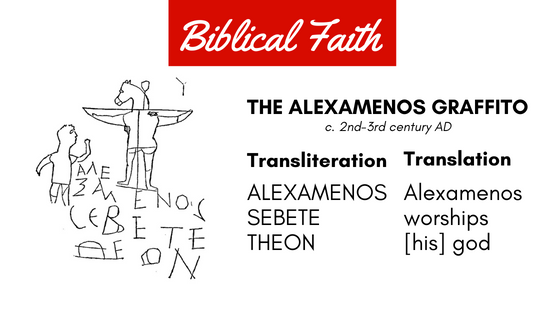
There is ample evidence that Christian persecution began early in the first century, most of it was sporadic rather than systemic. One curious example comes from an anonymous ancient antagonist who carved his aggression against a certain Christian named Alexamenos. This late second century, or early third century, carving is known as the Alexamenos Graffito, and it portrays a crucified man with the head of either a donkey or a horse and wrote around it:

ALEXAMENOS WORSHIPS [HIS?] GOD.4

Even when Christians were publicly shamed in graffiti, Christianity is represented by their “crucified god.” This type of ridicule from the public nevertheless shows a clear connection between the cross and the Christian Way and an early understanding of the divinity of Jesus.
It is possible that the Crucifix (the image of Jesus on the cross) as such emerged around the sixth century as a symbol of Christianity. The cross, however, has been forever paired with the proclamation of the gospel. Today it is in hospitals, as “the hospital” was invented by Christians who opened homes to care for the sick as early as the fourth century. The Red Cross as a benevolent organization uses the symbol of the cross as a symbol of compassion and concern, key beliefs of the Christian faith.

The Jesus Fish <><

The creativity of the ancient Christians is remarkable. Every now and then something of this ancient creativity finds its way back into the hands of the faithful. During the turbulent times of the 60’s and 70’s the fish symbol re-emerged as a cultural symbol of the Christian faith. But how did the fish symbol come to be used by ancient Christians?

One tradition says it goes back to times of persecution. When Christians would travel and find themselves in the company of strangers, they would draw on the ground an outline of a fish to see if they were among fellow believers.5 It was a symbol that veiled a hidden message: “I believe that Jesus is the Christ, the Son of God, the Savior.” The Greek word for fish (ichthus) had become an acronym for the above creedal statement.

Let’s unpack this a little more. Using our English letters to phonetically represent the Greek letters in the fish (ichthus) acronym, we have:

 i (iota) = Iesous (Jesus)
ch (chai) = Christos (Christ)
th (theta) = theos (God)
u (upsilon) = huios (son)
s (sigma) = Soter (savior)

Literally, it translates to: “Jesus Christ God Son Savior.” Sometimes it was drawn as a fish and other times as a circle with many lines like a pizza.

Note: Image taken from LeaderGuideBibleStudies.com

Today, the Jesus fish is a widely recognizable cultural icon of the Christian faith. It is no longer the hidden message it once was. Friend and foe know it as part of the Christian “branding.” Evolutionists, atheistic skeptics, and ufologists have even made their own mocking versions. Nevertheless, the Jesus fish is an ancient Christian symbol affirming our faith claim that Jesus is the Christ, the Son of God, the Savior.

Walking After His Pattern

The best image of Christ anyone will meet is the Christian who follows after the example of Jesus in the way they live their life and love their neighbor. In Peter’s letter, the apostle invites us to a life of deep commitment with the following words:

For to this you have been called, because Christ also suffered for you, leaving you an example, so that you might follow in his steps. (1 Peter 2:21)

The Christians Peter is writing to are experiencing a variety of tensions in their lives with neighbors in their community challenging them, criticizing them, and perhaps even forcing them into public legal situations where they must defend themselves and their new way of life.

Here, Peter calls on the imagery of children learning to write their letters by using a stencil to copy the letters until they can write the letters on their own. In the word “example” (hupogrammon) is found this ancient practice of children learning how to write their letters.6 Jesus is our template, our model, our tracing paper as we learn how to live a life as a servant of Christ.

In this section of his letter (1 Pet 2:21-25), Peter quotes and alludes to the suffering servant passage of Isaiah 53 as describing and outlining how Jesus endured rejection and suffering even to the point of the cross. How Jesus faced the cross, Peter argues, is how Christians ought to face the challenges of the world they live in. In short, his willingness to suffer on the cross becomes our paradigm/model for living. Scot McKnight puts a helpful perspective on this text:

Here is an early Christian interpretation of Christ’s life that is, at the same time, an exercise in the explanation of the essence of the Christian life. This little section, in other words, is a glimpse into a Christian worldview of the first century—a world not at all like our world because of the predominance of suffering in the early church, but a worldview that retains its significance for Christian living.7

Scot McKnight, 1 Peter, NIVAC

As the reasons for being a Christian drift towards matters of “to be better,” “to help others,” “to find community… a family…,” or something one could obtain from a support group or self-help book, the nagging truth of Christian discipleship formed by the paradigm of Jesus and his suffering on the cross for our redemption, the church may never come to realize its primitive spirit of sacrificial consecration prepared to do likewise as the sacrificial sheep of God.

The Christian is redeemed by the suffering Christ, and it is an essential part of the Christian life to endure suffering as we serve the Christ of the gospel we proclaim and live by.

What Symbols Do You Bear?

I hope these short reflections will help you think about how we think about Jesus in our life of faith. Are we marked by sorrow, pain, or harm from following Jesus? If not pray for others who have. Perhaps you have other ways to speak of your faith. Do you glory in his cross? Do you focus on the work of Christ on the cross and what that means for the work of Christ happening in your heart? Take time to meditate on this truth.

Our symbols may need some unpacking, like the Jesus Fish, but perhaps instead of looking at it as a “cheesey” Christian pop icon, you may see it as a meaningful symbol born from persecution for simply being a Christian. Nevertheless, the only symbol of Christ that truly touches the hearts of men is that of a Christian walking in the steps of his suffering servant Jesus.

May God bless you.

Endnotes

  1. Old Roman Symbol. ↩︎
  2. All Scripture quotations are taken from the English Standard Version (Wheaton, IL: Crossway). ↩︎
  3. J. Louis Martyn, Galatians: A New Translation with Introduction and Commentary, AYB 33A (New Haven, CT: Yale, 1974), 56. ↩︎
  4. Jen Rost suggests a broader window of c. 83 to the third century, “Alexamenos Graffito,” worldhistory.org ↩︎
  5. Elesha Coffman, “What is the Origin of the Christian Fish Symbol?,” Christianity Today (8 Aug 2008) ↩︎
  6. John H. Bennetch, “Exegetical Studies in 1 Peter,” BSac 99 (1942), 346. ↩︎
  7. Scot McKnight, 1 Peter, NIVAC (Grand Rapids, MI: Zondervan, 1996), 168. ↩︎
Modesty in Speech: Reflecting God’s Image in What We Say

Introduction

Do words matter? Framed in another way, is there a fundamental connection between speaking and God? Again, is there a spiritual component to communication? Consider the following. The Bible asserts that the universe came into existence at the command of God, “God said” (Gen 1:3, 6, 9, 11, 14, 20, 24, 26, 29). The Hebrew writer asserts,

By faith we understand that the worlds have been framed by the word of God, so that what is seen hath not been made out of things which appear.

Hebrews 11:3 (All Scripture references are from the American Standard Version unless otherwise noted)

In fact, both the origin and the dissolution of the universe is subject to the declaration –“word”– of God (2 Pet 3:5-7). Communicating is, then, a core activity of God; in other words, God speaks His Mind.

There are people in this world who seek for a chance to hear God speak to them. God has spoken, in his wisdom, through two monumental venues. The first is creation; the second, are the Scriptures. In Romans 1:20, Paul affirms,

For the invisible things of him since the creation of the world are clearly seen, being perceived through the things that are made, even his everlasting power and divinity; that they may be without excuse.

Romans 1:20

The world essentially speaks of a powerful supernatural eternal being Who is the origin of all that is seen; in a nutshell, the “heavens declare the glory of God; and the firmament showeth his handiwork” (Psa 19:1).

Second, God has spoken his mind and has preserved it in the Scriptures. It is written,

For who among men knoweth the things of a man, save the spirit of the man, which is in him? even so the things of God none knoweth, save the Spirit of God. But we received, not the spirit of the world, but the spirit which is from God; that we might know the things that were freely given to us of God.

1 Corinthians 2:11-12

In fact, the unveiling of God’s mind is the cause which brought about the Scriptures. It is written, “Every scripture inspired of God” (2 Tim 3:16). God has spoken his unique message through his prophets, who have committed those oracles to print (Eph 3:1-6; 2 Pet 1:19). King David once said of himself, “The Spirit of Jehovah spake by me, And his word was upon my tongue” (2 Sam 23:2).

What this discussion points to is a fundamental truth about God. Inasmuch as God is the source of love, it is equally true that God is the source of disclosure. In other words, communicating and disclosing the eternal mind is fundamental to the nature of God. This is important for a proper understanding of human communication because humanity is made in the image of God (Gen 1:26-27). God’s people are expected to reflect their Creator’s nature. In fact, Peter writes,

but like as he who called you is holy, be ye yourselves also holy in all manner of living; because it is written, Ye shall be holy; for I am holy.

1 Peter 1:15-16

Little wonder that Peter would further admonish, “if any man speaketh, speaking as it were oracles of God” (1 Pet 4:11). Every aspect of godly living is to be set apart for God’s purposes (Rom 6:17-18), and this includes how a person speaks.

Speaking is a process which discloses the thoughts and movements within a person’s heart; it reveals what is in the heart (Matt 6:22-23; Mark 7:20-23). All things being equal, regardless of the truths or lies a person speaks, it derives from the inner workings of the heart. Since communication is a spiritual matter and reflects one’s heart, it is not surprising that Jesus would state the following: “And I say unto you, that every idle word that men shall speak, they shall give account thereof in the day of judgment. For by thy words thou shalt be justified, and by thy words thou shalt be condemned” (Matt 12:36-37; cf. Rev 21:8; Rom 14:12, 10-12; 2 Cor 5:10; Eccl 12:14; Acts 17:30-31).

What a person “says” matters because it reflects a spiritual truth about a person’s heart. The heart is the touchstone upon which Jesus makes his case for a higher level of spirituality as addressed in the “Sermon on the Mount” (Matt 5:21-22, 27-28, 33-37, 43-48). When someone tells the truth, or lies, or uses a swear word, there is a corresponding spiritual truth which points to how one reflects the image of God. If one wishes to be a faithful child of God, one must “adorn” God’s teaching on modest speech (Tit 2:10). Our speech must reflect that we are made in the image of God, and it must exemplify the gracious and righteous nature of the gospel message.

Our Speech is to Reflect the Image of God

In writing to the Christians in Colossae, Paul walks through the conversion process (Col 2:10-3.4). They went through “the circumcision of Christ; having been buried with him in baptism” (2:11-12). In this “working of God” they were “raised with him” (2:12), and made “alive together with him” for forgiveness (2:13). To reinforce their commitment, Paul urges them to “put to death” their past vices:

now do ye also put them all away: anger, wrath, malice, railing, shameful speaking out of your mouth: lie not on to another; seeing that ye have put off the old man with his doings and have put on the new man, that is being renewed unto knowledge after the image of him that created him.

Colossians 3:8-10

A child of God should so speak from the heart that it reflects God’s image rebranded upon them. There is a deep truth here to unpack. The Lord Jesus warns and instructs how Christians are to treat others. One should not insult his brother (“Raca” Matt 5:22); instead, Christians are to be “the salt of the earth” and “the light of the world” (Matt 5:13).

Unfortunately, some are so good at the craft of sarcasm and caustic acidity that though they have not transgressed moral boundaries with their vocabulary, they are quite adept at verbally abusing their brethren. Instead, Christians should “receive one another, even as Christ also received you, to the glory of God” (Rom 15:7).

Our Speech is to be Exemplary

In writing to his protégé, Paul extends to Timothy an encouraging word for his ministry in Ephesus. He admonishes, “Let no man despise thy youth; but be thou an ensample to them that believe, in word, in manner of life, in love, in faith, in purity” (1 Tim 4:12). The nature of Timothy’s “youth” (neotatos) is a matter of speculation, but based on inscriptional evidence he may have been in his twenties if not early thirties.

He needed this instruction to dissuade those that would be critical of Timothy’s ministry due to his age; namely, Timothy’s moral and spiritual reputation would be established by the moral pattern of his “word” (i.e. “speech”). Timothy’s speech is to be exemplary, a template. In these words to Timothy, when it comes to their speech Christians are enjoined upon to be a “model citizen.”

Does this mean that one is required to always speak as if they were a graduate from a charm or etiquette school? Hardly, but it does mean that God’s people should be proactive in speaking appropriately. There is room to be culturally flexible provided it is moral. Paul writes,

Let your speech be always with grace, seasoned with salt, that ye may know how ye ought to answer each one.

Colossians 4:6

Ultimately, a Christian’s speech and vocabulary ought to create an attractive environment to their neighbors so that all may feel welcomed in their presence. The obvious illusion is to create an atmosphere where evangelism may occur (1 Thess 2:13; 2 Thess 2:14). Since it is God’s goodness that leads people to repentance (Rom 2:4), then it is also true that a Christian’s goodness can point others to their good God (Matt 5:16).

Concluding Thoughts

The biblical evidence shows that speaking and communicating the thoughts of one’s heart is an important spiritual component to being created in the image of God. Communication comes with a great challenge,

If any stumbleth not in word, the same is a perfect man, able to bridle the whole body also.

James 3:2

The entire course of one’s future can be directed by the outpouring of the thoughts and intentions of the heart when spoken (Jas 3:3-12). The most important aspect of what a person can do is to use one’s words to praise God and his son Jesus the Christ. As it is written,

Wherefore also God highly exalted him, and gave unto him the name which is above every name; that in the name of Jesus every knee should bow, of things in heaven and things on earth, and that every tongue should confess that Jesus Christ is Lord, to the glory of God the Father.

Philippians 2:9-11

This is a slightly reformatted version of the article which originally published in The Glendale Gleaner (Newbern, TN: Glendale church of Christ).


Obtainable Spiritual Goals – Routine

Routine – The Magic Word

It is said that famed American motivational speaker Earl Nightingale observed that humans are – for lack of a better phrase – “creatures of habit.” Another well-known motivational speaker named Hilary Hinton “Zig” Ziglar is reported to have shared similar views.

Ziglar is quoted as saying the following two statements: “When you choose a habit, you also choose the end of that habit,” and, “We build our character from the bricks of habit we pile up day by day.” These aphorisms speak for themselves.

Every person has a pattern of behavior that for the most part they rarely depart. Joe Smyth wakes up, showers, dresses, eats breakfast, takes the 8:15 AM to work, and then at 4:45 PM Joe finishes his daily paperwork, takes the 5:20 PM home, and eats dinner, watches a little ESPN, checks his email, and then goes to sleep. Then, the next day it starts all over again.

But wait, Joe Smyth is a Christian. Somewhere in his routine prayer, Bible study, the worship of God, his spiritual and moral maturation, and the sharing or defending of his faith must come into view – but where? That’s where the word habit comes into play – these actions must be made part of the routine, and over time, part of the habit.

Little wonder that Paul said to the church in Rome:

For those who live according to the flesh set their minds on the things of the flesh, but those who live according to the Spirit set their minds on the things of the Spirit. For to set the mind on the flesh is death, but to set the mind on the Spirit is life and peace. For the mind that is set on the flesh is hostile to God, for it does not submit to God’s law; indeed, it cannot. Those who are in the flesh cannot please God. (Romans 8:5-8)[1]

Notice the phrase “set the mind” and the other similar phraseology in this section of Romans, and observe that Paul is speaking of two routines – habits. One brings “life and peace” while the other brings “death” and hostility with God. Obviously, the zealous and devout Christian would choose the routine that brings life and peace.

How does a Christian begin to consider obtaining – or realizing – this goal? Paul is quite clear – it is the mind. In 8:5 Paul says a person must “give careful consideration” with the intention of espousing one side of a cause.[2]

The controversy is quite explicit in this passage, and Paul leaves the matter in the Christian’s hands. In fact, there are only two options with no middle ground. Logicians call this the two horns of a dilemma, where the selection of one option is equal to the rejection of the other option.

In essence, he says, “make up your mind decisively and espouse the principles which will guide your life to the end that you desire. If you want life and peace then follow the principles set forth by the Spirit, should you not take this decision then you have rejected the life and peace which are promised those who ‘set their minds on the things of the Spirit.'”

This passage articulates one major theme; namely, that in order to obtain spiritual goals a mind daily focused on the Spirit is essential. What we have here is a quest to obtain a spiritual habit, a spiritual routine, a spiritual lifestyle.[3] And this begins first in the mind, and then into action.

If your life was narrated like the opening few scenes of Stranger Than Fiction, where the number of steps it took to walk from one block to the next, where the time it took to wait for the bus was “clocked” to the minute and seconds, and even how many documents at work you sort through – would there be any time in your routine that included spiritual things on a daily basis?

If not, start the quest now by making room for spiritual things in your mind and routine.

Sources

  1. Unless otherwise noted, all quotations are taken from the English Standard Version (ESV) of the Holy Bible (Wheaton, IL: Crossway, 2001).
  2. (BDAG) Bauer, Walter, Frederick W. Danker, William F. Arndt, and F. Wilbur Gingrich, A Greek-English Lexicon of the New Testament and Other Christian Literature, 3d ed. (Chicago, IL: University of Chicago Press, 2000), 1066.
  3. In Romans 8:5, the verb phrase “set their minds” comes from a present active indicative Greek verb (phroneo); meaning, that the action here is continuous – even habitual. There is no end to the action in sight, thus the Christ is to always keep in view the direction which thought (of a practical kind) takes” (Harry Angus A. Kennedy, Expositor’s Greek Testament, ed. W. Roberston Nicoll [New York, NY: Doran, 1901], 3:420; cf. James H. Moulton and George Milligan, Vocabulary of the Greek Testament [1930; repr., Peabody, MA: Hendrickson, 1997], 676).