Family Ministry: Evaluating Garland on “Power and Roles”

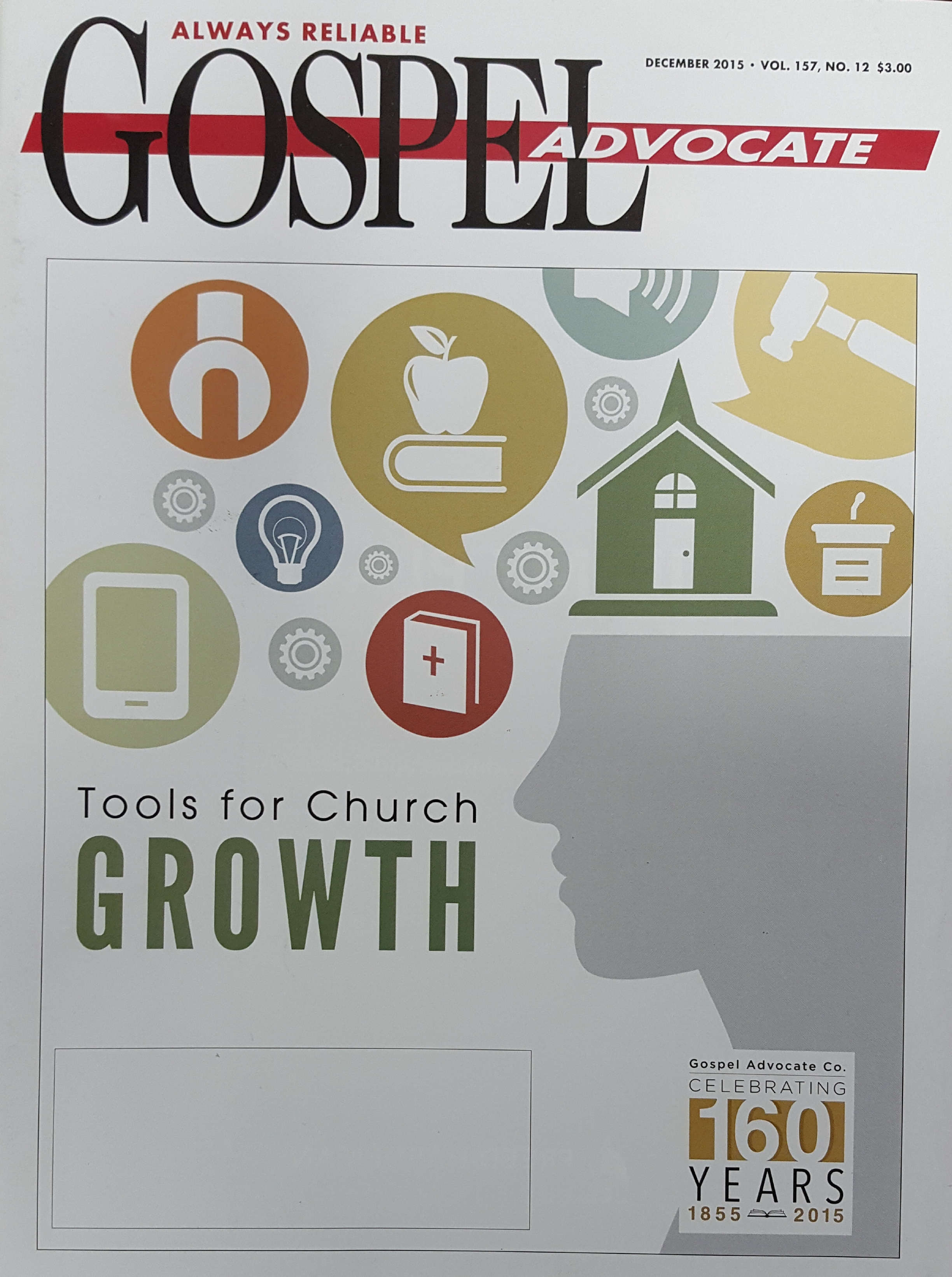
In the December 2015 issue of the Gospel Advocate magazine, my article, “The Widows Church of Christ” was published.[1] It focused on my experience one summer filling in at a small congregation near Freed-Hardeman University that at the time was composed exclusively of women and widows. In the piece, I briefly retold a conversation I had with one of the sisters there, rehearsed a few biblical examples of areas of women’s evangelistic involvement, and discussed women’s role in the assembly.

A reader called my attention to share her disagreement with the following few lines:

Scripture shows that Christian women prophesied and prayed in New Testament times (1 Corinthians 11:5; Acts 22:8-9), taught the Word of God accurately (Acts 18:26), and brought people to salvation (2 Timothy 1:5; 3:14-15). Christian women also served one another in many diverse ways (1 Timothy 5:2; Titus 2:3-5; Acts 9:36-43). Too, Christian women were patrons, fellow workers for the truth, and “house church” hostesses (Romans 16:1-16).[2]

She disagreed with my assessment, but not because the early church used women in its ministry. She said, “I disagree because we [i.e. women] are stupid.” I responded, “Who told you women are stupid?” She matter-of-factly responded, “we are.” I flatly denied her claim. I do not know who taught her this, all I know is that an entire life in the church has not changed her mind. Unfortunately, this has not been my only experience.

Many women in church ask me to speak on their behalf about ideas. Why? It is not because they are shy, but because they are “women” and women have no “right to share” ideas about the church. Perhaps it is not fair to put all the blame on the church. However, if the church truly embraces a culture of female dignity and equality as image-bearers of God, and equality as recipients of salvation (Gal 3:26-28), then it would be hoped that our sisters and fellow heirs in Christ should have a better perception of themselves as women in the church and society, and as wives and mothers in the home.

The issue at hand may be reduced to one word —power. Who has the power and who does not in the family, the church, in the world? Who should? Furthermore, what is power, and is it an innate quality or something else. The late Diana A. Garland (d. 2015), former dean of the Baylor School of Social Work at Baylor University, discusses power in detail within the sociological perspective of marital relationships and the impact of biblical interpretation in a chapter of her insightful volume, Family Ministry: A Comprehensive Guide.[3]

In it, she provides a working definition of power, explores Jesus’ teaching about power in Mark 9:33-37, summarizes gender roles in the home within the American context of the last century, and offers her interpretations of certain key biblical passages (Gen 1-3; Col 3:18-19; Eph 5:21-33, 1 Pet 3:1-6; 1 Cor 7, etc). It is argued here that Garland has presented a cohesive argument regarding power and Jesus’ teaching about power, but they are not complete discussions. Furthermore, Garland presents a brief social-historical summarization of gender roles which reflects a hierarchy —a model of marital headship— that has a built-in “inferiority of women” point of view. Garland’s interpretive trajectory is built on this framework.

This is problematic because Garland generalizes this viewpoint as one that is shared across cultures and eras, which it is not; moreover, she proceeds an attempt to dispel the notion that the biblical references of marriage and family headship do not teach an “inferiority of women” model. Garland offers an egalitarian framework, but although she raises important concerns, I believe a complementarian framework is a better-supported framework for matters of church work.

Definition of Power

Defining Power

In the first place, it is important to understand Garland’s point of view on power, gender roles, and hierarchy.[4] Garland provides a working definition of power that is helpful as a starting point for the present discussion and builds her discussion of power with M. Weber’s words in mind: “the probability that one person is able to exert his or her will despite resistance from others.” Such power may be an influence on another “whether or not that influence is resisted or even recognized by any of the actors.” From this it is suggested that power is not best thought of as a personal characteristic but instead as an influence from relational dynamics; thus, “power is,” Garland concludes, “a dynamic in all family relationships. We are always attempting to influence one another.”

While she regards power as ultimately “neutral” she points out that this relationship influence may be used for good (protect the vulnerable) or for ill (take advantage of the vulnerable).

Power and Gender Hierarchy

Garland paints a picture of a community and culture which shapes a power dynamic within the family that has historically given men more power in marriage than women.[5] Similarly, family theorists David H. Olson and John DeFrain suggest: “Tradition has dictated that considerable power go to the males in the family,” and add the caveat, “but women often have more power than they or anyone else admit.”[6] Still, Garland argues that culture and economics have played a historic role in reinforcing certain gender roles in the home and the workforce.

For example, Garland argues that in “traditional” homes husbands earned a living for the family, and gave their wives “an allowance,” and the wife, in turn, managed the emotional and interpersonal relationships of the home. As an extension of the prevailing culture, the church followed suit by emphasizing strong hierarchal gender roles where men had authority and power, while women were expected to submit and obey their husbands in keeping with a military-type paradigm of authority and submission.[7]

Vulnerable and Inferior Women

This unavoidably led to what Garland speaks of as a view of hierarchy—or headship—with a built-in “inferiority of woman” model. In this view, women are vulnerable, in need of protection, in need of structure, and in need of a man to insulate them from the attacks of Satan.[8] She cites Judith Miles as her “poster child” of this viewpoint, who argues in her own work, “I was to treat my own human husband as though he were the Lord, resident in our own humble home.”[9] Consequently, she would never question her husband on anything because such was to question the Lord himself.

Unfortunately, not only did some hold that women were theologically vulnerable, but some even advocated women were emotionally not “up to the task” of ministry. The rise of a liberation movement of women stems was therefore a response to this form of hierarchy model that held an implied inferiority view of women. As the woman’s liberation movement emerged in the 1960s and 1970s, the church, according to Garland, was threatened by the rise of demands by women for better (egalitarian) family relationships.

This is Garland’s starting point: a historically rigid view of hierarchy and gender roles in society and the home as reinforced by society and church, which not only implied an “inferior woman” model but in many cases overstated the headship of man.

Inferiority Illustrated

Garland’s portrayal should not be dismissed out of hand as it relates to the American church. The relationship between culture and church is not always easily discernible. The church has been affected by this type of “inferior women” hierarchy and has been reaping the whirlwind of this type of gender oversimplification. A few examples are in order.

Roy H. Lanier, Sr., in his Contending for the Faith column, “The Problem Page,” once responded to a letter from an elder’s wife.[10] Her problem focused on her husband’s mistreatment and undermining of her maternal role based on stereotypical female “problems” (emotional and biological). His dismissive treatment of her had now trickled down to their children. Lanier’s response was extensive and centered on a demonstration from Ephesians 5:21–33 that headship does not permit, nor condone, such treatment. Lanier argued, “it is obvious that her husband does not love her as Christ loves His church.”[11]

In F. Dale Simpson’s 1972 book on leadership, Simpson addressed the problem of women in the mission field: “most married missionaries have to overcome the resistance of their wives to go to a foreign mission field.”[12] Therefore, while

women are biologically stronger than men… are as intelligent as men and more careful about details… women are not as temperamentally suited for carrying out the great commission as men.

F. Dale Simpson, Leading the First-Century Church in the Space Age

Simpson offers only his experience and his opinion about the temperament of women in the mission field.

Long-time missionary and educator, Earl D. Edwards, provides a correction based on several behavioral studies.[13] Edwards rightly points out that different genders tend to have differences that are present at birth and socially amplified; yet, such gender-specific roles (functions) are gender differences and are not a reflection of gender inferiorities or superiorities.[14]

The Struggle is Real

In short, Garland is addressing a real problem about church culture and power, and how it relates to women and wives. It strikes at the heart of a woman’s worth in the home and in the church, and in ministry in general. The church would be wise to hear her call to be alert to this problem. However, Garland does not reject a simply abusive hierarchal power within the marriage as expressed in certain stereotyped gender roles. She clearly rejects any hierarchy with a power structure within marriage—i.e., male headship is not biblical and therefore not normative biblical teaching.

Jesus’ Teaching on Power

In the second place, Garland moves toward a brief exploration of Jesus’ teaching about power in Mark 9:33–37 and uses it to frame her discussion of power dynamics within two broad Christian family contexts: gender roles and discipline.[15]

And they came to Capernaum. And when he was in the house he asked them, “What were you discussing on the way?” But they kept silent, for on the way they had argued with one another about who was the greatest. And he sat down and called the twelve. And he said to them, “If anyone would be first, he must be last of all and servant of all.” And he took a child and put him in the midst of them, and taking him in his arms, he said to them, “Whoever receives one such child in my name receives me, and whoever receives me, receives not me but him who sent me.” (Mark 9:33–37 ESV)

In this passage, Jesus’ illustrates and demonstrates the true use of power in light of the fact that the disciples had been arguing over “who was the greatest” (Mark 9:34).[16] The passage is, then, a corrective focused on “how his followers should use what they have to serve others rather than exalt themselves.”[17] Indeed, greatness is measured in service, in welcoming the smallest, least powerful, to the most vulnerable of society (Mark 9:35). Unfortunately, the disciples still did not retain the lesson since Jesus must correct them again (Mark 10:13–14); yet, Garland sees Jesus’ point as follows:

Rather than using your power to benefit yourself, use it to serve and benefit others. Order your life as Christians by protecting and caring for those most at risk of others abusing their power.[18]

Diana Garland, Family Ministry

Garland affirms that Jesus “used his own power to care for them” by completing the passion of the cross which he predicts three times (Mark 8:31; 9:30–31; 10:32–34). Power is never conserved for oneself but instead is the instrument to serve others. Elsewhere Jesus says,

The kings of the Gentiles exercise lordship over them, and those in authority over them are called benefactors. But not so with you. Rather, let the greatest among you become as the youngest, and the leader as one who serves. (Luke 22:25–26).

Garland’s Miscue

What appears to be lacking in Garland’s treatment of power in Mark 9:33–37 is the broader literary concern with discipleship in the kingdom of God which begins in Mark 8:26 and ends in Mark 10:52.[19] This is not a small matter because, in Mark 8:34, Jesus frames the discussion of true discipleship: “If anyone would come after me, let him deny himself and take up his cross and follow me.”

To follow Jesus means to submit to his plan, to submit to one’s role in the kingdom of God. “Discipleship… comes then with the commitment to humility and self-denial, rejection and suffering.”[20] The hard lesson the disciples continued to fail to appropriate is that the kingdom of God is at the disposal of others—especially the vulnerable—is the transformative experience of discipleship. Thus, power and one’s role are interwoven. Jesus demonstrates this by submitting to his role as God’s servant on the cross (Luke 22:42).

The matter is not simply about power and influence, for Mark 9:33–37 and Mark 10:13–16 teach that discipleship includes one’s submission to God’s transforming kingdom. It is not that Garland is wrong, but that her framing appears incomplete which, for the attention given to her work overall, is a significant oversight.

Overgeneralizations on Power and Gender Roles

In the third place, Garland generalizes that power and gender roles have been male-dominated across cultures and eras, which it is not.[21] This is an important drawback. The American church may be influenced by the surrounding culture and societal gender role expectations (even as traditional roles are presently eroding), but extrapolating from it that all cultures share a similar or comparable power structure along gender lines in families is problematic.

Cultural Anthropology

Not all cultures share the same expectations for gender roles. For example, Paul G. Hiebert, anthropologist and missionary, writes,

while most societies place some responsibility on the father for rearing the child, this is not universal. But the biological and social dependency of an infant on its mother is recognized in all social societies.[22]

Paul G. Hiebert, Cultural Anthropology

It appears that certain biological relationships (mother-child) have built-within them influences that exert power on behaviors, and while they may manifest differently in various cultures, they do not imply inferiority or lack of equality. These relationships, do, however, create forms of power management that can create a displacement of power. This is a vital element to evaluate Garland’s overarching premise that power exercised implies the inferiority of one influenced by another.

The Psychology of Parental Authority

Psychologists David G. Myers and C. Nathan DeWall describe that within parent-child relationships authority, or, power, is observable in three parenting styles: authoritarian, permissive, and authoritative.[23] The extent to which parents try to control their children is, “the most heavily researched aspect of parenting.” Parents either “set rules and expect obedience” (authoritarian) which tends to affect their children’s social skills and self-esteem. Or, they “give in to their children’s desires” (permissive) which tends to develop children who are agreeable and immature. And, parents who “are both demanding and responsive” (authoritative) tend to produce children who are well-rounded emotionally and socially.

A parent’s use, abuse, or nonuse of power can tend to have drastically different outcomes. The presumed element here in these relationships is that a parent is in a hierarchal relationship with their children (cf. Eph 6:1-4), and within this relationship, power is being managed and applied. Garland’s overarching point is that this is in principle antithetical to Jesus’ teaching on power, but power and role are inseparable. 

Family Power Management

Olson and DeFrain explore the wide range of “family power” management which is of significance here. According to them, “family power is the ability of one family member to change the behavior of the other family members.”[24] And while Garland concedes that “power” and “influence” are morally neutral, she approaches the subject of gender roles, power, and marriage from a morally negative point of view. Yet, as Olson and DeFrain point out, power —particularly family power— is a complex, dynamic interactive feature of a family system. Everyone in a family has power and everyone exerts it on the other member of the family. Even infants, according to Garland, have power. Yet, Garland suggests that a male headship hierarchy historically has mitigated women’s power in the marriage relationship, and therefore, empowers men and silences women, encouraging male power and delegitimizing female power and influence. Garland is not wrong if painting with broad strokes.

Marital Hierarchy

Garland’s argument that the removal of the hierarchy in male-female roles in marriage and family, and therefore must be applied to the church, is problematic.

Garland attempts to dispel the notion that the biblical references to marriage and family headship do not teach an “inferiority of women” model. The creation account in Genesis 1–3 “provides,” according to Garland, “the primary foundation for a hierarchical understanding of husband-wife relationships.”[25] The order of creation does not prove male headship nor female submission; instead, Garland proposes that the pre-fall notation of “them” in Genesis 1:26–31 suggests shared dominion, shared identity, and a shared name. Moreover, the woman was not simply a “helpmeet” (KJV), but instead, is a soul-mate helper who is a “bone-and-flesh mirror image of the man who remains incomplete without her.”[26]

The Hebrew term ‘ezer certainly points to a “help” that comes from someone strong (Gen 2:20), as it is used in “warrior-esque” passages (Deut 33:29; Ezek 12:14), and is even used to describe God (Exod 18:4; Psa 121:1–2, 8). Thus, this is not a chain-of-command relationship where Eve is the weaker and more vulnerable of the two.

Garland provides a view of these passages that are cohesive and within reason of the evidence, but it is in Genesis 3:16, where the trouble lies. Garland argues that change after the fall is not a curse from God, but instead a pronouncement by God of how the relationship between Adam and Eve will now be.

In her view, God is being descriptive, not prescriptive. This is not an edict that imposes a new hierarchical relationship based on gender. Observe Garland’s argument that the fall

results in dire consequences for their relationship: the husband now shall rule over the wife. This new development implies that it was not what God had originally determined for their relationship. The dominance of the husband in Genesis 3:16 is described, not prescribed… it is the consequence of their joint disobedience.

Thus, the idea of hierarchical gender relationships is nothing but “a perversion of God’s intention in creation. The partnership has been destroyed. Sin disfigures the good God offered us.“[27] A variety of authors have offered a similar take in recent years. Linda L. Belleville, for example, is certainly at the forefront of pressing this interpretive option against the traditional view of male headship from Genesis 2–3.[28] Belleville, likewise affirms:

male rule finds no explicit place in the Bible’s theology at all. Adam’s sin is noted (Rom 5:12-19; 1 Cor 15:20-22), as is Eve’s deception (2 Cor 11:3; 1 Tim 2:14). But the man’s rule over the woman is not cited even once (not even for the husband-wife relationship). The simple fact is that male rule does not reappear in the OT. The woman is nowhere commanded to obey the man (not even her husband), and the man is nowhere commanded to rule the woman (not even his wife).[29]

Belleville likewise suggests that Genesis 3:16 is a statement of the natural outcomes of the husband-wife relationship to follow due to the “fallen condition” of the world.

Garland, Headship, and the Biblical Narrative

It is the view taken here, in response to Garland––and to some degree Belleville––that Genesis 1:1–2:3 and 2:4–25 do provide the foundation for the traditional view of gender roles and should be regarded as normative.[30] The account of day six in Genesis 1 is a broad-picture passage. It speaks to the equality shared between man and woman as a distinct created order, or class, that is made in the image of God, and for this reason, have a human responsibility together to “have dominion… Be fruitful and multiply and fill the earth and subdue it” (Gen 1:26–28). But, when day six is given an expanded view in 2:4–25, the foundation for how human power is to be managed is explained—it is to be done in a relationship with someone just like Adam.

This power and influence are managed between husband and wife (2:20–24). And while the family power style is not explained in Genesis 2, Genesis 3:16 becomes an informative model of the way the husband-wife relationship exists outside the garden due to sin as God punished Adam (3:17–19) and the serpent (3:14–15), so God punishes Eve (3:16).

Problems with the Descriptive View

The argument that God is only describing how things will be, clearly undermines several theological themes which begin at this point. These are not mere descriptions of the fallen world.

First, God declared the serpent’s dust-filled days but also that he will feel the consequence of a crushed head by “the woman’s” offspring. This is not descriptive, this is a proclamation of Divine action and judgment upon the serpent, and salvation for humanity (John 16:11).

Second, God declared that Adam would face further hardship in the production of food and nourishment. Adam already understood work. He knew how to til and maintain the vegetation of the garden since day six (2:15). Whatever is forthcoming outside the garden for him is new and punishment for his sin. They are consequential.

And finally, God addresses Eve’s actions with further pain associated with childbearing and nuance to the relationship between her and her husband. When God says, “I will surely” do this and that, it must be interpreted as a consequence. The most pertinent here is the following, “Your desire shall be contrary to your husband, but he shall rule over you” (Gen 3:16b).

The curse upon Eve is clearly speaking of a matter of power management within the husband-wife relationship. It is the same vocabulary and issue of power management in Genesis 4:7 with Cain and his personified anger who desired to control Cain. Cain must rule over its desire. Moreover, the language is found again in the Song of Solomon, where the bride turns this “curse” into a wedding vow, “I am my beloved’s, and his desire is for me” (Song 7:10). Contrary to Belleville’s claim that the “simple fact is that male rule does not reappear in the OT,” the Bible does recognize implicitly male headship.

Biblically Grounded Patriarchy is Never Condemned

Interestingly, Old Testament scholar Bruce K. Waltke points out that of all the social injustices mentioned by the prophets of Israel, patriarchy is never mentioned among them. Following Abraham Heschel, he argues:

They challenged the injustices of their culture. The prophet is an iconoclast, challenging the apparently holy, revered and awesome beliefs cherished as certainties, institutions endowed with supreme sanctity. They exposed the scandalous pretensions, they challenged kings, priests, institutions and even the temple.[31]

Waltke is probably correct when he argues that the problem that often affects interpretation is the definitions of concepts of patriarchy and equality brought to bear on the texts of Scripture. Eve was every bit Adam’s equal. They both shared the power and authority over the creation given to them by God. That power was to be worked out in their marriage in some form of family power style.

In Genesis and throughout the rest of the Bible, the family power structure to manage power is a hierarchy, with the husband as head of the wife and as Christ head of the church (Eph 5:23). Yet, such headship does not exist in a vacuum. A husband’s headship does not exist properly without being sacrificial, loving, or nourishing. Neither does it embrace a tyrannical hold on his wife. He is to be as self-sacrificing as Jesus was and is for the church. If the husband is head of the wife as Christ is head of the church —his bride— then one should be careful in calling headship structure “a perversion of God’s intention” and a “partnership” destroyed as Garland has. For this reason, her work and view would be detrimental to family ministry.

Endnotes

  1. Jovan Payes, “The Widows Church of Christ,” Gospel Advocate 157.12 (Dec 2015): 29–30.
  2. Payes, “Widows Church of Christ,” 30.
  3. “Power and Roles” is chapter 11 in Diana R. Garland, Family Ministry: A Comprehensive Guide, 2d ed. (Downers Grove, IL: IVP Academic, 2012), 370–411.
  4. Garland, Family Ministry, 370. All proceeding quotations in this paragraph are from page 370.
  5. Garland, Family Ministry, 372.
  6. David H. Olson and John DeFrain, Marriages and Families: Intimacy, Diversity, and Strengths, 4th ed. (New York, NY: McGraw-Hill, 2003), 213. Power, control, and authority are continuously exercised in families, and struggles for personal power in families are exceedingly common. 
  7. Garland, Family Ministry, 372.
  8. Garland, Family Ministry, 373.
  9. Ibid.
  10. Roy H. Lanier, Sr., “An Elder’s Wife has a Problem,” 20 Years of the Problem Page (Abilene, TX: Quality, 1984), 1:177–81.
  11. Lanier, “An Elder’s Wife,” 178.
  12. F. Dale Simpson, Leading the First-Century Church in the Space Age (Abilene, TX: Quality Printing, 1972), 121–22. 
  13. Earl D. Edwards, “The Role of Women in the Work and Worship of the Church,” Protecting Our Blind Side: A Discussion of Contemporary Concerns in churches of Christ (Henderson, TN: Hester Publications, 2007), 255–57.
  14. Edwards, “Role of Women,” 156–57.
  15. Garland, Family Ministry, 371–72.
  16. Unless otherwise stated all Scripture quotations are taken from the English Standard Version of The Holy Bible (Wheaton, IL: Crossway, 2001).
  17. Garland, Family Ministry, 371.
  18. Garland, Family Ministry, 371.
  19. Jovan Payes, “Leaders Stand Up for the Weak,” In My Place: The Servant Savior in Mark, ed. Douglas Y. Burleson (Delight, AR: Gospel Light, 2015), 376–77.
  20. Payes, “Leaders Stand Up,” 376.
  21. Garland, Family Ministry, 372–92.
  22. Paul G. Hiebert, Cultural Anthropology, 2d ed. (1983; repr., Grand Rapids, MI: Baker Books, 1999), 197.
  23. David G. Myers and C. Nathan DeWall, Psychology in Everyday Life, 3rd ed. (New York, NY: Worth Publishers, 2014), 84.
  24. Olson and DeFrain, Marriage and Families, 213.
  25. Garland, Family Ministry, 374.
  26. Garland, Family Ministry, 376.
  27. Garland, Family Ministry, 376–77. Emphasis original.
  28. See Linda L. Belleville, “Women in Ministry: An Egalitarian Perspective,” Two Views on Women in Ministry, rev. ed., ed. James R. Beck (Grand Rapids, MI: Zondervan, 2005), 21–103.
  29. Belleville, “Women in Ministry,” 31.
  30. Bruce K. Waltke, “The Role of Women in the Bible,” Crux 31.3 (Sept 1995): 29–40; reprinted in Bruce K. Waltke, The Dance Between God and Humanity: Reading the Bible Today as the People of God (Grand Rapids, MI: Eerdmans, 2013), 457–75.
  31. Waltke, “The Role of Women in the Bible,” 30.

Bibliography

Beck, James R. Editor. Two Views on Women in Ministry. Revised edition. Grand Rapids, MI: Zondervan, 2005.

Edwards, Earl D. Protecting Our “Blind Side”: A Discussion of Contemporary Concerns in churches of Christ. Henderson, TN: Hester Publications, 2007.

Garland, Diana R. Family Ministry: A Comprehensive Guide. 2d edition. Downers Grove, IL: IVP Academic, 2012.

Hiebert, Paul G. Cultural Anthropology. 2d edition. 1983. Repr., Grand Rapids, MI: Baker Books, 1999.

Lanier, Roy H., Sr. 20 Years of the Problem Page. 2 volumes. Abilene, TX: Quality Publications, 1984.

Myers, David G., and C. Nathan DeWall. Psychology in Everyday Life. 3rd edition. New York, NY: Worth Publishers, 2014.

Olson, David H., and John DeFrain. Marriages and Families: Intimacy, Diversity, and Strengths. 4th edition. Boston, MA: McGraw-Hill, 2003.

Payes, Jovan. “Leaders Stand Up for the Weak.” Pages 375–81 in In My Place: The Servant Savior in Mark. Edited by Douglas Y. Burleson. Delight, AR: Gospel Light, 2015.

_____. “The Widows Church of Christ.” Gospel Advocate 157.12 (Dec 2015): 29–30.

Simpson, F. Dale. Leading the First Century Church in the Space Age. Abilene, TX: Quality Printing, 1972.

Waltke, Bruce K. The Dance Between God and Humanity: Reading the Bible Today as the People of God. Grand Rapids, MI: Eerdmans, 2013.

_____. “The Role of Women in the Bible.” Crux 31.3 (Sept 1995): 29–40.


The Value of Godly Women to the Church

Define value. Dictionary definitions notwithstanding, John Keats (1795-1821) begins his poem, “Endymion,” with the words, “a thing of beauty is a joy forever.” Keats speaks to the power that people —their character and actions— have in retrospect. “That, whether there be shine or gloom o’ercast, They always must be with us, or we die.” The Scriptures show, however, what is “a joy forever”; in a word: godliness. Paul writes, “for bodily exercise is profitable for a little: but godliness is profitable unto all things, having promise of the life which now is, and of that which is to come” (1 Tim 4:8). [All Scripture references are from the American Standard Version unless otherwise noted.]

Nothing is more valuable and potent in this world than “godly seed” (i.e., offspring; Mal 2:15). Humanity, after all, was made to bear the image of God on the earth (Gen 1:26-31): “Let us make man in our image, after our likeness.” While there is tremendous learning to be gained from understanding the binary nature of humanity (“male and female”), we wish to pursue a study on the value of godly women to the cause of God as it is manifested in the NT church in the past and today.

Godliness is a Matter of Character

Godliness is reflected in the content of a person’s character and conduct. The church is an amazing place full of potential when it reflects the character of its godly women. There is no greater influence in the Lord’s church than godly women. For example, David once said,

know that Jehovah hath set apart for himself [she] that is godly: Jehovah will hear when I call unto [her]. Stand in awe, and sin not: Commune with your own heart upon your bed, and be still.[1] (Psalm 4:3-4, ASV edited)

The Hebrew word (hāsîd) for “godly” (holy) one implies a “kindness” that extends grace toward others because they have at one point received grace.[2] The word is used with great regularity in the Psalms. Godliness is seen, then, as a matter of character, of piety.

Godliness is fundamental to Christian conduct (2 Pet 1:6-7, 10-11). Paul writes that Christian women are to profess godliness through good works:

that women adorn themselves in modest apparel, with shamefastness and sobriety; not with braided hair, and gold or pearls or costly raiment; but (which becometh women professing godliness) through good works. (1 Timothy 2:9-10)

The Greek word (theosébeia) for “godliness” speaks to a reverence for God manifested in a set of beliefs and practices.[2] Christian women are to ground their value in their character and reverence for God (1 Tim 4:7-8; 6:11; 2 Tim 3:12; Tit 1:1, 2:12; eusébeia).[3]

Godly women of such character are of inestimable worth to the church. They leave an indelible mark upon everyone they touch. When they show divine kindness to their neighbor when they extend grace to others because they have experienced it as well, and when godly women focus on the content of their character and faithfulness to God, then the world will understand the value of godly women to the cause of Christ. Any home, company, and the church know the powerful influence of such godly women for they cast a beautiful shadow of faith and devotion, service and evangelism, determination and selflessness. This value is seen at the end of Proverbs 31 (10-31), “a woman that feareth Jehovah, she shall be praised. Give her of the fruit of her hands; And let her works praise her in the gates” (30-31).

Examples of Godly Women in New Testament

Let us consider a few examples of the value women have to the church. Women disciples have always been a part of Jesus’ ministry (Matt 27:55; Mark 15:41; Luke 10:38-42; John 4:1-26).

Financiers

Luke’s Gospel Account provides a note on some of the financial supporters and companions of Jesus as he and the twelve went throughout cities and villages “preaching and bringing the good tidings of the kingdom of God” (Luke 8:1-3).

Soon afterward he went on through cities and villages, proclaiming and bringing the good news of the kingdom of God. And the twelve were with him, and also some women who had been healed of evil spirits and infirmities: Mary, called Magdalene, from whom seven demons had gone out, and Joanna, the wife of Chuza, Herod’s household manager, and Susanna, and many others, who provided for them out of their means. (Luke 8:1–3)

Among these many women were named three in particular: Mary Magdalene, Joanna, and Susanna. They served Jesus and the twelve from their own possessions and property (“their substance”). After being healed from infirmities and evil spirits, they served as continuous financial supporters of Jesus presumably to bring the same “good tidings” into the lives of others.

Disciples

The Gospel accounts reveal that the women disciples of Jesus were the first to witness and share the resurrection event of Jesus with the disciples. Matthew recounts the encounter of Mary Magdalene and the “other” Mary who came to Jesus sepulcher and were greeted by the angel who had rolled back the stone of the tomb (28:1-10). Mark adds that the “other” Mary is the mother of James and that a third woman was them – Salome (16:1-8). Luke adds that there was a second angelic man, and several other women including Joanna that were greeted with, “Why seek ye the living among the dead?” (24:1-12). John’s Gospel shows Mary Magdalene confused over the empty tomb, comforted by Jesus himself, and told to say that Jesus would ascend to the Father (20:1-18). At a time when the prevailing cultural theory was that a woman’s testimony was inferior to a man’s, the earliest witnesses to the empty tomb of Jesus are the women disciples of Jesus.

Message Sharing

Luke continues to demonstrate the value and influence of women in the early church. The Acts of the Apostles demonstrates at every turn the value of godly women to the church. Women (including Mary, Jesus’ mother) were among the disciples in the upper room as they waited for the coming of the Holy Spirit promised by Jesus (1:14), and Peter declares the prophetic words of Joel (2:28ff) that “your daughters shall prophesy… and on my handmaidens… will I pour forth of my Spirit” (2:17-18).

And in the last days it shall be, God declares, that I will pour out my Spirit on all flesh, and your sons and your daughters shall prophesy, and your young men shall see visions, and your old men shall dream dreams; even on my male servants and female servants in those days I will pour out my Spirit, and they shall prophesy. (Acts 2:17–18)

Paul himself would abide with Philip the evangelist who “had four virgin daughters, who prophesied” (21:8-9; 1 Cor 11:5).

Doing Good

Luke, by the Spirit, give ample attention to a disciple named Tabitha who “was full of good works and alms deeds” who had fallen ill and died (9:36-37). Peter would be summoned by the church to be with them during this time. Her good works and influence were demonstrated by those who grieved at her death because “all the widows stood by him weeping, and showing the coats and garments” she made “while she was with them” (9:39). Caring for others —particularly widows— has always been an important demonstration of pure religion before God (Jas 1:27). Paul would instruct on the importance of the church and women of faith to care of widows (1 Tim 5:1-17; Acts 6:1-7).

All Encompassing

As the Hebrew writer says (11:32), “for the time will fail me” to continue tell of Christian women who were patrons, fellow workers for the truth, founding members of congregations and “house church” hostesses (Acts 16:11-15). They corrected false teachers (Acts 18:24-28). They raise up godly men to be evangelists (2 Tim 1:3-8, 3:12-17). They loved their husbands and children and demonstrated administrative skill in their homes (1 Tim 5:14; 1 Pet 3:1-6). Finally, Romans 16:1-16 demonstrates that many sisters served in the Lord as servants of God, evangelistic collaborators, teachers and financiers. Christian women ministered the gospel to the first-century world without hindrance.

Godly Women in the Church Today

The Lord-God envisioned an invaluable and elevated place for women in the world. These divine truths hold true today despite the ongoing debate over social gender expectation of men and women. Godly women have tremendous value to the church today, because their roles are still as invaluable as ever. Godly women continue to manage their homes, whether they are a full time stay-at-home wife/mother, work from home, or go to the office. They embrace their domestic role in the home as wife and mother (1 Tim 2:15).

Single women, however, bring a singleness of zeal to the church. Paul says they are “careful for the things of the Lord” (1 Cor 7:34). The breadth of their valuable influence is tremendous. They lead ladies’ Bible classes and workshops, are congregational Bible class teachers, write books and blogs, and contribute to academia. They mentor other disciples.

Our sisters minister to the widows and widowers in senior/assisted living homes, and they comfort the sick in hospitals —some even being/training to be hospital chaplains. Some with a medical background participate in medical-evangelistic campaigns. Others enter the world of missions, focusing their energies on evangelistic pursuits. Many have been brought to Christ due to the teaching efforts of godly women who teach overseas through Bible teaching correspondence courses.

Concluding Thoughts

May the church always embrace the ministries women have in the kingdom of God. This being said I am struck with the climate which often arises in the necessary discussion concerning the ministry of women in the church. I often feel the discussion is filled with much angst and the second guessing of motives when it comes to the reconsideration of my beloved’s sisters’ role in the world. Unfortunately, I think some roadblocks also lie in gender expectations which are culturally driven (“perceived” roles) rather than biblically driven (“biblical” roles). Nevertheless, this brief essay is about extolling the influence of godly women to the church and I believe it has succeeded to reach our goal.

Endnotes

  1. I have replaced the masculine for the feminine in brackets [] simply to express the point of this essay, which is to emphasize the godliness of women.
  2. William Wilson, Wilson’s Old Testament Word Studies (repr., Peabody, MA: Hendrickson, n.d.), 196; R. Laird Harris, “hsd,” Theological Wordbook of the Old Testament, eds. R. Laird Harris, et al. (Chicago, IL: Moody Press, 1980), TWOT 1:305-07.
  3. theosébeia,” BDAG 452.
  4. eusébeia,” BDAG 412.

This is a reformatted and slightly expanded version of the article which was originally published in The Glendale Gleaner (Newbern, TN: Glendale church of Christ).


The Widows church of Christ

Reprinted from the December 2015 issue of Gospel Advocate Magazine.

20180131_133232

When I was a younger preacher looking for opportunities to preach and teach, I helped a congregation which was, to my surprise, exclusively comprised of widows. The “Widows church of Christ” (as I shall call them) taught me a great deal about fidelity to God’s Word in the face of a temptation to do otherwise.

It had never crossed my mind that I would stumble upon an all woman congregation. My assumption that there would always be mix-gender congregations was completely shattered. I’m glad.

My first reaction, I must admit, was arrogant. “Poor brethren, you have no leaders.” I had forgotten that still they had the Lord, the Apostolic Word. They had different talents and skills to be used on behalf of the Lord (1 Cor 12; Rom 12). They still gathered in His name, communed at the table of the Lord, gave of their financial means, offered the fruit of their lips. They were still the blood-bought body of Christ (Eph 1:22-23; Col 1:18; Acts 20:28). They still had the responsibility to bring the gospel to the world (Mark 16:15-16; Matt 28:18-20).

I Asked a Question

I asked a sister why they invited male preachers to teach and preach when they could minister the word to themselves. After all, Scripture shows that Christian women prophesied and prayed in New Testament times (1 Cor 11:5; Acts 22:8-9), taught the Word of God accurately (Acts 18:26), and brought people to salvation (2 Tim 1:5; 3:14-15). Christian women also served one another in many diverse ways (1 Tim 5:2; Tit 2:3-5; Acts 9:36-43).

Too, Christian women were patrons, fellow workers for the truth, and “house church” hostesses (Rom 16:1-16), demonstrating that there is not a ministry our sisters cannot participate in (Acts 8). There are many sisters in the Lord mentioned throughout the New Testament as servants of God, evangelistic collaborators, and financiers. To say it in another way, Christian women can minister the gospel to the world without hindrance.

She responded, “Because the men are to lead prayers and preach God’s Word in the assembly.” She further explained, “We do have our own Bible study together as sisters during the week, but on Sundays we plan for visitors. We respect God’s plan for the worship assembly.”

This was a reference to 1 Tim 2:8-15, and the Apostle Paul’s instructions for prayers and teaching in the public assembly. In fact, the phrase, “in every place” (en panti topō 2:8) is a New Testament shorthand for “in every place of assembly.” In the assembly, Paul emphasizes “the preservation of male and female distinctions” by providing a “distinctive sphere” for Christian men and women to operate within.

In this setting, Christian “males” (Grk. andras) are to lead prayers on behalf of the body of Christ (2:8), provided they have a lifestyle consistent with godliness. Christian women are to “likewise” demonstrate godliness when assembled for prayer (2:9-10). Paul, then, adds the command that in the assembly Christian women “must learn in silence in full submission” (2:11). This does not suggest that she should check her brain in at the pew, nor is this a term that requires absolute silence. It simply explains her participation in the assembly as peaceful (2:2).

Paul goes on to explain, however, that a sister’s participation in the assembly is limited (2:12). He affirms, “I do not permit a woman” (1) “to teach” nor (2) “to have authority over a man.” Instead, she is “to be in silence” as an active learner (2:11). This instruction is explained (2:13 “for”) to be connected to the order of creation and the order of the fall along with its consequences (Gen 2-3), and a reminder of her demanding ministry towards her own godliness, her family and household (12-15).

Expanding the Role of Women

Although there is considerable literature centered on expanding the role of Christians sisters in the assembly beyond the above biblical dimensions, it was refreshing to see a group of sisters in Christ concerned with God’s guidelines for the worship assembly – even though they could have worshipped God among themselves.

It was a few years earlier that I had received a letter from a congregation where their elders unanimously offered “a position statement on the expanded role of women” in the congregation where they had oversight. They acknowledged that the “congregation’s thinking on this subject has been evolving for the past several years.” The letter outlines several roles where their sisters had evolved including teaching and co-teaching co-ed adult Bible classes, and Scripture reading in Sunday morning worship.

They further expressed their “intention to, in the near future, begin using women to serve the communion emblems, preside at the communion table and lead public prayers during the regular worship services.” They had not, at that moment, any intention to have “women as elders” and “women as pulpit ministers.”

One of the arguments used to sidestep the words of the Apostle Paul is that the text reads, “I do not permit”; hence, this verse does not represent “God’s law.” Far from it. The argument goes, that since he is “addressing a specific time and place with his statement” then Paul has no concern for providing “a law for all time.”

The question then becomes if the injunction by the Apostle is only valid when addressing the situation Paul is speaking to, and has no permanent place as God’s law for the church, then what about the other logical appendages to his argument? Is quietness a situational matter? Are the issues of holiness, modesty, self-control, learning in quietness merely situational and hence not of any permanent value because Paul writes, “I desire” (2:8) and “I do not permit” (2:12)? Or is it only the prohibitions which are situational (“I do not permit”)? If so, the positive statements in this text demand our sister’s presence in the assembly to be embraced with godliness, modesty and learning in quietness and submission. Or are these situational as well and therefore not God’s law?

The fact of the matter is that Paul ties this entire argument for the when the church assembles “in every place” to the events of creation, the order in which the first humans were made, and the admission of Eve being deceived. The weakness is not in Paul’s argumentation, nor in his use of “I.” The weakness lies with a hermeneutic which circumvents the natural reading of the passage.

Concluding Thoughts

My brief stint with the good sister at The Widows church of Christ was a powerful reminder that we can be faithful to God’s inspired texts regarding our gender roles in the assembly. My good sister showed me that faithfulness in the face of a difficult and complicated ministry was possible. Furthermore, they did not sell their building and go elsewhere; instead, they remained in the town, “because,” as she concluded, “the Lord’s body needs to be here.” God bless our sisters who are convicted to maintain their godly roles in the assembly and participate in so many amazing and unsung ministries.

Jovan Payes preaches for the Highland Church of Christ in Bakersfield, Calif.

To subscribe to Gospel Advocate, click here.


Who is to Care for the Widows? (1 Tim 5:16)

college papers

If any believing woman has relatives who are widows, let her care for them. Let the church not be burdened, so that it may care for those who are truly widows. (ESV)

If any believing man or woman has widows, let them relieve them, and do not let the church be burdened, that it may relieve those who are really widows. (NKJV)

The opening words of 1 Timothy 5:16 is plagued with four variant readings. At the outset, this paper will follow the order of the fifth revised edition of The Greek New Testament (UBS5)[1] textual apparatus in arranging the variant readings. The first reading is in that which is in the main body of the UBS5 Greek text, “a woman that believes” (pistē), the second variant reading is “a man that believes” (pistos), the third variant reading is the longer “man or woman that believes” (pistos e pistē), and the fourth variant reading is the accusative plural “women that believe” (pistas).

The variants throw into question who are the believers to care for their widows. Is it Christian women or men (variants 1-2)? Is it either or (variant 3), or is it a general call to care (variant 4)? The following processes will be followed: (1) evaluate the external and internal evidence, then (2) observe its effect on modern translations, and then (3) apply the most probable reading to approach an understanding of the reading in 1 Timothy 5:16.

Evaluating the Evidence

External Evidence

The weight of the external evidence of the four variant readings are early, but they are not of the same strength. In particular, the second (pistos) and fourth (pistas) variant readings are void of extant Greek manuscripts. The second reading is represented by the Ethiopic tradition from the sixth century, half of Ambrose (397), Augustine (430), and a Latin translation of Theodore of Mopsuestia, Cilicia. The meager witnesses for the fourth reading are exclusively translational itg (ninth) and vgmss (fourth and fifth).

The third longer reading (pistos e piste) is represented with witnesses which begin in the fourth and fifth centuries. The reading appears early in patristic witnesses such as John Chrysostom (407), Ambrosiaster (post 384), and also Ambrose; moreover, it has witness in Old Latin translations from the third and sixth centuries (itb, d). The earliest extant Greek manuscript witness, however, is the bilingual (Greek and Latin) sixth-century uncial Codex Claromontanus (D 06).[2]

Despite the earlier witness of the longer variant reading against pistos and pistas, the uncials which support the first reading (pistē) are much earlier. These witnesses are from the fourth and fifth centuries and are traditionally more substantial in their textual value.[3] The fourth-century evidence has Aleph (Sinaiticus), along with fifth-century codexes Alexandrinus (A) and palimpsests Ephraem (C 04), and uncial 048.[4] Patristic evidence has early witnesses as Athanasius (373) and mid-fifth century Pelagius. Translational evidence for the preferred reading is in the fourth-century Sahidic Coptic text in Egypt (copsa). The early dates of the external evidence weigh in agreement with the UBS5 inclusion of the preferred reading.

Geographic Distribution

The geographical distribution is spread somewhat evenly among Eastern and Western text-type lines. The longer reading is distributed widely in the West more so than in the East. The inclusion of the longer reading is supported by Alexandrian Uncials, Western D, and Byzantium readings (K 018, L020). It is also distributed in the Greek Church (Chrysostom, and a majority of Lectionary readings) and Latin Fathers Ambrosiaster and Ambrose. Nevertheless, pistē has the widest breadth of distribution, impressively stretching from Greek Father Athanasius (373) in Alexandria, Egypt, in the East to the Latin Father Pelagius (418) in Britain in the far West at roughly the same time. The overlap of both readings in the translational evidence is also equally distributed and this is best typified by Latin Father Ambrose who is a witness to both readings; however, the longer reading is mainly supported by the Western witnesses. The geographical distribution of the second and third readings are both substantially Western.

Regarding text-type affinities and other aspects of these particular variants, the first and third variants share text types and there is some external evidence that needs to be considered. First, the first and third readings both share Alexandrian and Western text types, with the longer reading, having late witnesses from the Byzantium text type. The second and fourth readings have no text-type witnesses. Second, in the evaluation of the external evidence of the four readings, it is clear that the second and fourth readings have connections to early witnesses but are relegated to translational evidence in Old Latin and the Vulgate.

Moreover, even the patristic witnesses for the second reading are Latin such as Ambrose and Augustine, and even the witness from Greek Father Theodore of Mopsuestia, Cilicia, is only found in a Latin translation. This suggests that unless better evidence emerges, the second and fourth readings should continue to be viewed as inferior readings which are probably translational in origin.[5]

One piece of the manuscript evidence which has not been considered is that the textual apparatus also lists a considerable amount of minuscule evidence for the longer reading both from Western and Eastern text types; however, the earliest minuscule witnesses are from the tenth century (1175, 1739, 1912), eleventh century (104, 256, 424, 459, 1962), and later. This evidence is consistent with the late witnesses from the ninth century in Byzantium uncials K and L, and the Alexandrian 044 from a similar period. The abundance of these manuscripts which are geographically dispersed very well may prove to be sufficient evidence for their primacy as the text reading; however, the majority of late manuscripts are not weightier than the strong early Alexandrian texts which support the preferred text of the UBS5.

There are strong lines of evidence for dismissing the second and fourth readings because the external evidence is purely translational and patristic. The first and the third readings have competitive manuscript witnesses and have comparative geographic distribution, which slightly leans toward the third reading; nevertheless, the quality of the early uncial witnesses, translational evidence, and distribution between patristic fathers from Alexandria to Britain in the same window of time favor the preferred reading of “woman that believes” (pistē).

Internal Probabilities

Next, it is important to evaluate the internal evidence of the four variants readings and determine which reading has the best transcriptional probability of being the correct reading.[6] Currently, the editorial committee of the UBS5 places a {B} rating for the short reading piste which “indicates that the text is almost certain.”[7] Among the variants, there are three short readings (piste, pistos, pistas) and one longer reading (pistos e pistē).

The shortest reading (pistē) with the most external support is a difficult reading, for it makes Christian women solely responsible for the care of widows,[8] as opposed to a more general statement that calls all believers to care for the widows of the Christian community. It would certainly be more likely to have been broadened, especially in light of a few broad tis statements in 1 Timothy 5 (4, 8, 15).

Among the shorter readings, the second (pistos) and fourth (pistas) readings appear as linguistic changes intended to understand the care for widows as a broad Christian responsibility (“if any believer” and “if anyone has widows who are believers”). It would be likely for a scribe, or translator, to broaden the responsibility to “anyone” or to “a believer” than to limit it to the more difficult shorter reading, “a woman who believes” (i.e. a Christian sister). The latter best explains the former two readings.

The shorter reading and in the longer third reading (pistos e pistē). The longer reading makes the care of widows a gender-inclusive responsibility in the church (“any man or woman who believes”). Regarding longer variant readings, the conventional textual critical wisdom prefers a longer reading so long as the change is unintentional;[9] from a practical point of view, a copyist would “more likely” omit words than to add words.

Metzger concedes that “it is possible” that, if the longer reading is original, a copyist may have accidentally omitted pistos e;[10] however, the longer reading has late attestation and may be best explained as a conflation of the variants (pistos and pistas) attempting to broaden the responsibility to care for widows in 1 Timothy 5:16 to both male and female believers (cf. 4, 8). This would effectively diminish the leading role of believing women that Paul had in mind.[11] However, the more difficult reading is piste and is better attested; in fact, it requires an explanation as to why Christian sisters are called to care for their widows. The first reading, then, is better attested, shorter, and more difficult; and in terms of probability is a natural impetus to explain the other variants.

How English Translations Stack

The direction most modern translations go is to follow the strength of the textual basis for piste, “a woman who believes” over the longer reading in 1 Timothy 5:16.

Major English New Testaments which take the longer variant reading, however, are the AV/KJV tradition (1611, 1979), Moffatt (1922), NEB (1961); moreover, less familiar versions such as The Living Oracles/Sacred Writings (1828) and McCord’s Everlasting Gospel/FHV5 (2005) also include the longer reading.

Since the time of the American Standard tradition (1901, 1971, 1995), the following major translation has accepted the shorter reading: the Revised Standard tradition (1952, 1990), JB tradition (1966, 1985), the NAB tradition (1970, 1986, 2011), TEV (1976), the NIV tradition (1984, 2002, 2011), ETR (1987), REB (1989), NCV (1991), CEV (1995), NET (1996-2006), HCSB (1999), and ESV (2001). The less-known Plain English Bible (2003), The Voice Bible (2012), and the Jehovah’s Witness’ NWTR (2013) also have shorter and better-attested reading.

The wholesale selection of the shorter reading by the vast majority of modern English translations provides a supportive scholastic culture to the present evaluation of the external and internal evidence in favor of pistē.

Applying “Believing Woman”

Finally, it is critical to find the application of the present conclusion that the shorter variant has the strongest probability to be the text of 1 Timothy 5:16 and understand Paul’s instruction to Timothy regarding the care of widows in the church. The verse is situated in the final words of the pericope concerning directives for the care of widows and the expectations of young widows (1 Tim 5:3-16).[12] 

There is a strong distinction made between the church (5:8b, 9, 16) and Christian families with widows (5:4, 8a), and a distinction made between vulnerable widows to which the church has a responsibility to (5:5-7, 9-10) and young widows who should remarry and establish a proper family life (5:11-15). The last verse (5:16) apparently weaves these four counterpoint groups into a praxis for ministry towards widows which brings the Christian family to the forefront of such benevolent ministry; moreover, every Christian sister (widowed or not) is placed at the focal point to care for any widows they are related to (“she has”).

The counterpoint in this text is that such family ministry in Christian homes, carried out by a “woman who believes,” allows the church to care for the widows who are truly vulnerable (5:3, 5a, 16b). Bruce Winter observes:

Christian women were being called upon to relieve the church of the extra mouths to feed who were their widowed relatives. There is no censure in v. 16, but a call to shoulder responsibility for kinship relationships so that the church can adequately support widows who are without relatives.[13]

Bruce W. Winter, “Providentia for the Widows of 1 Timothy 5:3-16.” TynBul 39 (1988)

Indeed, this Pauline injunction demonstrates a corrective in the Ephesian church culture where Timothy evangelized. Apparently, the church had been “burdened” and “exhausted” (bareō/omai) financially for sure;[14] but also, perhaps the capacity to serve had reached its limit and so the church was significantly fettered.

Nevertheless, Paul is clear there are widows whom the church, as a community, must help (the true widow), but there are widows who must be cared for by their Christian families. In the latter point, Paul argues out the principle at stake: “if anyone does not provide for his relatives, and especially for members of his household, he has denied the faith and is worse than an unbeliever” (1 Tim 5:8). Paul then calls upon Christian women specifically to meet this ministry need.

In the ideal realm, Christian families are responsible for their own widowed grandmother as a demonstration of godly repayment (5:4). Christians males (5:8) are responsible for this service (presumably the husband of the family), but the transition to women believers (remarried women, wives) is significant since they are described as the ones who “run” and “control” their household (5:14).[15]

Part of the power of connecting “wife” and household authority is that it “implies the new and improved position which was secured to women by the Gospel.”[16] Furthermore, this requires a full range of administrative responsibilities.[17] The practical application, then, appears to ask of the “believing woman” her full range of resources and ability to care for “her widow.” As such, if “a woman took good care of her household [including her widow], the enemy would not be able to say anything against them.”[18]

This understanding would encourage a multi-generational inclusive model of family responsibilities as part of a Christian worldview. There are, however, many methods of care for the older members of the family. Still, as Walter Liefeld[19] observes, a few considerations should be made to evaluate the need of a widow:

  1. Determine the actual needs of the widow. Do not presume to know their needs or abilities. It is critical to appreciate their abilities – known or latent. Moreover, consider that not all needs are physical (financial, home); some needs are emotional, spiritual, and intellectual.
  2. Revisit and reaffirm family ties and responsibilities. For family cultures that tend to live far from each other, it is vital to reconnect and reestablish family ties. Distance is not an excuse. Communication, visitation, and creating space for one’s widow to find their new or expanded niche.
  3. One must take into account a widow’s responsibility. Truly, a widow must learn to grieve in a healthy manner. Paul encouraged the younger widows to reestablish a family and marry. He further recognized a widow’s need to manage and maintain her relationship with God. Ultimately, she must find her role in ministry to others.
  4. The church has a role in supporting a family to care for their widow. (a) Consider enlisting a member to qualify for hospice care in order to be a bridge between the congregation and the grieving widow. (b) Develop an awareness of the stages of bereavement to better help to bring comfort and encouragement. (c) Develop a team that is knowledgeable of basic financial instruments and entitlement programs one might be amenable to. This would help bring awareness of issues. (d) There should be a visitation program that the elders, deacons and preachers, and members should participate in to check in on various needs. (e) While a congregation should not act as a private investigator’s office, a congregation should not act blindly toward senior abuse.

These are but a few items to consider in the quest toward New Testament discipleship concerning the care of widows.

Concluding Thoughts

While this paper was specifically focused upon the injunction by Paul to “any woman of faith” and her responsibility to care for “her” widow, it is critical to remember that this is one side of the coin for the care of widows in the church. It is true that the church should not be so burdened that it cannot function to carry out its mission; however, the community of the church has a responsibility toward its widows who are widows indeed.

The conclusion drawn here is that the shorter, well-attested variant reading piste best explains the other variants. Furthermore, it better weaves within the counterpoints in the discussion which finds closure in verse 16. It provides insight into the service which Christian women rendered on behalf of their faith, as an extension of their Christian family, and as an asset to the church and its ministry to its own widows. To add the fourth reading (pistos e pistē) provides an additional counterpoint that detracts from the focus on the “younger widows” (5:11).

Instead of carousing (5:11-13) they are to remarry and minister to their own widows whoever they may be (14-15). Knight legitimately proposes the possibility that this ministry to widows is an extension of the Christian sister’s husband and her household;[19] therefore, it seems reasonable to conclude that when she ministers to her widows, she ministers to her family’s widow.

The focus on “a woman who believes” is a powerful reminder of the importance Christian sister have in the church’s ministry and in their Christian homes. As in the early church, so today the need for “women of faith” to minister still exists within the church and their families.

The Voice Bible rendering reflects this emphasis:

Tell any woman of faith: if you have a widow in your family, help her so the church is unencumbered and is free to extend aid to the widows who are truly in need of its help.[20]

Endnotes

  1. (UBS5) Barbara Aland, et al., eds., The Greek New Testament, 5th rev. ed. (Stuttgart, Germany: Deutsche Bibelgesellschaft, 2014).
  2. Frederick G. Kenyon, The Text of the Greek Bible: A Students Handbook, Rev. ed. (London: Duckworth, 1949), 96.
  3. (NA28) Eberhard Nestle and Erwin Nestle, Novum Testamentum Graece, 28th rev. ed., eds. Barbara Aland, et al. (Stuttgart, Germany: Deutsche Bibelgesellschaft, 2012), 63*. There exists no papyrus testimony which supports any of the variant readings in 1 Timothy 5:16.
  4. The fourth-century Codex Vaticanus (B) is silent on the variant readings due to the fact that it lacks the letters to Timothy. See Neil R. Lightfoot, How We Got the Bible, 3rd ed. (Grand Rapids, MI: Baker Books, 2003), 38.
  5. Bruce M. Metzger, A Textual Commentary on the Greek New Testament, 2d ed. (1994; repr., Stuttgart, Germany: Deutsche Bibelgesellschaft, 2001), 574-75.
  6. Metzger, Textual Commentary, 12*-14*; J. Harold Greenlee, Introduction to New Testament Textual Criticism, Rev. ed. (Grand Rapids, MI: Eerdmans, 1964; repr., Peabody, MA: Hendrickson, 1999), 111-14.
  7. Metzger, Textual Commentary, 14*.
  8. Donald Guthrie, The Pastoral Epistles: An Introduction and Commentary (1957; repr., Grand Rapids, MI: Eerdmans, 1978), 104.
  9. Greenlee, New Testament Textual Criticism, 112.
  10. Since the extant evidence for these two variants is translational it is possible that the variants emerged in that process (Metzger, Textual Commentary, 575), or in the process of oral transmission since pistos and pistas may be pronounced the same (Greenlee, New Testament Textual Criticism, 57).
  11. Walter L. Liefeld, 1 & 2 Timothy, Titus, Kindle ed. (Grand Rapids, MI: Zondervan, 1999), loc. 9699. Liefeld writes, this “would not be the first time that an ancient copyist changed the text to give preference to the male” (fn 21).
  12. Bruce W. Winter, “Providentia for the Widows of 1 Timothy 5:3-16.” TynBul 39 (1988): 83-99.
  13. George W. Knight, III, The Pastoral Epistles (1992.; repr., Grand Rapids, Mich.: Eerdmans, 2013), 222. Winter, “Providentia for the Widows of 1 Timothy 5:3-16,” 94.
  14. Gottlob Schrenk, “baros, barus, bareō,” TDNT 1: 561.
  15. Karl Heinrich Rengstorf, “despotes, oikodespotēs, oikodespoteō,” TDNT 2: 49.
  16. Walter Lock, A Critical and Exegetical Commentary on the Pastoral Epistles, ICC (Edinburgh: T&T Clark, 1924), 61.
  17. Linda Belleville, “Commentary on 1 Timothy,” Cornerstone Biblical Commentary, ed. Philip W. Comfort (Carol Stream, IL: Tyndale House Publishers, 2009), CBC 17: 95.
  18. Belleville, CBC 17: 101.
  19. Liefeld, 1 & 2 Timothy, 186-88 (loc. 3722-65).
  20. Knight, The Pastoral Epistles, 229.
  21. The Voice Bible: Step into the Story of Scripture (Nashville, TN: Nelson, 2012).